
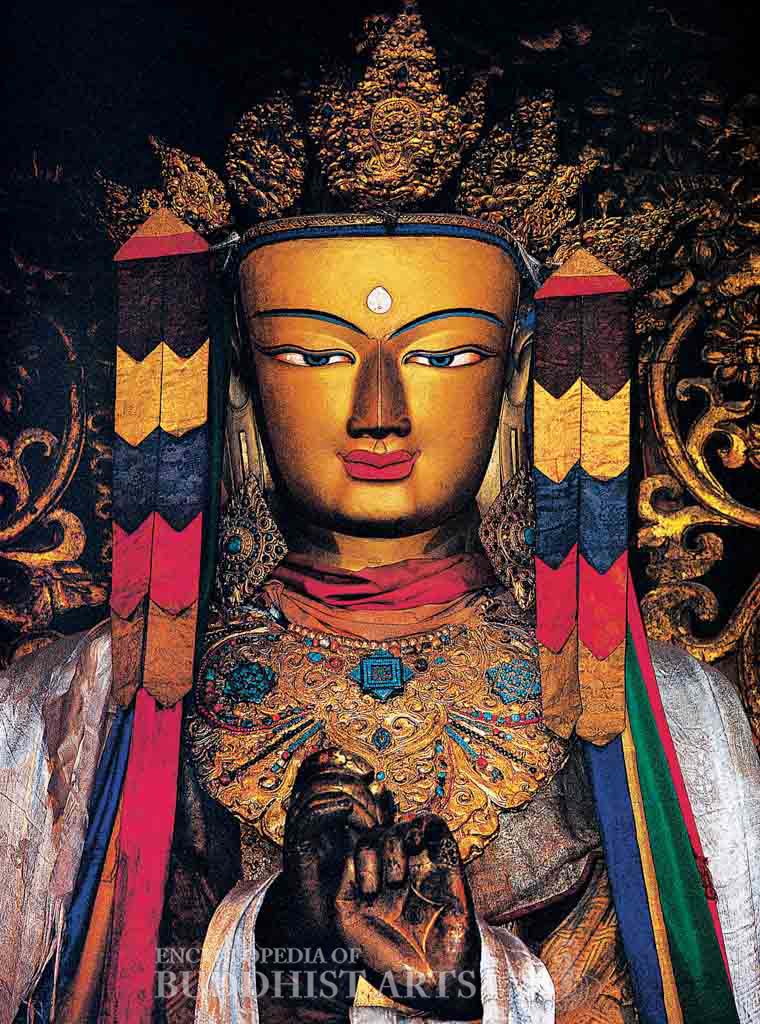
Palcho Monastery: Vairocana Buddha
Gilt copper alloy
Palcho Monastery: Vairocana Buddha
CHINA, Tibet, Gyantse
This statue was cast in bronze between the 15th and 16th centuries. Each face of the Four-Headed Vairocana is similar, wearing a five-leaf crown and a slight smile. The slight protrusion at the chins is a facial characteristic of Tibetan statues. The crown, white urna, and the ornament at the chest are exquisitely sculpted and lavishly decorated with turquoise. The Buddha is identified as Vairocana by the bodhyangi (wisdom fist) mudra he displays, where the raised index finger of the left hand is enclosed in the clenched fingers of the right fist. The palm of the left hand faces outward. This gesture is slightly different than the conventional bodhyangi mudra, where the four fingers of the left hand form a fist.
For more details, go to the Encyclopedia of Buddhist Arts: Sculpture N-Sr, page 790.
Cite this article:
author = Hsingyun and Youheng and Lovelock, Yann and Chou, Yuan and Huntington, Susan and Edson, Gary and Neather, Robert,
booktitle = {Encyclopedia of Buddhist Arts: Sculpture N-Sr},
pages = 790,
title = {{Palcho Monastery: Vairocana Buddha}},
volume = 12,
year = {2016}}