
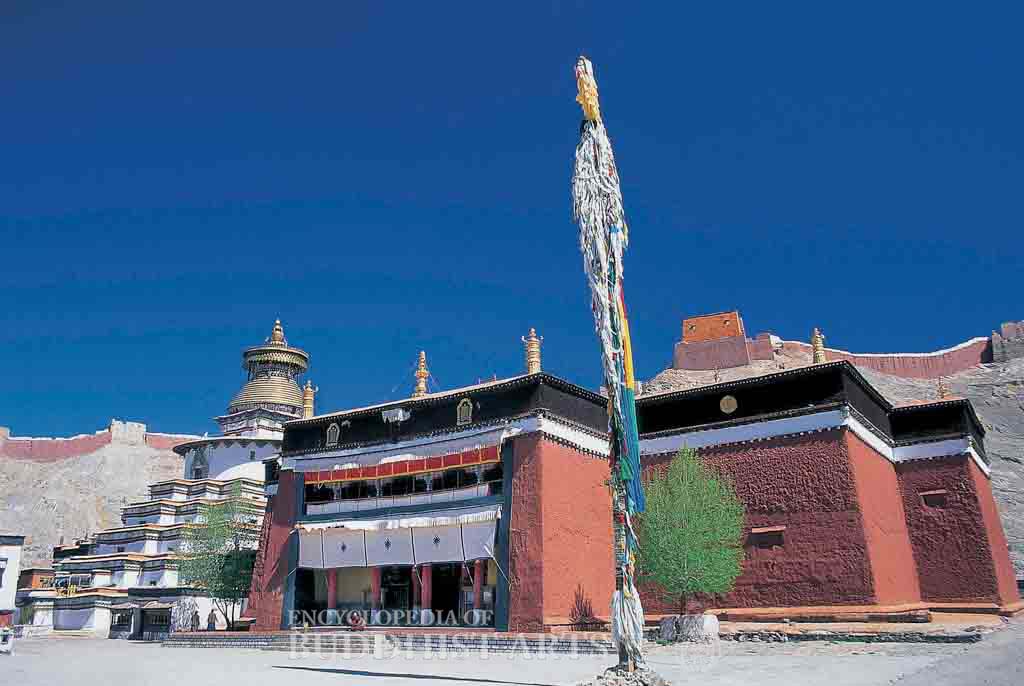
Palcho Monastery
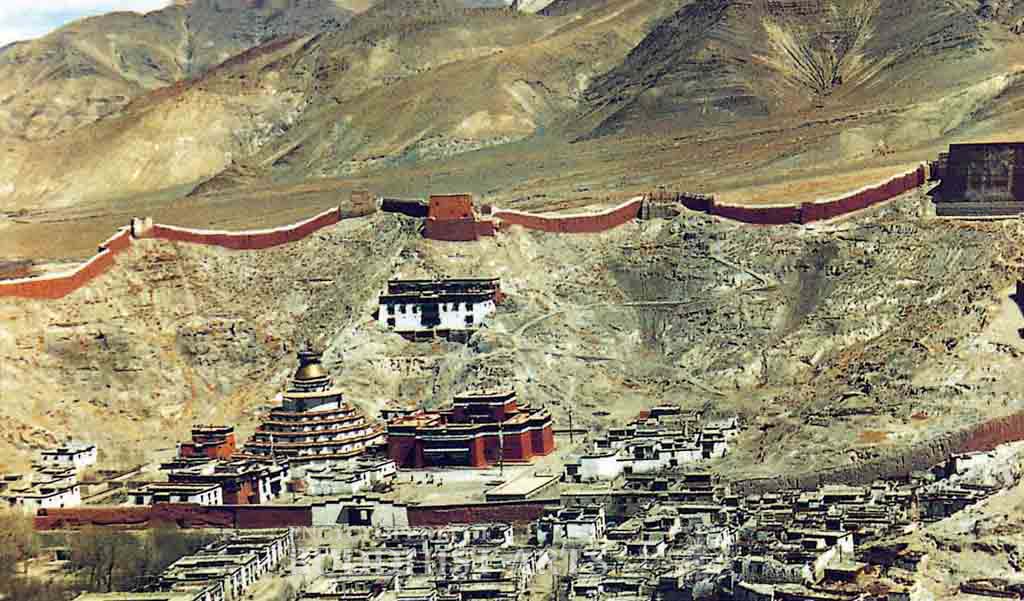
Palcho Monastery (aerial view)
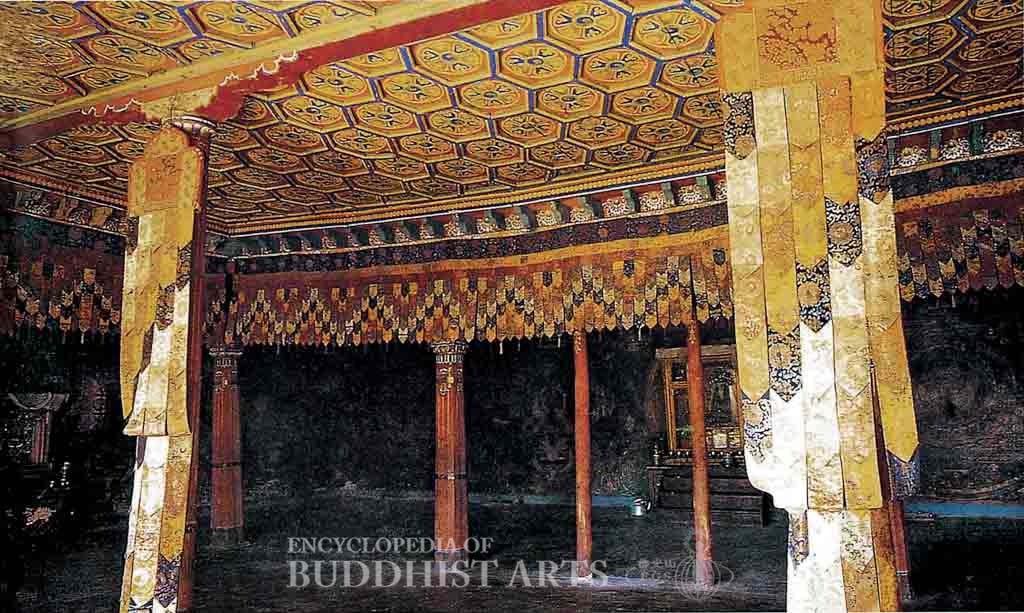
Palcho Monastery: Central Hall - Third Story Shrine (interior)
Palcho Monastery
CHINA, Tibet, Gyantse
Palcho means Auspicious Wheels and Supreme Bliss. It was built in 1418 by Prince Rabten Kunzang Phak and the First Panchen Lama, Khedrup Gelek Pelzang. Originally there were 17 Buddhist colleges belonging to the Sakya, Kadam, and Gelug schools, which was a distinguishing feature of the monastery. Most of the buildings have been destroyed and only the central hall and the Kumbum Stupa are well-preserved. It was listed as a National Cultural Heritage Site in 1996.
The monastery was built according to the contours of the hill. The main gate is in the southeast corner and faces south. It is bounded by high rammed earth walls with regularly-placed towers. The main complex includes the central hall and the Kumbum Stupa. The central hall is three stories high with a cruciform plan. The nine-by-seven bay assembly hall stands in the center of the first story and is surrounded on each side by four shrines. The north shrine is lined by walkways with prayer wheels on its sides and rear. On the second and third stories there are walkways lined with prayer wheels outside the shrine. The third story consists of only one shrine on the north side of the courtyard. In the shrine there are tortoiseshell-patterned ceilings supported by cylindrical columns. Each pattern grid is painted with a lotus base whose petals have the Six-Syllable Mantra, “om mani padme hum,” written on them. This is rarely seen in Tibetan architecture. Within each shrine are valuable artifacts, such as delicate Buddha statues and murals, which date from the time when the monastery was built.
For more details, go to the Encyclopedia of Buddhist Arts: Architecture M-S, page 807.
Cite this article:
author = Hsingyun and Youheng and Johnson, Peter and Mankuang and Lancaster, Lewis,
booktitle = {Encyclopedia of Buddhist Arts: Architecture M-S},
pages = 807,
title = {{Palcho Monastery}},
volume = 3,
year = {2016}}