
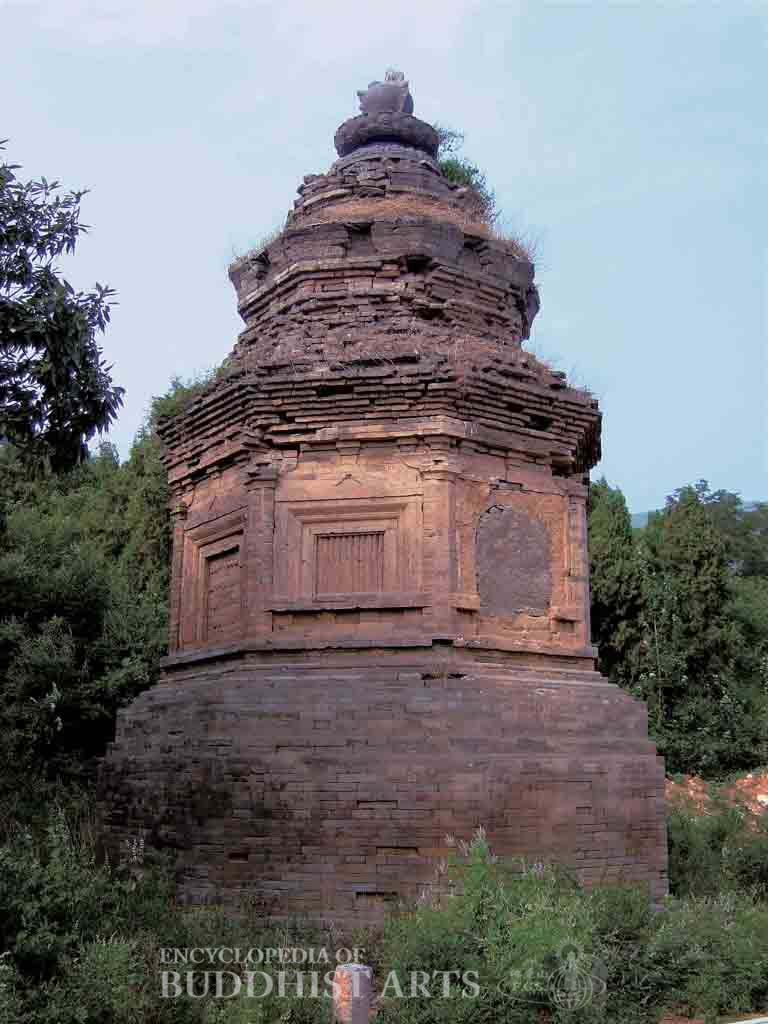
Huishan Temple Jingzang Pagoda
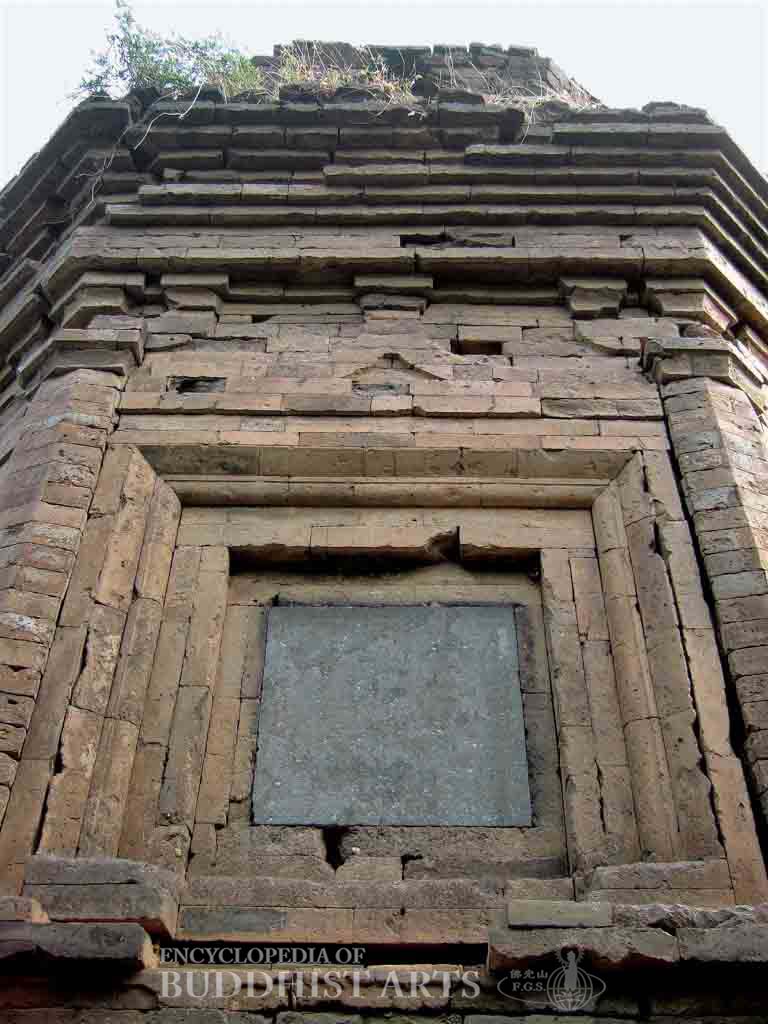
Huishan Temple Jingzang Pagoda (detail)
Huishan Temple Jingzang Pagoda
CHINA, Henan, Zhengzhou
It is located outside Huishan Temple, at the southern foot of Taishi Mountain, and is the oldest existing octagonal brick pagoda in China. It was built in 746 during the Tang dynasty. It was listed as a National Cultural Heritage Site in 1998.
Facing south, the single-story, octagonal, brick pagoda is 10.4 m high and built in imitation of a timber structure. It consists of an underground palace, a large base platform, the pagoda body, and roof. There are pilasters at the corners of the pagoda body. The pilasters are linked by architraves, above which tripartite and intermediate bracket sets support the eaves in the form of corbeling. An arched doorway can be found on the south side of the pagoda, while the north side is inlaid with a blue limestone plaque. The east and west sides have false doors, while the remaining walls have imitation vertical bar windows. Above the pagoda body there is a Sumeru platform which forms part of the base of the spire, along with some leaf patterns. The pagoda is surmounted by a finely carved flaming jewel carved from rock. There is an octagonal central chamber within the pagoda.
Most other existing pagodas built during or before the Sui (581–618) and Tang (618–907) dynasties do not have more than four sides. Even though the hexagonal pagoda at Foguang Temple, and the twelve-sided pagoda at Songyue Temple are both from the Northern Wei dynasty (386–534), they are unique cases. It was not until after the Liao (907–1125) and Song (960–1279) dynasties that octagonal pagodas became popular. This is the only example of an octagonal pagoda from the Tang dynasty.
For more details, go to the Encyclopedia of Buddhist Arts: Architecture G-L, page 473.
Cite this article:
author = Hsingyun and Youheng and Johnson, Peter and Mankuang and Lancaster, Lewis,
booktitle = {Encyclopedia of Buddhist Arts: Architecture G-L},
pages = 473,
title = {{Huishan Temple Jingzang Pagoda}},
volume = 2,
year = {2016}}