
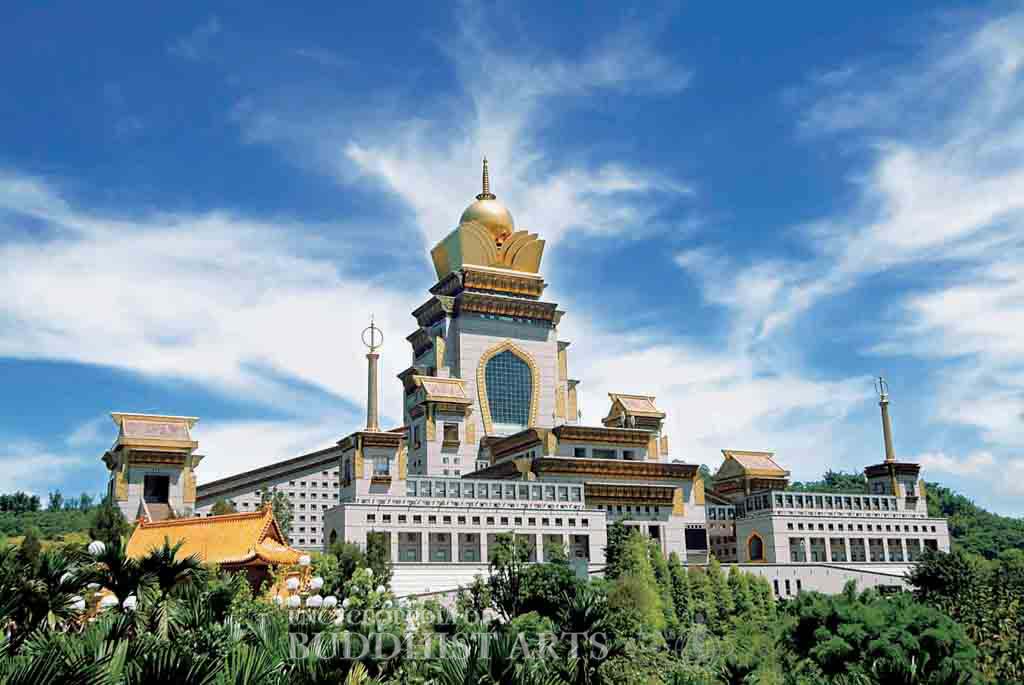
Chung Tai Chan Monastery
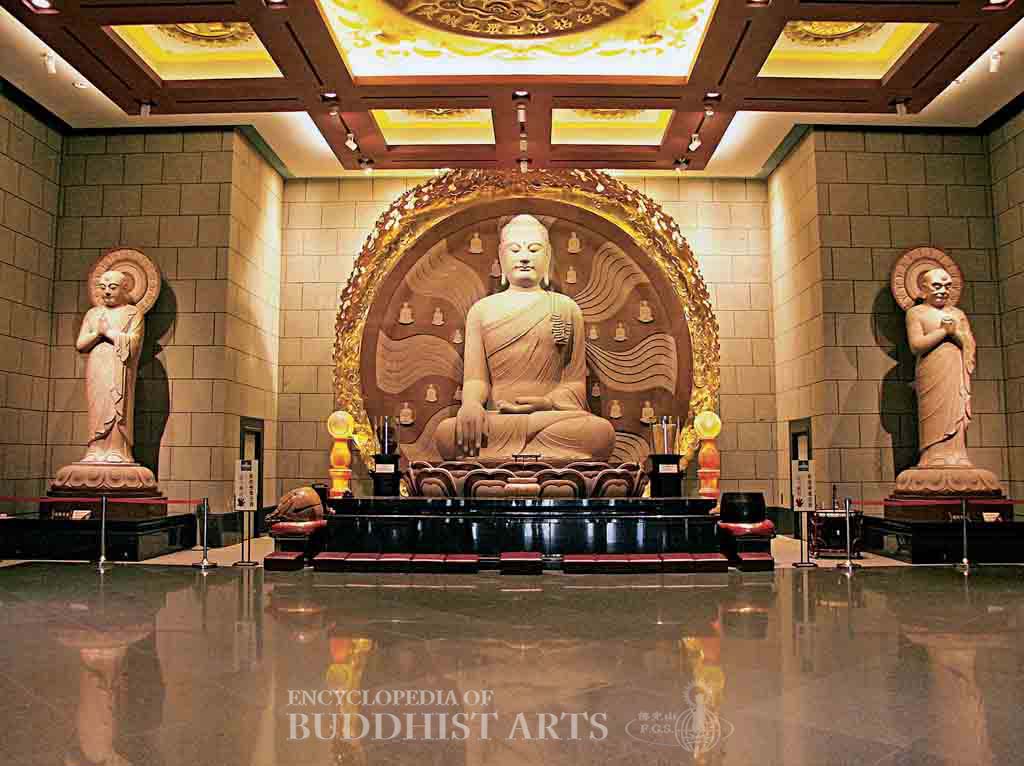
Chung Tai Chan Monastery: Great Hero Hall (interior)
Chung Tai Chan Monastery
TAIWAN, Nantou
After practicing for a number of years in a hermitage in Wanli, Taiwan, Master Wei Chueh built Lingquan Temple in 1987. However, it soon proved to be too small and construction of a new monastery on a different site began in 1994. It was completed in 2001 and named Chung Tai Chan Monastery.
The monastery’s main building is a 36-story tower, which is 136 m high, 230 m wide, and 120 m deep. It houses the Heavenly King Hall, Great Hero Hall, Great Magnificent Hall, meditation hall, Great Enlightenment Hall, Manjusri Hall, Samantabhadra Hall, Hall of Ten Thousand Buddhas, Avalokitesvara Hall, Ksitigarbha Hall, and the bell and drum towers. There are also outside staircases of various sizes, representing the various stages of cultivation.
The Heavenly King Hall is located on the first story and houses statues of Maitreya Bodhisattva, Skanda Bodhisattva, and 12 m high standing figures of the Four Heavenly Kings at the four corners. On the second story there is the Great Hero Hall, which is decorated in red and gray. The hall contains statues of Sakyamuni Buddha flanked by Mahakasyapa and Ananda. The Patriarch Hall and the Sangharama Hall adjoin the Great Hero Hall on either side and are dedicated to Bodhidharma and Sangharama. The Great Magnificent Hall and the meditation hall are both on the fifth story. The Great Magnificent Hall is decorated in gold and houses Vairocana Buddha. On the sides there are the Medicine Buddha Hall and the Amitabha Hall. The meditation hall contains three Buddha statues at the front, and has a 9 m wide peripheral path for walking meditation.
The Great Enlightenment Hall is located on the ninth story and contains a statue of Vairocana Buddha. The walls and floors are laid with white stone to symbolize the intrinsic pure nature of all beings. The adjoining side halls are dedicated to Manjusri and Samantabhadra Bodhisattvas. On the 16th story there is the Hall of Ten Thousand Buddhas. The walls of this hall are filled with 10,000 miniature bronze figures of the Medicine Buddha, as well as the 88 Buddhas. At the front and back there are two large petal-shaped glass curtain walls, while in the center there is a seven-tier Medicine Buddha Pagoda constructed in Burmese teak. The pagoda is built without the use of a single nail. Each tier of the pagoda houses a bronze statue of the Medicine Buddha. Above the Hall of Ten Thousand Buddhas, there is the Golden Dome, which represents the wish-fulfilling jewel, surmounted by a spire.
The Avalokitesvara Hall and Ksitigarbha Hall are located on either side of the main building on the seventh story, where the outside staircases intersect. The bell and drum towers are situated on the left and right of the central axis. A striking aspect of the monastery is the incorporation of Buddhist, Christian, Islamic, and various other religious influences in its architectural design.
For more details, go to the Encyclopedia of Buddhist Arts: Architecture A-F, page 169.
Cite this article:
author = Hsingyun and Youheng and Johnson, Peter and Mankuang and Lancaster, Lewis,
booktitle = {Encyclopedia of Buddhist Arts: Architecture A-F},
pages = 169,
title = {{Chung Tai Chan Monastery}},
volume = 1,
year = {2016}}