

Jueshan Temple Pagoda Murals: Avalokitesvara Bodhisattva

Jueshan Temple Pagoda Murals: Ksitigarbha Bodhisattva

Jueshan Temple Pagoda Murals: Dhrtarastra
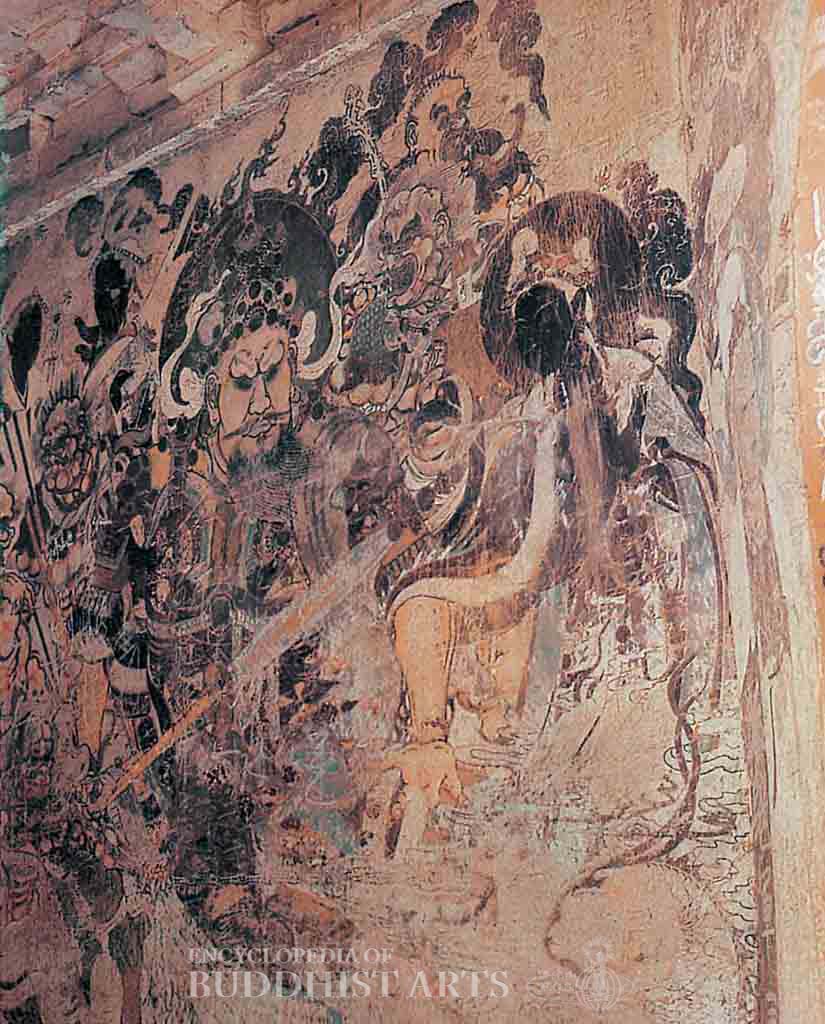
Jueshan Temple Pagoda Murals: Vaisravana
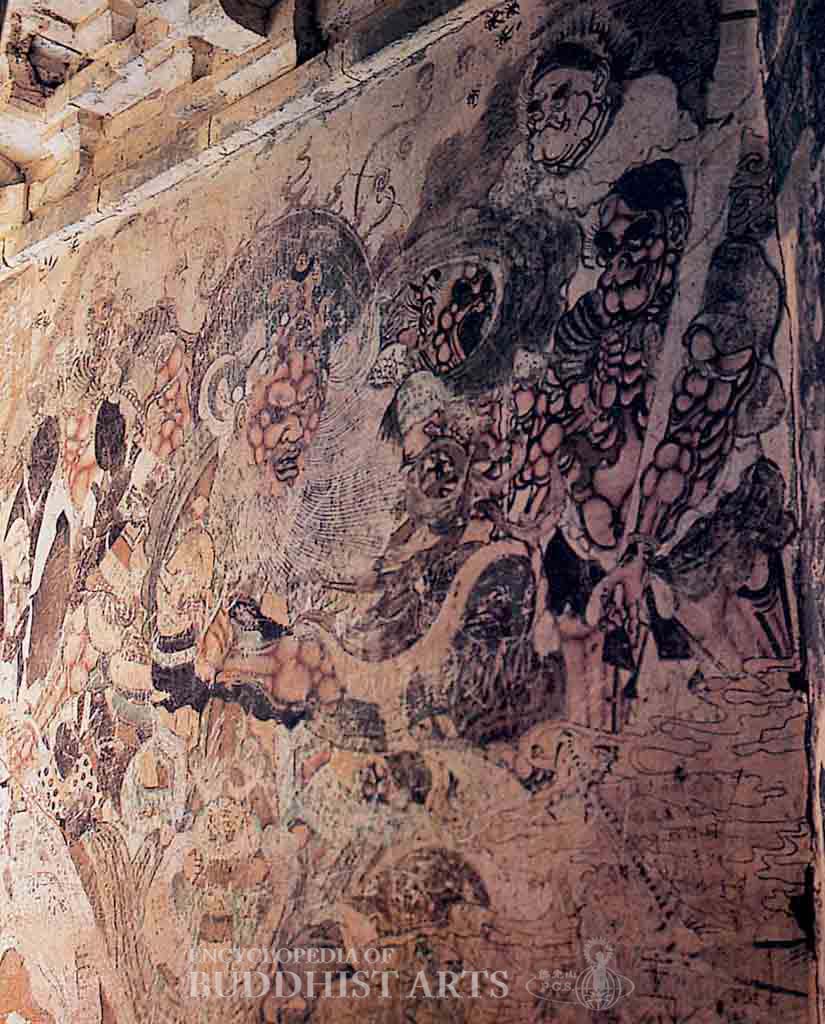
Jueshan Temple Pagoda Murals: Hayagriva

Jueshan Temple Pagoda Murals: Aparajita

Jueshan Temple Pagoda Murals: Apsara
Jueshan Temple Pagoda Murals
CHINA, Shanxi, Datong; Liao dynasty
This mural is painted in Jueshan Temple Pagoda in Datong. The pagoda was built in 1090 during the Liao dynasty. It is an octagonal 13-tier, brick structure measuring 44.2 m high. An octagonal pillar in the center of the pagoda is surrounded by inner walls, forming a passageway. The walls and the central pillar are decorated with murals that cover a total surface area of 92.16 sq m. The images were painted when the pagoda was constructed, with the exception of the murals on the north and south sides of the central pillar and on the inner walls above the doorways, which were repainted during the Ming (1368–1644) and Qing (1644–1911) dynasties.
There are depictions of Sakyamuni Buddha on the north and south sides of the central pillar, facing the doorways. The Buddha on the south side forms the vitarka (teaching) mudra, while the Buddha on the north side forms the bhumisparsa (earth-touching) mudra. The six remaining sides are illustrated with Bodhisattvas, the Four Heavenly Kings and two warriors. Manjusri, Samantabhadra, Avalokitesvara, and Ksitigarbha Bodhisattvas are painted on the inner walls on both sides of the doorways. The other walls are decorated with images of wisdom kings including Hayagriva and Aparajita.
The Bodhisattvas have round faces, and wear headdresses, ornaments, long robes, and stoles. The Four Heavenly Kings, who appear strong and robust, wear crowns and armor. They stand on clouds, each holding different objects, including a dagger-axe, sword, halberd, and canopy. The Wisdom Kings are depicted as large figures, occupying almost half of each wall. They look fierce, with unkempt hair, wide-open eyes, three faces, and six arms. Their hands hold objects including knife, sword, spear, and halberd. Smaller Bodhisattvas, Dharma protectors, and apsaras flank the central figures.
All of the walls were first painted with a white base before the figures were added. Each section of the murals is a distinct illustration that also connects with the image beside it. For example, the north and south walls of the central pillar painted with Buddha images are flanked by walls with images of attendant Bodhisattvas. The murals are colored in red, yellow, brown, and green, and the wash technique is used to give the images depth.
For more details, go to the Encyclopedia of Buddhist Arts: Painting I-O, page 395.
Cite this article:
author = Hsingyun and Youheng and Youlu and Wilson, Graham and Manho and Mankuang and Huntington, Susan,
booktitle = {Encyclopedia of Buddhist Arts: Painting I-O},
pages = 395,
title = {{Jueshan Temple Pagoda Murals}},
volume = 15,
year = {2016}}