
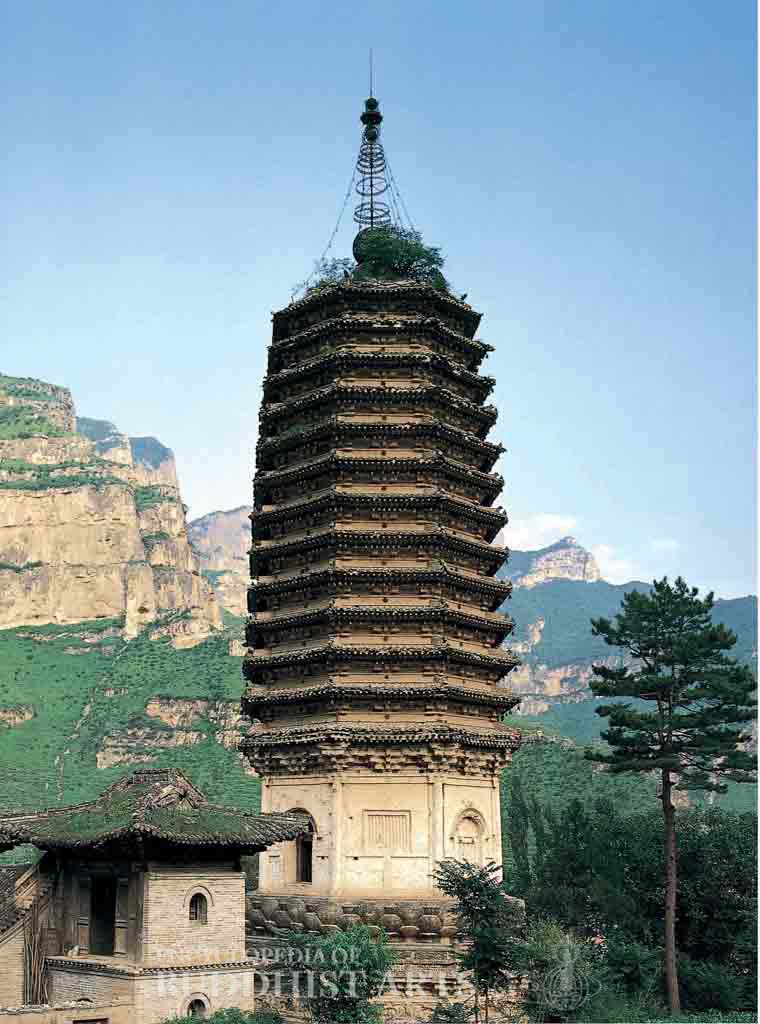
Jueshan Temple Pagoda
Jueshan Temple Pagoda
CHINA, Shanxi, Datong
This temple was built between 1089 and 1090 during the Liao dynasty, and is still in good condition. It was listed as a National Cultural Heritage Site in 2001.
The 13-tier octagonal brick pagoda is 44.2 m high. The base consists of three layers: a Sumeru, a flat layer, and an upright lotus. Apart from the delicately carved imitation timber, the base is decorated with Bodhisattvas, warriors, dragons, people, creatures, and floral motifs. Doors are located on the north and south sides, while the east and west sides have false doors. The remaining sides have fake vertical bar windows made from brick. There are pilasters at the corners. Bracket sets made from bricks can be found beneath the upward-curving eaves. The pyramidal roof has a spire made from seven stacked rings, a canopy, a crescent moon, and a jewel.
The lower part of the pagoda is hollow with an octagonal central pillar. Murals dating back to the construction of the pagoda, as well as from the Ming (1368–1644) and Qing (1644–1911) dynasties, can be found covering the walls and central pillar. The central pillar has some pre-Tang dynasty (618–907) features, which distinguish it from other pagodas constructed during the Liao dynasty.
For more details, go to the Encyclopedia of Buddhist Arts: Architecture G-L, page 556.
Cite this article:
author = Hsingyun and Youheng and Johnson, Peter and Mankuang and Lancaster, Lewis,
booktitle = {Encyclopedia of Buddhist Arts: Architecture G-L},
pages = 556,
title = {{Jueshan Temple Pagoda}},
volume = 2,
year = {2016}}