
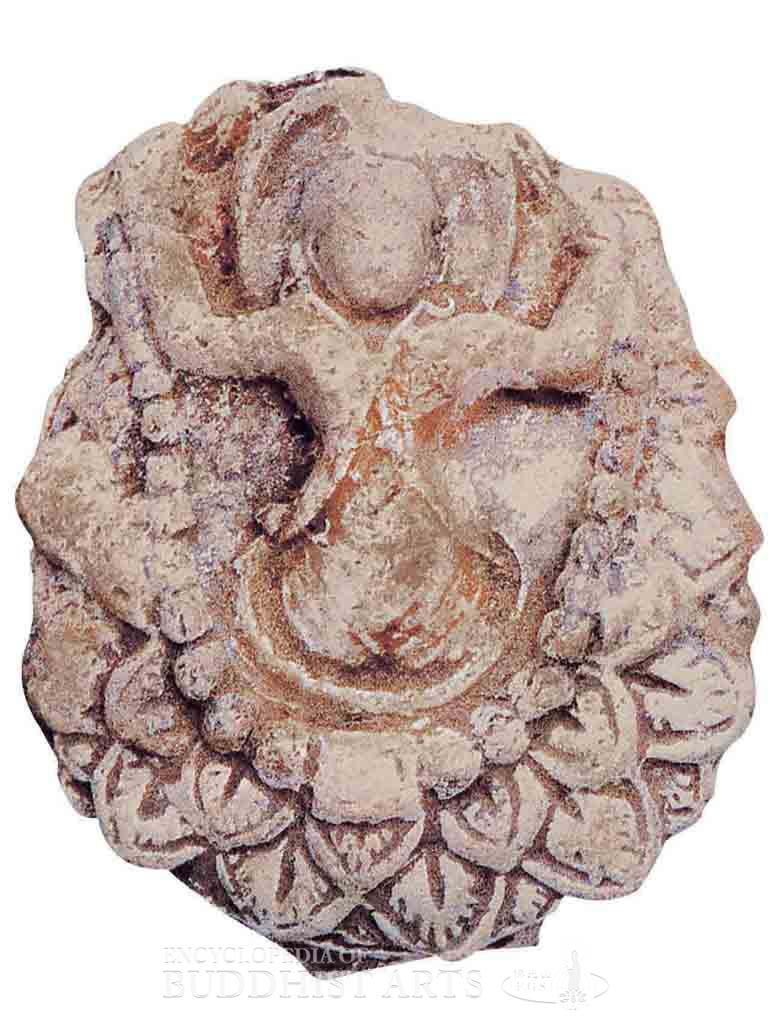
Kumlabat Monastery: Heavenly Being
Gypsum
Kumlabat Monastery: Heavenly Being
CHINA, Xinjiang, Hotan
Kumlabat Monastery, where this piece was discovered, is thought to be the ancient site of Shurangfen (Mouse Mound) in Khotan, described by Master Xuanzang in his Great Tang Records on the Western Regions. Three Buddhist temple sites were discovered at the location in 1989, built approximately between the Jin dynasty (265–420) and the Northern Dynasties (386–581). The piece is among those found in one of the halls, which also housed numerous Buddhas, pictures of animals and plaster remains of architectural furnishing.
This artifact depicts a heavenly being emerging from a lotus and is believed to be part of a Buddha’s nimbus or mandorla. The figure itself has a nimbus and is holding a garland with both hands as an offering. Red paint is still visible on the figure’s clothing, which is set against a blue background.
For more details, go to the Encyclopedia of Buddhist Arts: Sculpture G-M, page 570.
Cite this article:
author = Hsingyun and Youheng and Lovelock, Yann and Chou, Yuan and Huntington, Susan and Edson, Gary and Neather, Robert,
booktitle = {Encyclopedia of Buddhist Arts: Sculpture G-M},
pages = 570,
title = {{Kumlabat Monastery: Heavenly Being}},
volume = 11,
year = {2016}}