
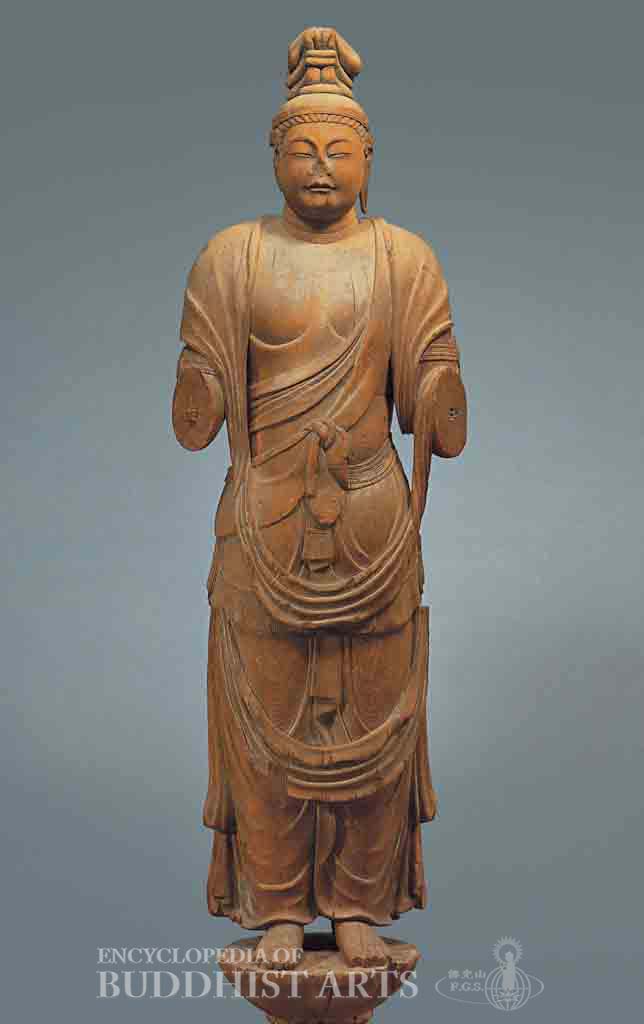
Toshodaiji Temple: Lion’s Roar Bodhisattva
Nutmeg wood
Toshodaiji Temple: Lion’s Roar Bodhisattva
JAPAN, Nara; Nara period
This influential early sculpture dates from the foundation of Toshodaiji Temple in the mid-8th century, and is listed as a National Treasure. It is thought the artist either came to Japan from China with Master Jianzhen, the temple’s founder during the Tang dynasty, or that he was a Japanese schooled in the Chinese style.
The statue was carved from a single piece of nutmeg wood. The Bodhisattva, who shares common features with Amoghapasa Avalokitesvara described in scriptural texts, was originally four armed, has been considerably damaged. The hair is arranged about a frame and held in place by a fillet. Stoles drape the robust upper body and fall over the arms to form a double loop across the skirt, which extends to the ankles of the barefooted figure.
For more details, go to the Encyclopedia of Buddhist Arts: Sculpture St-Z, page 1244.
Cite this article:
author = Hsingyun and Youheng and Lovelock, Yann and Chou, Yuan and Huntington, Susan and Edson, Gary and Neather, Robert,
booktitle = {Encyclopedia of Buddhist Arts: Sculpture St-Z},
pages = 1244,
title = {{Toshodaiji Temple: Lion’s Roar Bodhisattva}},
volume = 13,
year = {2016}}