
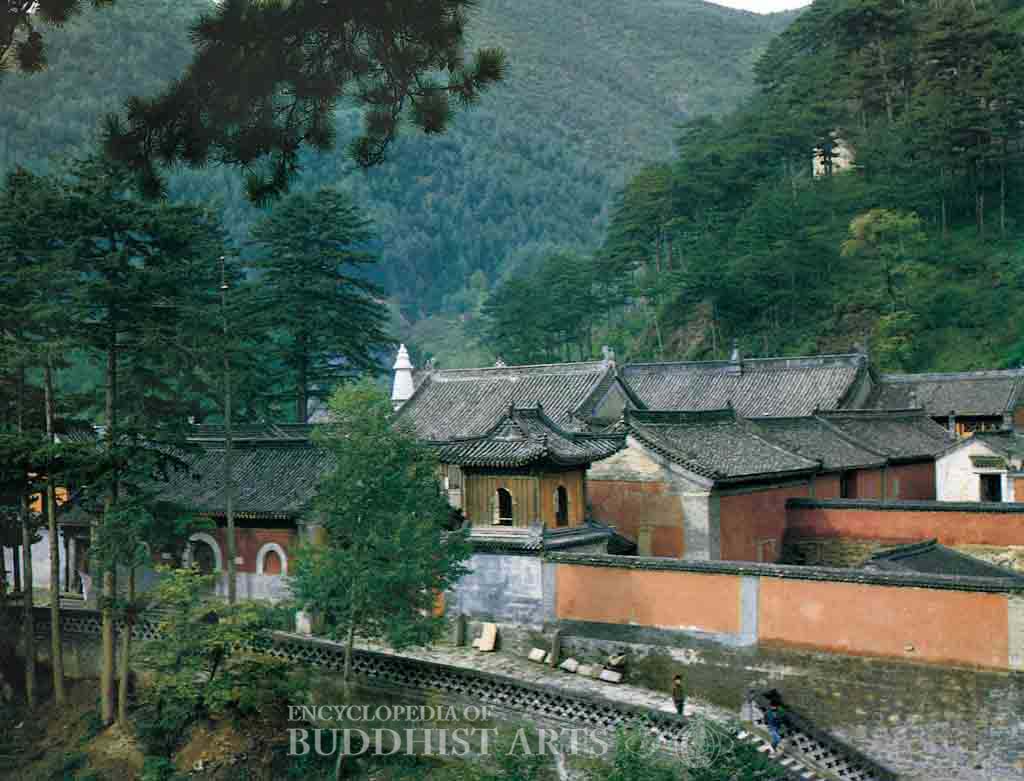
Wutaishan Zhenhai Temple
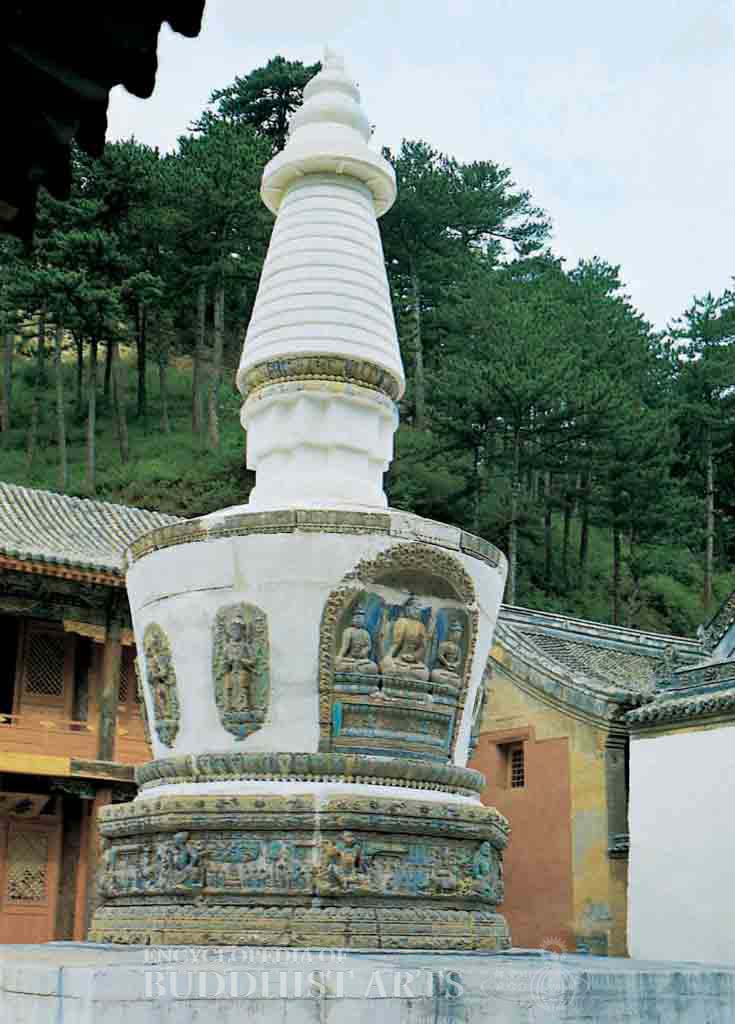
Wutaishan Zhenhai Temple: Stupa of National Master the Third Changkya
Wutaishan Zhenhai Temple
CHINA, Shanxi, Xinzhou
The temple is located 5 km to the south of Taihuai town on Wutaishan. It was built in the Ming dynasty (1368–1644) and was converted to a Tibetan temple during the early Qing dynasty (1644–1911). Between 1750 and 1786 the Third Changkya, Rolpai Dorje, would spend the summer at Wutaishan in meditation, teaching or writing. Initially he most often stayed at Shancai Dong Temple, Diamond Cave, and Pusa Ding Temple, but later he dwelled on a more regular basis at Yongle Yuan, which is the south courtyard of this temple. From then onwards, every Changkya would spend his summers at this temple and Mongolian Buddhists would make a pilgrimage here to pay their respects to the Changkya. The temple is listed as a Provincial Cultural Heritage Site.
Facing east, the temple consists of the front, rear, and south courtyards. The buildings along the central axis of the front courtyard include the Heavenly King Hall, Great Hero Hall, and Avalokitesvara Hall. The three-bay wide Great Hero Hall has a single-eave hip-and-gable roof. Statues of Sakyamuni Buddha, the Medicine Buddha, and Amitabha Buddha are enshrined within the hall. The Avalokitesvara Hall is also called the Hall of the Three Great Bodhisattvas, since it contains Avalokitesvara flanked by Manjusri and Samantabhadra, all depicted with curly hair and beards.
In the rear courtyard there is the Relic Hall of Changkya, which contains the Relic Stupa of the Third Changkya, Rolpai Dorje. The Stupa of National Master the Third Changkya is found within the south courtyard. Constructed from white stone and built in 1786 during the Qing dynasty, this stupa stands on an octagonal Sumeru base. The Life of the Buddha is carved on the base, with warriors located at each corner in a supporting posture. A Buddha niche is located at the front of the stupa, with the Buddhas of the Past, Present, and Future depicted inside: Dipamkara, Sakyamuni, and Maitreya. The two-story, five-bay wide sutra repository in the south courtyard enshrines an image of Tsongkhapa.
For more details, go to the Encyclopedia of Buddhist Arts: Architecture T-Z, page 1299.
Cite this article:
author = Hsingyun and Youheng and Johnson, Peter and Mankuang and Lancaster, Lewis,
booktitle = {Encyclopedia of Buddhist Arts: Architecture T-Z},
pages = 1299,
title = {{Wutaishan Zhenhai Temple}},
volume = 4,
year = {2016}}