
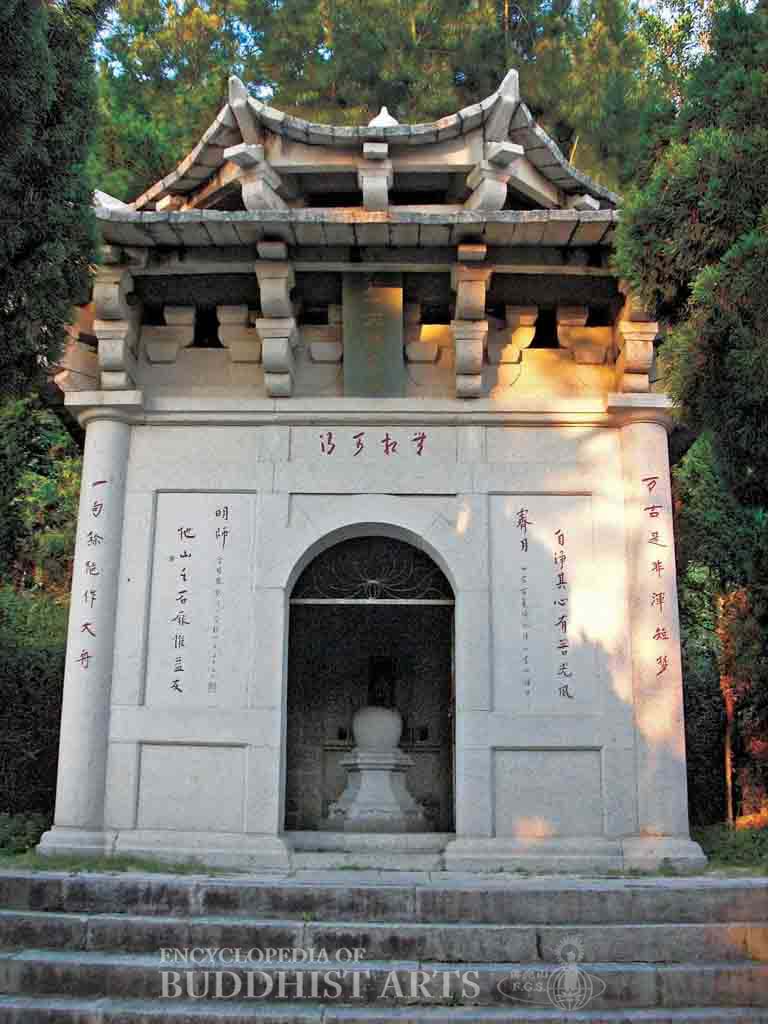
Hongyi Relic Pagoda
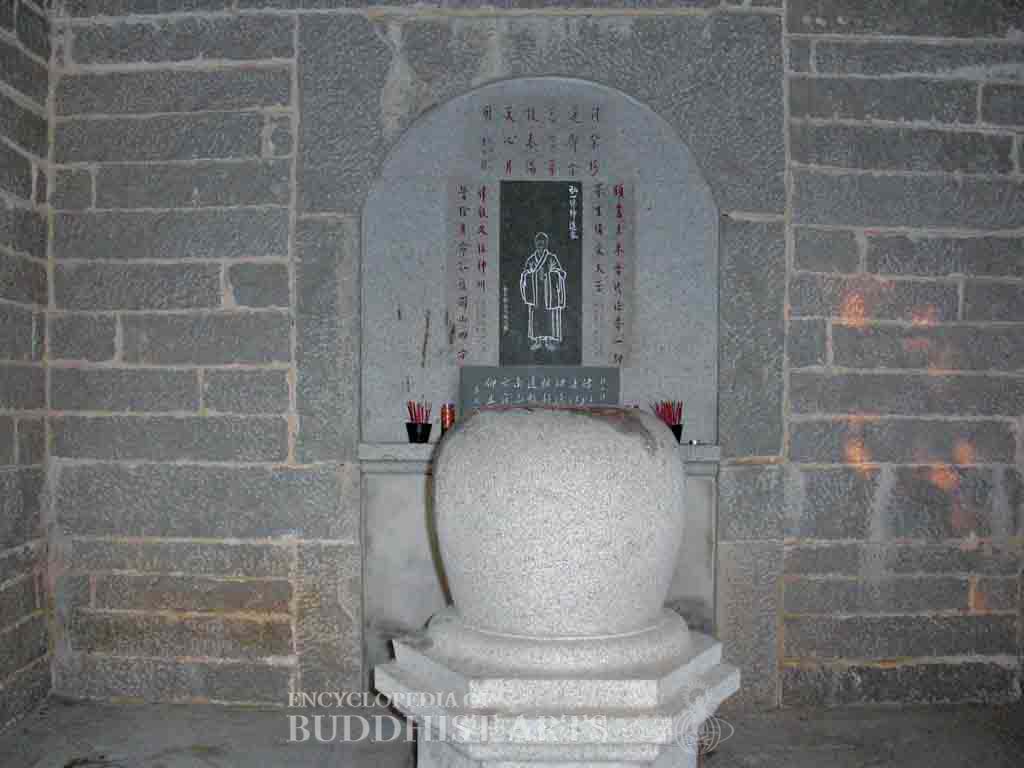
Hongyi Relic Pagoda (interior)
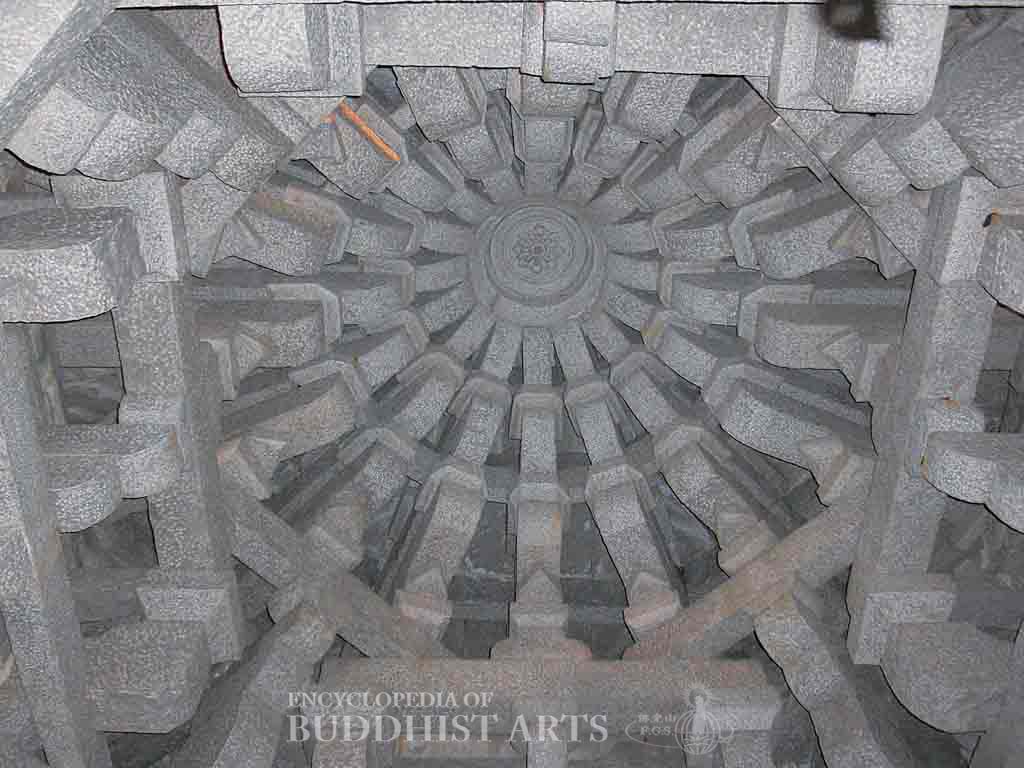
Hongyi Relic Pagoda: Ceiling
Hongyi Relic Pagoda
CHINA, Fujian, Quanzhou
It is located on Mituo (Amitabha) Cliff and was built in 1943 to enshrine relics of Master Hongyi, an eminent monk in the Nanshan Vinaya school. The pagoda was damaged in 1950 and the existing structure is a result of reconstruction in 1979. It was listed as a Municipal Cultural Heritage Site in 1991.
The square pagoda is constructed from white granite in imitation of a timber structure and is 15 m high. The body of the pagoda measures 8.7 m high and 4.8 m on each side. The roof has double eaves: the lower eaves are square and the upper eaves are octagonal with a pyramidal roof above. The spire is in the shape of a gourd. Originally, there were doors on all four sides of the structure, but now only the arched doorway on the south side remains. There is a round pillar at each corner.
A line engraving of Master Hongyi is located on the back wall, within the pagoda. The original portrait was by Feng Zikai, a painter as well as a disciple of Master Hongyi. At the top, there is an inscription by Master Hongyi just before he died, “If you ask me where I would reside, I would have no words to answer. Like the sprouting branches and the blossoming flowers in spring, the mind dwells in emptiness, like the openness of infinite space and perfection of the full moon.” In the middle there is a white granite stupa with a hexagonal base surmounted by an inverted bowl, which houses seven relics. A large boulder stands on the south-eastern side of the pagoda with the parting words of Hongyi, “With Both Sorrow and Joy.”
For more details, go to the Encyclopedia of Buddhist Arts: Architecture G-L, page 453.
Cite this article:
author = Hsingyun and Youheng and Johnson, Peter and Mankuang and Lancaster, Lewis,
booktitle = {Encyclopedia of Buddhist Arts: Architecture G-L},
pages = 453,
title = {{Hongyi Relic Pagoda}},
volume = 2,
year = {2016}}