
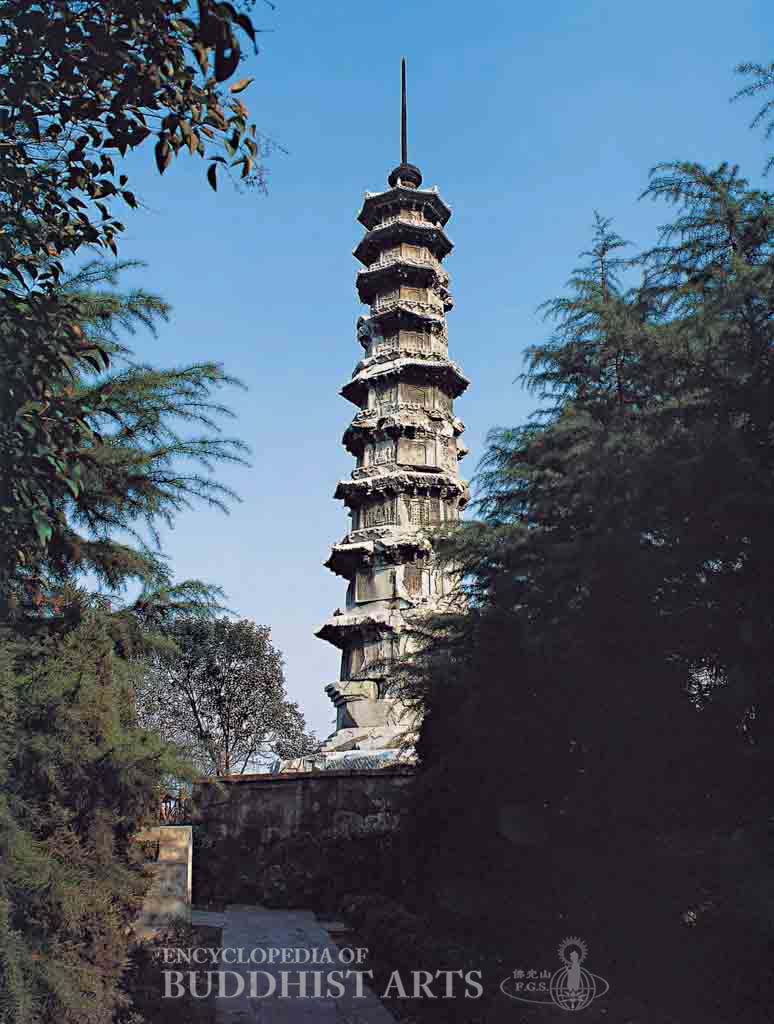
Zhakou White Pagoda
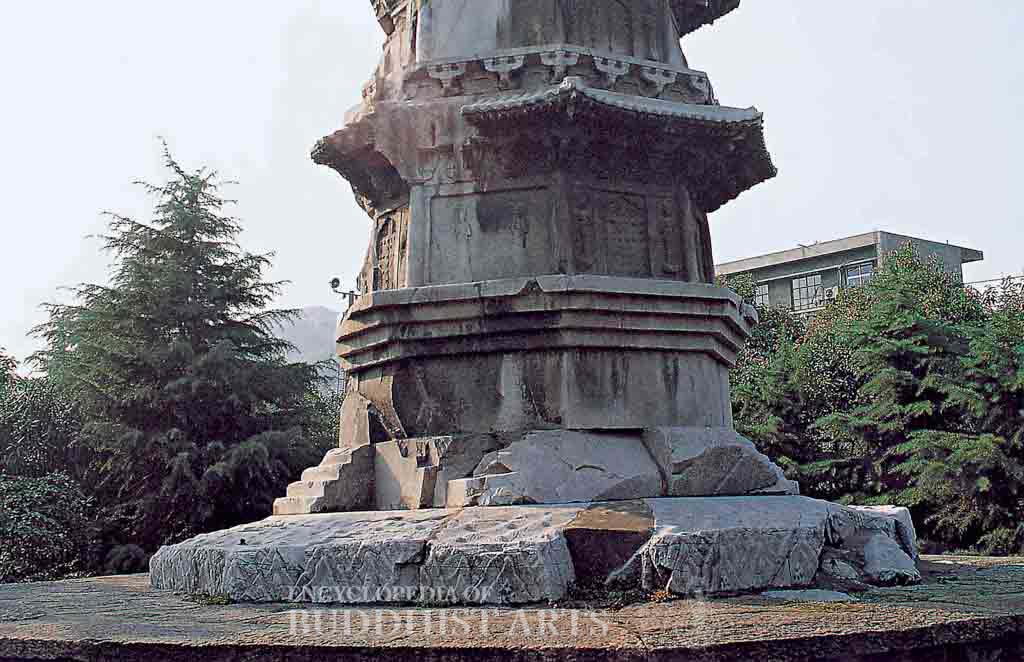
Zhakou White Pagoda (detail)
Zhakou White Pagoda
CHINA, Zhejiang, Hangzhou
This pagoda is located on Baitashan (White Pagoda Mountain), on the bank of the Qiantang River. It was built in the late Wuyue Kingdom period (907–978). It was listed as a National Cultural Heritage Site in 1988.
The nine-tier, stone pagoda is 14.4 m high and is built in imitation of a timber structure. The base platform of the pagoda is decorated with carvings of mountain peaks and waves, which represent the nine mountains and eight oceans from Buddhist cosmology. The Sumeru base has the Usnisavijaya Dharani Sutra inscribed on the concave section. There are pilasters at the corners of every tier with architraves linking them. The walls facing the four cardinal directions on each tier are separated into three bays by pilasters, with doors carved in the central bays. The remaining walls have carvings of Buddhas and Bodhisattvas, except for the second tier, which has inscriptions of the Usnisavijaya Dharani Sutra. The eaves are supported by two-tier bracket sets. The pagoda has a function similar to that of a sutra pillar; however, its appearance is that of an imitation timber pagoda.
For more details, go to the Encyclopedia of Buddhist Arts: Architecture T-Z, page 1391.
Cite this article:
author = Hsingyun and Youheng and Johnson, Peter and Mankuang and Lancaster, Lewis,
booktitle = {Encyclopedia of Buddhist Arts: Architecture T-Z},
pages = 1391,
title = {{Zhakou White Pagoda}},
volume = 4,
year = {2016}}