
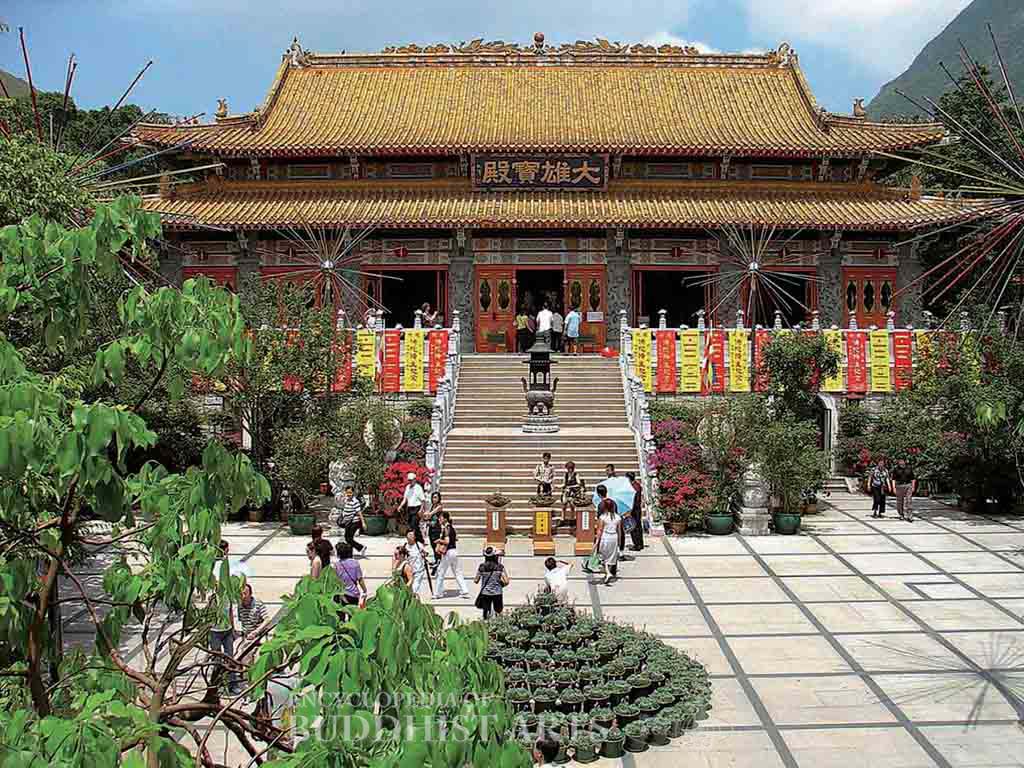
Po Lin Monastery: Great Hero Hall
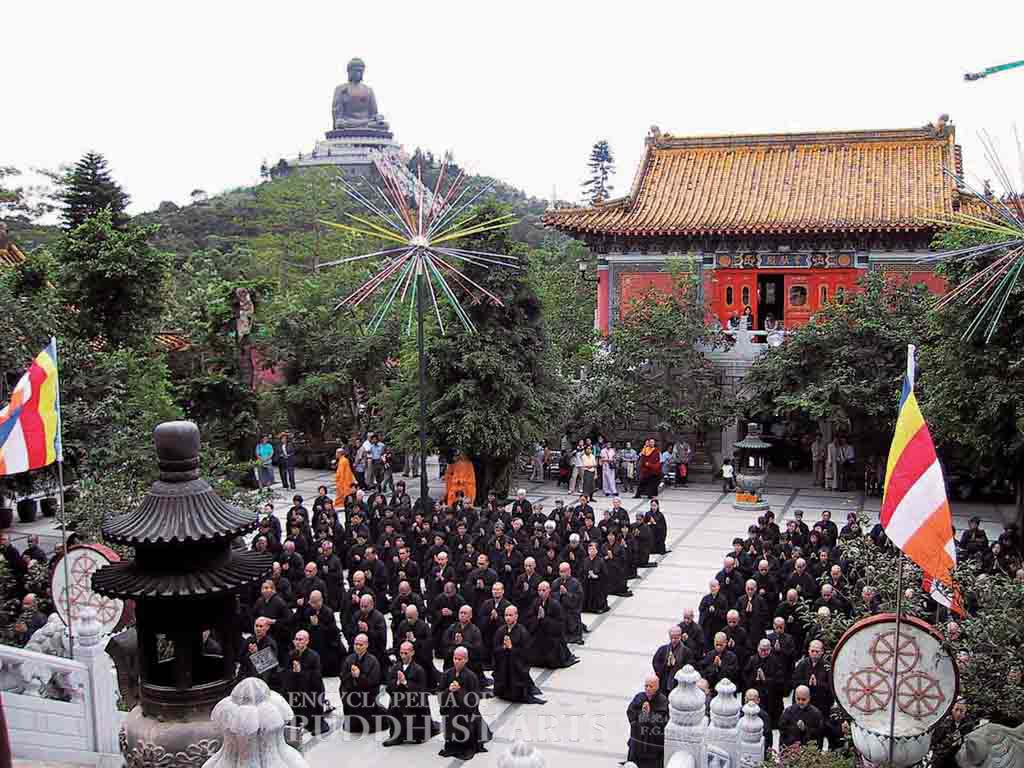
Po Lin Monastery
Po Lin Monastery
CHINA, Hong Kong
Po Lin Monastery was established in 1906 by Chan Masters Dayue, Duanxiu, and Yueming, who came from Jinshan Temple in Jiangsu. It was expanded in subsequent years to include the Ksitigarbha Hall, Patriarch Hall, dining hall, and meditation hall. The Great Hero Hall was expanded in 1964. Funding for the construction of the Tian Tan Buddha was started in 1976 and the statue was eventually completed in 1993.
The principal buildings include the main temple gate, Skanda Hall, Great Hero Hall, Perfect Enlightenment Hall, and the Patriarch Hall. The main temple gate is constructed from granite and has three hip roofs which are supported by bracket sets. The two-story, three-by-one bay Skanda Hall is located just behind the gate and to the left. It has a single-eave hip-and-gable roof. The doors and windows are painted in vermilion. The walls of the lower story are made of white granite, and the balustrades of the balcony on the upper story are made of stone.
The seven-bay wide Great Hero Hall has a double-eave hip-and-gable roof. The ridge is decorated with dragons. Stone octagonal columns carved with dragons support the structure. Statues of the Three Buddhas are enshrined within the hall, along with the Eighteen Arhats on both sides. The panels of the balustrades within the hall are carved with openwork. Apsaras are painted on the ceiling, and match the decorations on the bracket sets. Underneath the Great Hero Hall is the Arhat Hall, which serves as a lecture hall as well as an ordination hall. Statues of Avalokitesvara, Manjusri, and Samantabhadra Bodhisattvas are enshrined inside, together with the Five Hundred Arhats. Behind the Great Hero Hall there is a series of three adjoining rooms: the sutra repository, Vajra Cave, and the former Great Hero Hall. A white jade statue of Sakyamuni Buddha is enshrined in the former Great Hero Hall.
Located to the southwest of the temple, the Tian Tan Big Buddha stands on Muk Yue (Wooden Fish) Peak. It is consdered to be one of the most famous bronze seated Buddha statues located outdoors. There is a museum in the base of the statue housing artifacts such as a relic of the Buddha, an illustration carved from Phoebe wood depicting the teaching of the Avatamsaka Sutra, and the Bell of the Flaming Mouth.
For more details, go to the Encyclopedia of Buddhist Arts: Architecture M-S, page 829.
Cite this article:
author = Hsingyun and Youheng and Johnson, Peter and Mankuang and Lancaster, Lewis,
booktitle = {Encyclopedia of Buddhist Arts: Architecture M-S},
pages = 829,
title = {{Po Lin Monastery}},
volume = 3,
year = {2016}}