
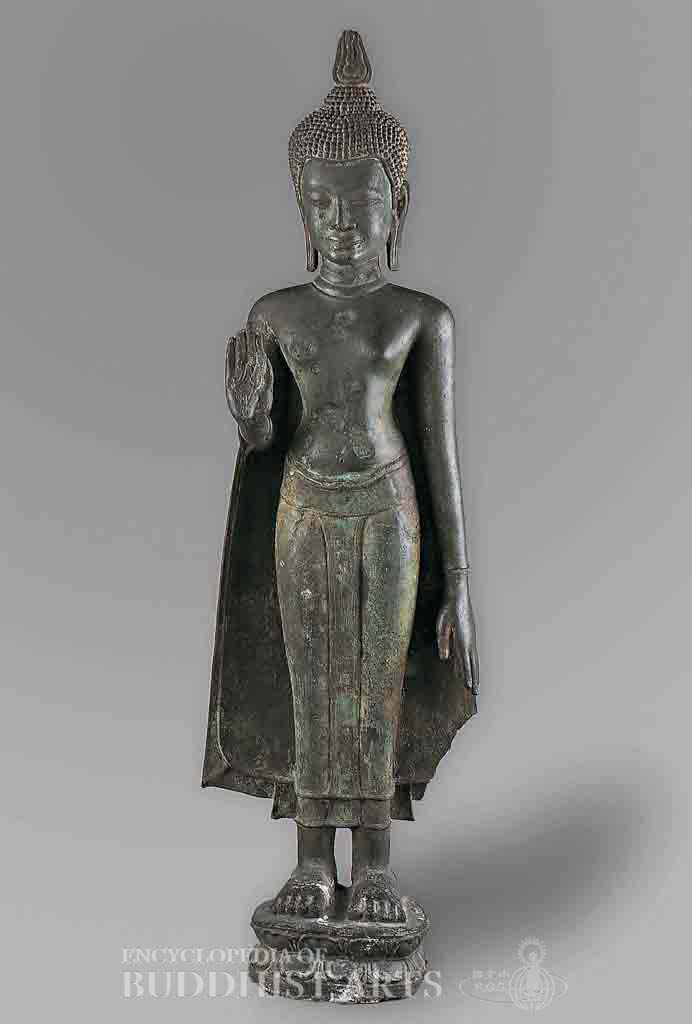
Standing Buddha
Bronze
Standing Buddha
THAILAND
This Thai sculpture is in the distinctive style found during the reign of King Ramathibodi I (reigned 1351–1369), demonstrated by the distinctive flame pattern above the topknot and the crown-like shape of the hair. The meticulously curled hair, the full oval-shaped face, the finely curved eyebrows, and three lines on the neck are, however, allusions to the artistic styles of the Cambodian Angkor period (circa 9th–15th century) once dominant in the area. The statue is standing on a double-tier lotus pedestal. The right hand makes the abhaya (fearlessness) mudra while the left hand hangs down naturally by the side of the body. The Buddha is clad in a flat, smooth monastic robe that covers both shoulders, with the under-robe wrapped from the waist to the calves and neatly folded down the center. This garment is held in place by a flat cotton belt.
For more details, go to the Encyclopedia of Buddhist Arts: Sculpture St-Z, page 1155.
Cite this article:
author = Hsingyun and Youheng and Lovelock, Yann and Chou, Yuan and Huntington, Susan and Edson, Gary and Neather, Robert,
booktitle = {Encyclopedia of Buddhist Arts: Sculpture St-Z},
pages = 1155,
title = {{Standing Buddha}},
volume = 13,
year = {2016}}