
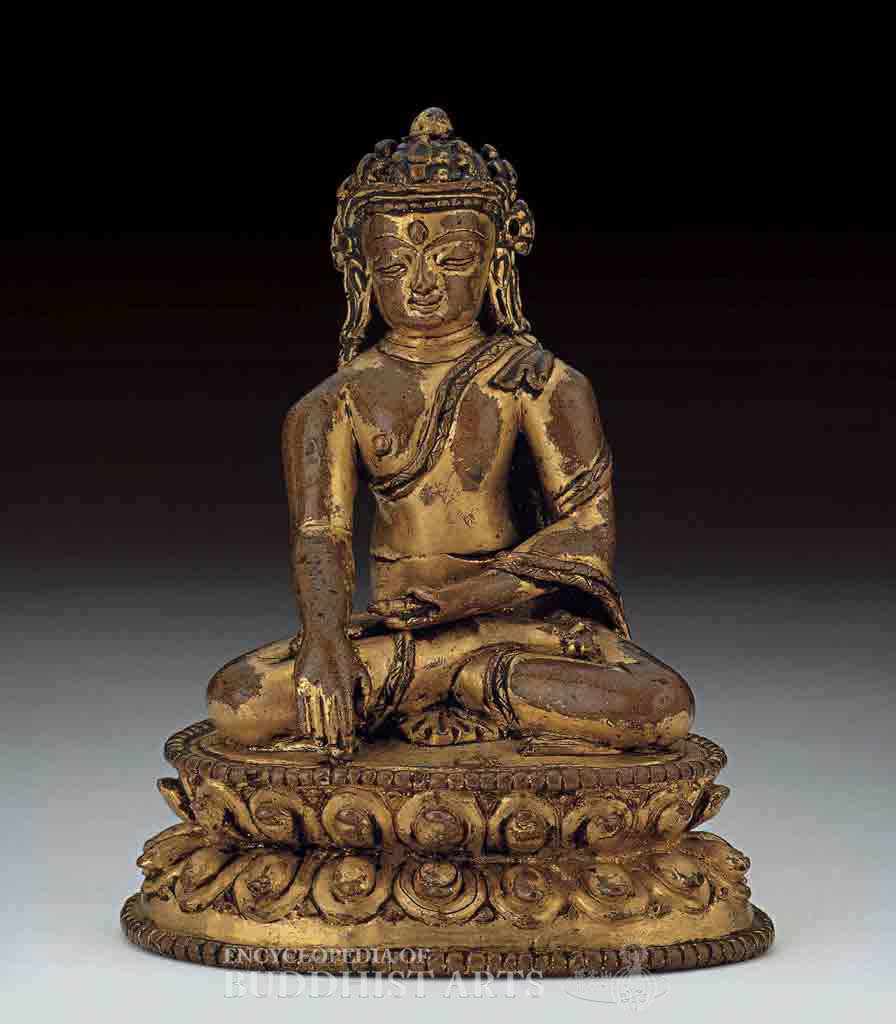
Seated Buddha
Gilt copper
Seated Buddha
NEPAL; Khasa period
The Buddha is seated in full lotus position on a double lotus throne with the right hand in bhumisparsa (earth-touching) mudra. The hair is restrained by a fillet and decorated with the jewel often seen on such figures in Nepal. Other characteristics include the raised urna, the long hollow elongated earlobes, and the three lines on the neck. The monastic robe leaves the right shoulder bare and has geometric patterns on its hem. A small corner of the garment is folded over the left shoulder. The left hand holds a corner of the garment, a characteristic of statues in the Dolpo region. An obvious crack is visible along the midriff and has caused the figure to lean off-center. Devotees have rubbed off most of the gilding on the statue due to prolonged handling. The beaded pattern along the throne is an influence from the style of the Pala period (circa 8th–12th century).
For more details, go to the Encyclopedia of Buddhist Arts: Sculpture N-Sr, page 1027.
Cite this article:
author = Hsingyun and Youheng and Lovelock, Yann and Chou, Yuan and Huntington, Susan and Edson, Gary and Neather, Robert,
booktitle = {Encyclopedia of Buddhist Arts: Sculpture N-Sr},
pages = 1027,
title = {{Seated Buddha}},
volume = 12,
year = {2016}}