
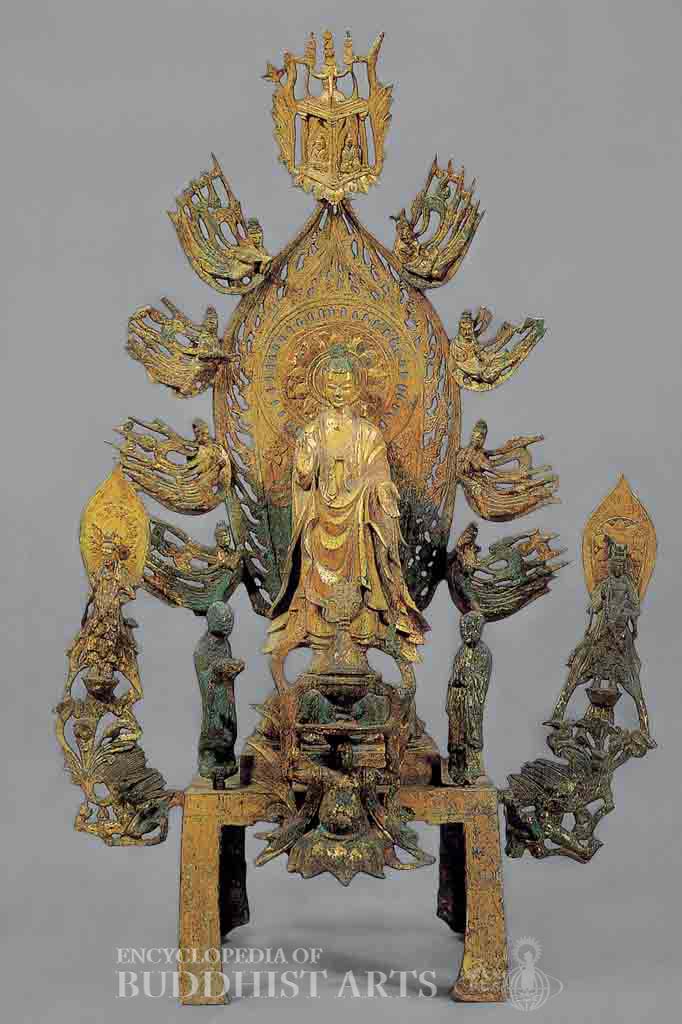
Buddha Pentad
Gilt bronze
Buddha Pentad
CHINA; Northern Wei dynasty
The Buddha stands on a lotus pedestal at the center of a complex composition, with the right hand probably in the abhaya (fearlessness) mudra and the left hand in varada (wish-granting) mudra. The figure wears a loose gown that flows downwards in numerous layers. A lotus nimbus is located behind the Buddha’s head, and is surrounded by a ring of light rays and tongues of flame cast in openwork. The outermost rim of the mandorla is encircled with apsaras with trailing stoles. A pagoda with spires and the composition rise from a four-legged pedestal that supports other figures. Two disciples stand on either side of a mountain censer located at the Buddha’s feet. Bodhisattvas are standing on lotus pedestals extensions behind the disciples. These Bodhisattvas wear garments similar in style to the main figure and have only slightly less ornate mandorlas. This piece resembles Wu You’s Maitreya Buddha triad, dated to 524, and is reminiscent of the Northern Wei (386–534) style. The statue is believed to have been made in Hebei.
For more details, go to the Encyclopedia of Buddhist Arts: Sculpture A-F, page 199.
Cite this article:
author = Hsingyun and Youheng and Lovelock, Yann and Chou, Yuan and Huntington, Susan and Edson, Gary and Neather, Robert,
booktitle = {Encyclopedia of Buddhist Arts: Sculpture A-F},
pages = 199,
title = {{Buddha Pentad}},
volume = 10,
year = {2016}}