
Seated Buddha
Bronze
Seated Buddha (back)
Seated Buddha
INDIA
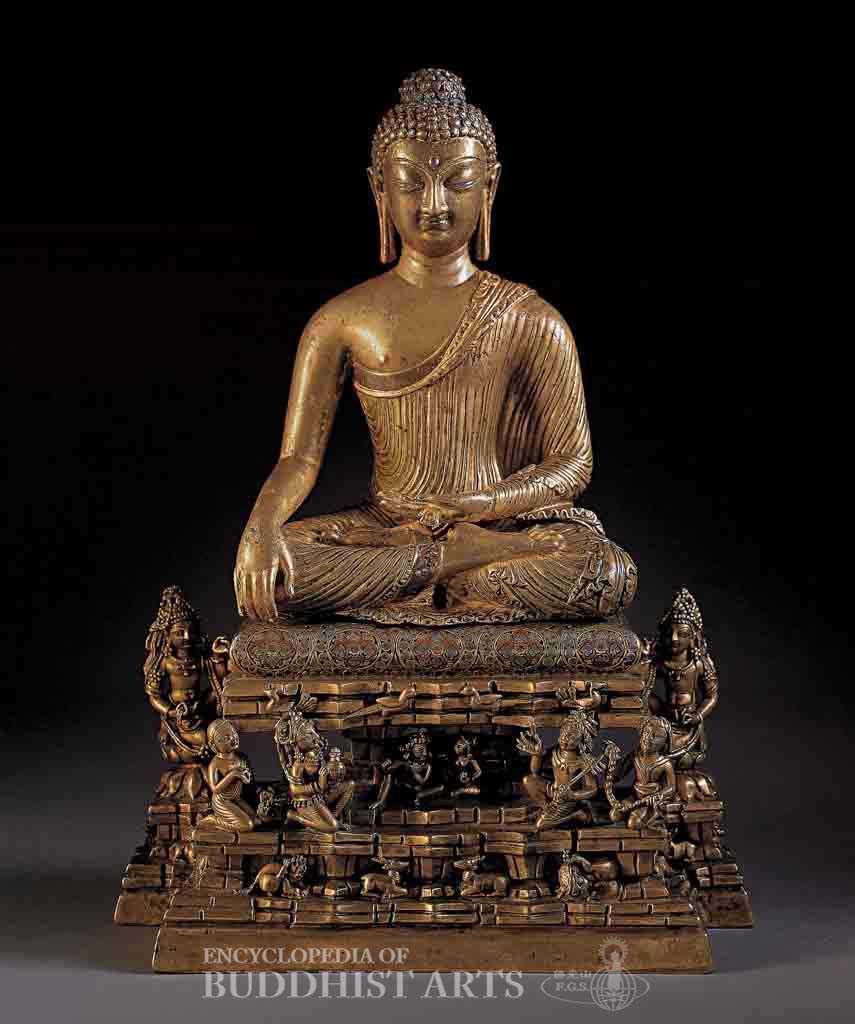
The figure, from the Kashmir region, is seated in full lotus position on a cushion decorated with geometric patterns. The Buddha has a pronounced usnisa covered in large curls. A silver stud on the forehead represents the urna and elongated earlobes frame the neck with its three lines. The monastic robe leaves the right shoulder bare with ruffles present along the hem. The right hand is in bhumisparsa (earth-touching) mudra while the left hand tightens the fold of the garment about that arm.
The Sumeru throne is created with a striated effect to resemble a cliff face. A pair of parrots and peacocks are perched along the front. A flute-playing male figure accompanied by a female is seated within the alcove of the throne. Four kneeling figures, arranged in a symmetrical composition are located at the middle platform. The male figure on the right holds a musical instrument in his left hand and a plectrum in his right. A male figure behind the musician holds a garland of flowers. The female on the left side carries a vase, while a monk kneels behind her, holding a garland of flowers. Two richly jeweled Bodhisattvas kneel on double lotus pedestals and support the sides of the throne. The figure on the left touches the garland of flowers he wears, while the other carries a gem. Various animals kneel between the pilasters along the base of the pedestal. The pair of deer facing each other at the center symbolizes the Buddha’s teaching.
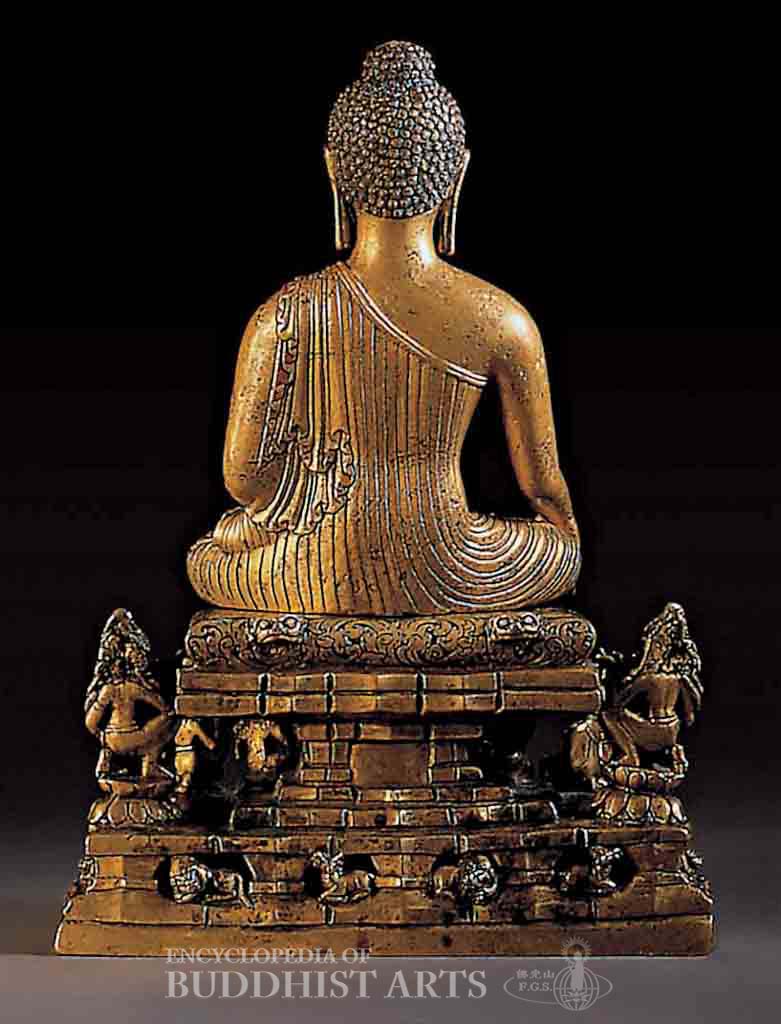
The statue and the throne were created separately and the presence of mortise and tenon joints at the back suggests that there was also a mandorla.
For more details, go to the Encyclopedia of Buddhist Arts: Sculpture N-Sr, page 1017.
Cite this article:
author = Hsingyun and Youheng and Lovelock, Yann and Chou, Yuan and Huntington, Susan and Edson, Gary and Neather, Robert,
booktitle = {Encyclopedia of Buddhist Arts: Sculpture N-Sr},
pages = 1017,
title = {{Seated Buddha}},
volume = 12,
year = {2016}}