
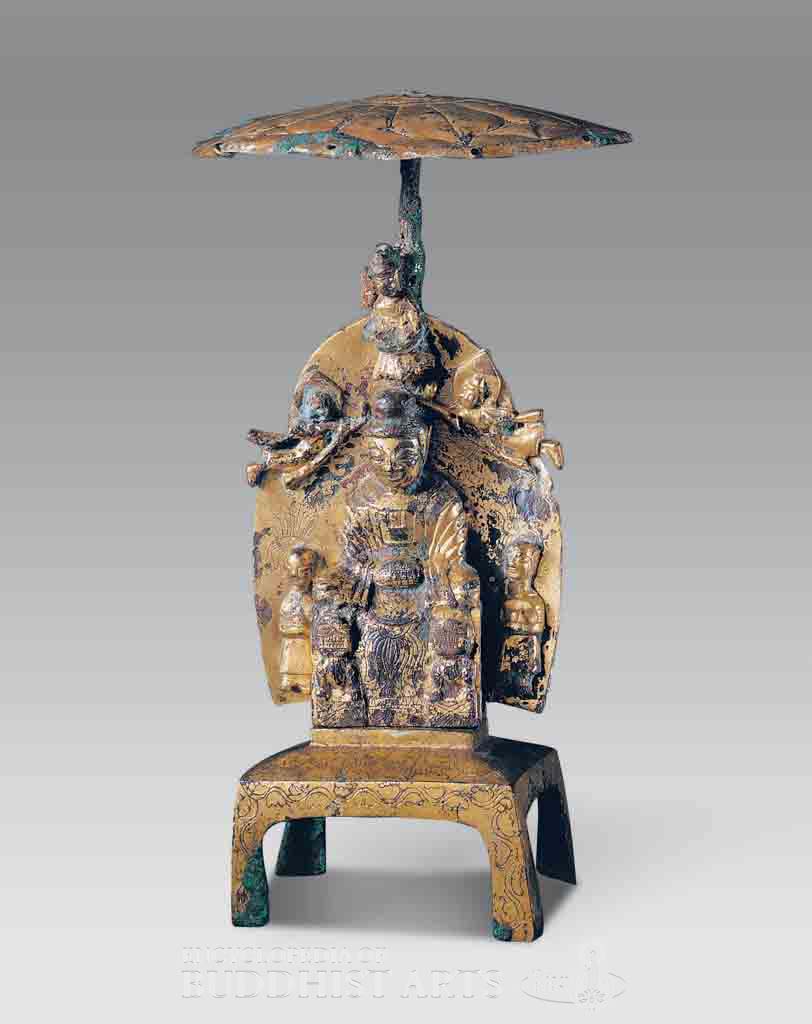
Shijiazhuang: Buddha and Attendants
Gilt bronze
Shijiazhuang: Buddha and Attendants
CHINA, Hebei, Shijiazhuang; Sixteen Kingdoms to Northern Wei dynasty
The statue was unearthed from Shijiazhuang in 1955. It consists of a Buddha and two disciples, balanced on a four-legged stand with a mandorla and canopy. The Buddha sits cross-legged on a lion throne with hands in a variation of dhyana (meditation) mudra. Apsaras are located on either side of the Buddha’s head, while a Buddha figure is at the mandorla’s apex. An umbrella-shaped canopy with holes found along its edges is positioned above the figures. Experts believe bell-shaped decorations once hung from these canopy holes. Engravings of vine-like patterns cover the stand. There is an abundance of other similar statues that have been found proving the style was popular. Comparison with other similar statues lead experts to believe this piece was created around 338. There is, however, a variation in the way the clothing is portrayed, which is comparable with similar statues made during the Sixteen Kingdoms (303–439) or the early Northern Wei dynasty (386–534).
For more details, go to the Encyclopedia of Buddhist Arts: Sculpture N-Sr, page 1059.
Cite this article:
author = Hsingyun and Youheng and Lovelock, Yann and Chou, Yuan and Huntington, Susan and Edson, Gary and Neather, Robert,
booktitle = {Encyclopedia of Buddhist Arts: Sculpture N-Sr},
pages = 1059,
title = {{Shijiazhuang: Buddha and Attendants}},
volume = 12,
year = {2016}}