
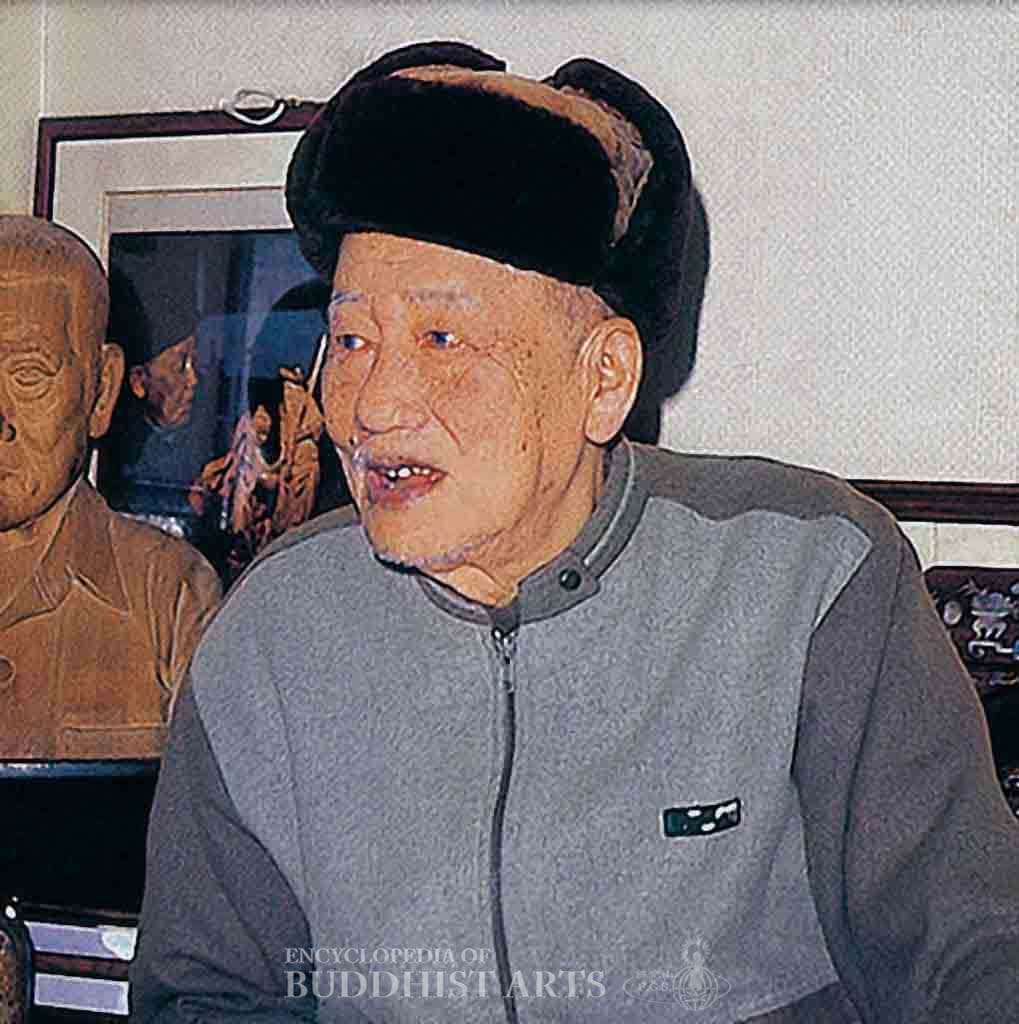
Li Sung-Lin
Li Sung-Lin
TAIWAN, Changhua
Li Sung-Lin was born into a family of wood carvers and began studying structural carpentry when he was 13 years old. At age 18, Li helped to repair the woodwork at Tianhou Temple in Lukang. After that, he became involved in restoration projects at several other temples around Taiwan. Later, Li moved from building repairs to figure carving. He carved diverse subjects and combined traditional with contemporary, re-inventing and reviving wood carving art. In 1936, his carving, Moth Orchid, was exhibited in the Taiwan Pavilion at the Japan Expo. In 1964, Li was invited to the New York Expo and displayed carvings depicting four Chinese inventions: the compass, silk reeling, papermaking, and printing. These pieces are now kept in the Institute of Asian Studies at St. John’s University in New York, USA.
Li dedicated himself to his art, and was particularly skilled in carving figures such as Buddhas, Bodhisattvas, and Arhats in traditional style with a fluid, animated style. His works include Pair of Dragons with a Ruyi, kept at the Lukang Folk Arts Museum and Dragon-Subduing Arhat, currently in the collection of the Kaohsiung Museum of Fine Arts. In 1985, Li received the first Folk Art Award from the Ministry of Education, and in 1989, the Ministry recognized him as an Important Folk Artist.
Li’s son, Li Bing-kuei, continues the family tradition of wood carving. Like his father, he specializes in carving figures. He has held numerous exhibitions, and in 1997, he won the Global Chinese Arts and Culture Award. His works include Zhong Kui, in the collection of Keelung Cultural Center and Bodhisattva, in Sanyi Wood Sculpture Museum.
For more details, go to the Encyclopedia of Buddhist Arts: People, page 164.
Cite this article:
author = Hsingyun and Youheng and Youlu and Pokorski, Stefanie and Yichao and Mankuang and Miaohsi,
booktitle = {Encyclopedia of Buddhist Arts: People },
pages = 164,
title = {{Li Sung-Lin}},
volume = 19,
year = {2016}}