
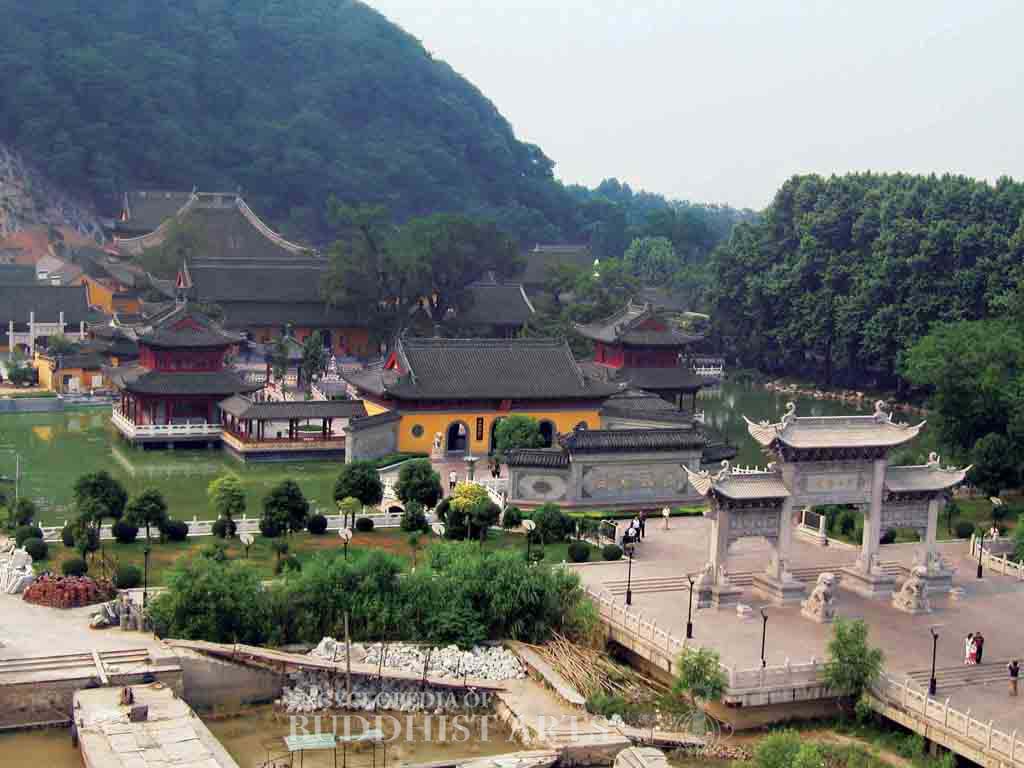
Dinghui Temple
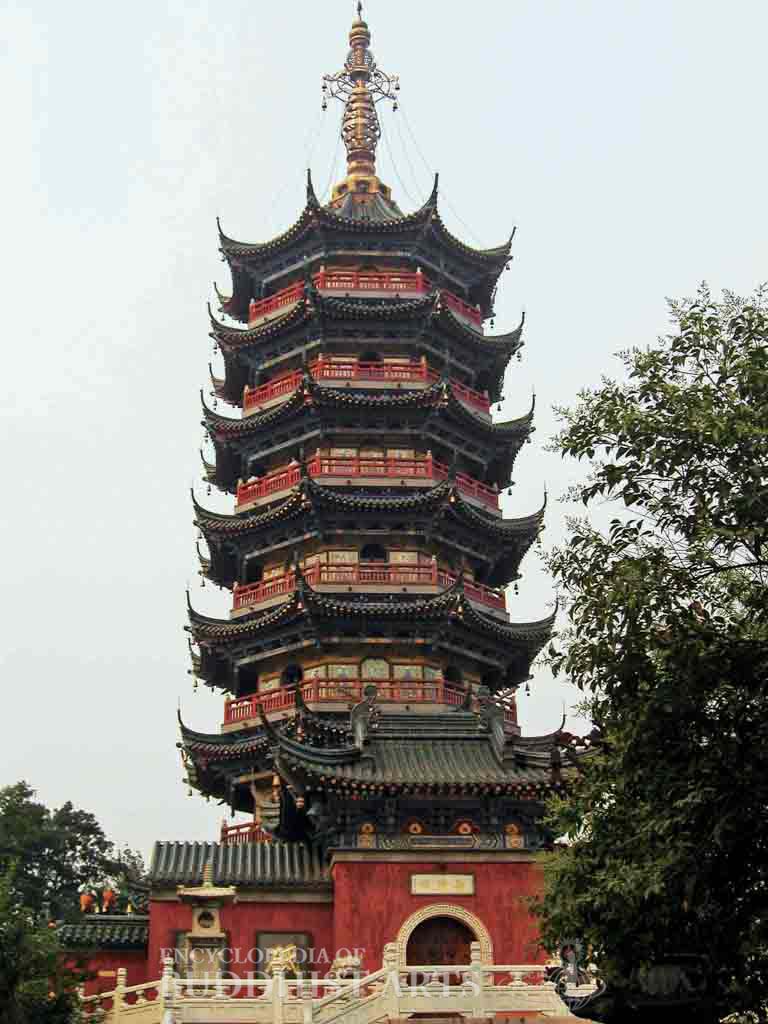
Dinghui Temple: Ten Thousand Buddha Pagoda
Dinghui Temple
CHINA, Jiangsu, Zhenjiang
Dinghui means Wisdom and Meditation. It is located on the southern slope of Jiaoshan Mountain. It was built during the rule of Emperor Xian (reigned 189–220) of the Eastern Han dynasty. It has been destroyed and repaired a number of times throughout its history, including reconstruction and expansion between 1426 and 1449 during the Ming dynasty. It was listed as a key Buddhist temple in the Han region of China in 1983.
The temple faces south and the buildings along the central axis include the main temple gate, Heavenly King Hall, Great Hero Hall, and the sutra repository. Side buildings include the drum and bell towers, the Sangharama Hall, and the Patriarch Hall. A screen wall and a three-bay gateway are located in front of the temple, while the Ten Thousand Buddha Pagoda is located on the peak of Jiaoshan.
The Great Hero Hall has a double-eave hip roof. It houses statues of Sakyamuni Buddha, the Medicine Buddha, and Maitreya Buddha. Despite the fact that the hall has been repaired a number of times, it retains its Ming dynasty (1368–1644) characteristics. In front of the Heavenly King Hall there is a courtyard containing the Imperial Stele Pavilion. Both the front and back of the stele are engraved with poems written by Emperor Qianlong (reigned 1736–1795) when he visited Jiaoshan during his inspections of the south. The foundation of the Ten Thousand Buddha Pagoda was laid in 1998 and construction was completed the following year. The seven-story, octagonal, reinforced concrete pagoda is 42 m high.
For more details, go to the Encyclopedia of Buddhist Arts: Architecture A-F, page 241.
Cite this article:
author = Hsingyun and Youheng and Johnson, Peter and Mankuang and Lancaster, Lewis,
booktitle = {Encyclopedia of Buddhist Arts: Architecture A-F},
pages = 241,
title = {{Dinghui Temple}},
volume = 1,
year = {2016}}