
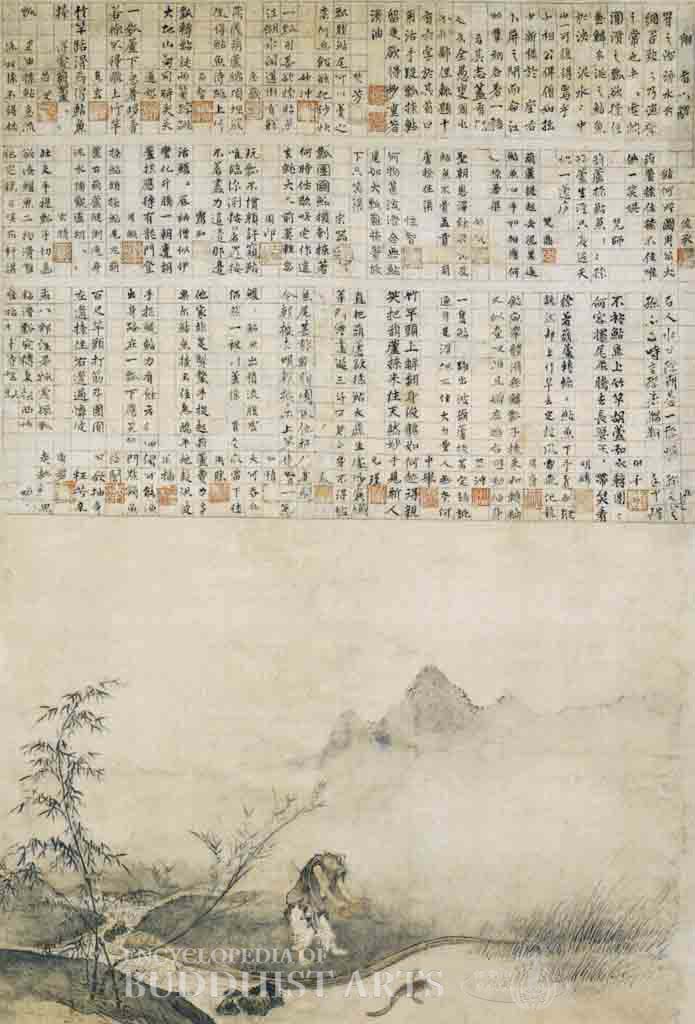
Catching a Catfish with a Gourd by Josetsu; Muromachi period
Ink and color on paper
Josetsu
JAPAN; Nanbokucho to Muromachi period (1336–1573)
Josetsu was a monk and painter at Shokokuji Temple in Kyoto. His name, Josetsu, which means “appearing clumsy” was said to have been given to him by Zen Master Zekkai Chushin based on the quote, “those who are extremely clever appear clumsy,” written by the well-known Daoist philosopher Laozi. The famed painter Tensho Shubun, who also stayed at Shokokuji Temple, was a student of Josetsu, and various others such as those of the Kano and Hasegawa schools of painting, and the Zen monk painter Sesshu Toyo, are said to have greatly respected him as the master and pioneer of Japanese ink painting.
According to various sources, Josetsu created his most well-known painting, Catching a Catfish with a Gourd, under the official order of Shogun Ashikaga Yoshimochi, with whom he had close association. Poetic praises were written by monk Daigaku Shusu, along with the words of 30 other monks, on the top of the painting. The painting, now a National Treasure, is currently retained in the Taizoin Temple in Kyoto.
Josetsu’s paintings incorporate the innovative styles of Southern Song dynasty (1127–1279) Chinese artists such as Liang Kai and Ma Yuan, exemplified by only few brushstrokes in the corner of the canvas, leaving the majority of it blank. The Three Teachings, a symbolic representation of the teachings of Buddhism, Confucianism, and Daoism, is said to be painted by Josetsu and is kept at Ryosokuin Temple in Kyoto. In addition, the lightly-colored ink painting of Chinese Zither and Chess Game, kept at Ryokoin Temple in Kyoto, is also a work of his. Both paintings are listed as Important Cultural Properties.
For more details, go to the Encyclopedia of Buddhist Arts: People, page 124.
Cite this article:
author = Hsingyun and Youheng and Youlu and Pokorski, Stefanie and Yichao and Mankuang and Miaohsi,
booktitle = {Encyclopedia of Buddhist Arts: People },
pages = 124,
title = {{Josetsu}},
volume = 19,
year = {2016}}