
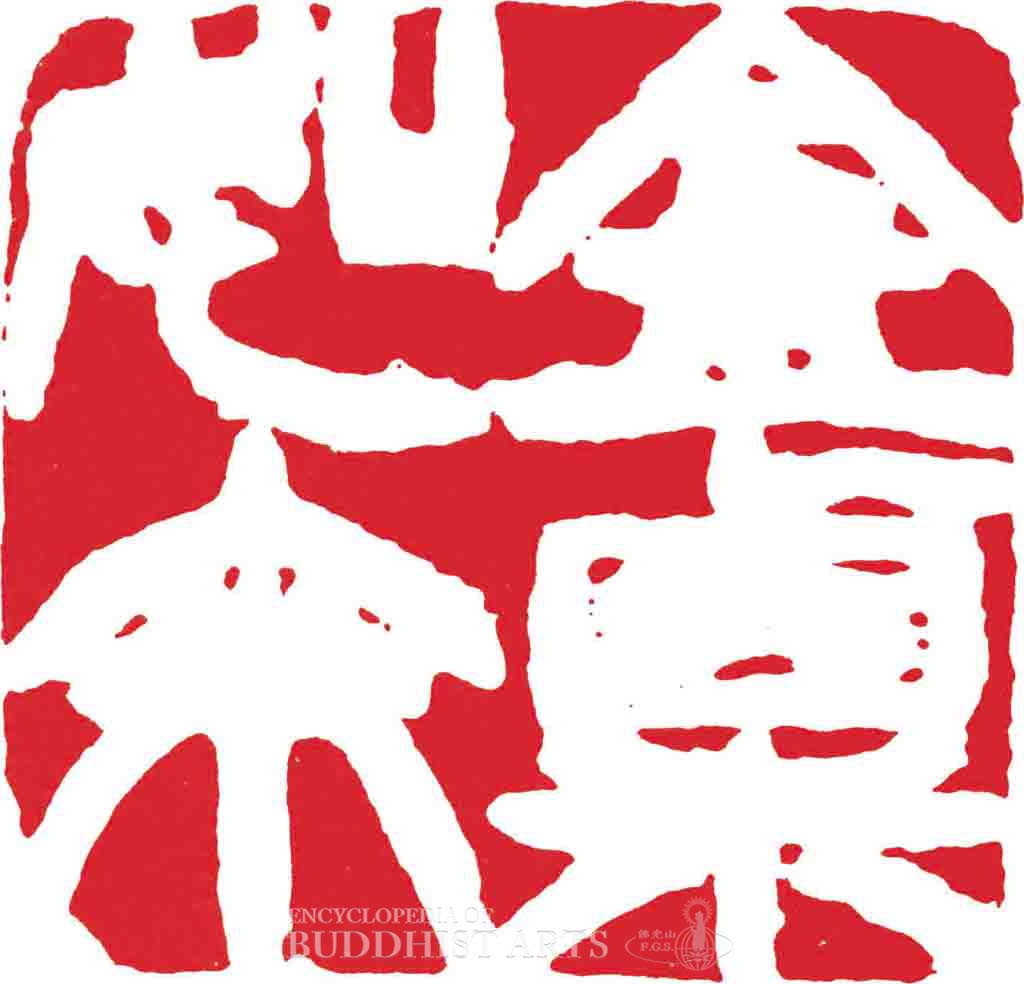
Golden Grain Tathagata by Nakamura Randai; Meiji period
White-character square seal
Nakamura Randai
JAPAN, Fukushima; Meiji to Taisho period (1868–1926)
Nakamura Randai was originally named Inayoshi and also known as Hakuhyo or Soko. He was a seal engraver born in Aizu Wakamatsu (present day Fukushima), but later lived in Edo (present day Tokyo).
He learned seal engraving at the age of 20 under Takada Lakuun, subsequently studying the styles of the Ming (1368–1644) and Qing (1644–1911) dynasties of China. Inspired by the skills of Wen Peng and He Zhenzhi, he later immersed himself in the style of Xu Shangeng, a seal artist from Qing dynasty China. Nakamura researched ancient seals and script styles of the Qin (221–207 BCE) and Han (206 BCE–220 CE), as well as the Zhejiang school style, laying a solid foundation for the development of his own engraving skills.
His preferred carving medium was wood. Deft in cutting, he wielded the knife as if it were a pen. With his rich imagination, creativity, and skill, Nakamura became the representative seal engraver in his era. He was the founder of Teibi Insha, and authored Randai Inson and Collection of Nakamura’s Seals. Golden Grain Tathagata, a white-character square seal, is an excellent example of his extant works.
For more details, go to the Encyclopedia of Buddhist Arts: People, page 199.
Cite this article:
author = Hsingyun and Youheng and Youlu and Pokorski, Stefanie and Yichao and Mankuang and Miaohsi,
booktitle = {Encyclopedia of Buddhist Arts: People },
pages = 199,
title = {{Nakamura Randai}},
volume = 19,
year = {2016}}