

Ritual Costume
Silk

Ritual Costume
Ritual Costume

Ritual Costume

Ritual Costume
Ritual Costumes
CHINA; Qing dynasty
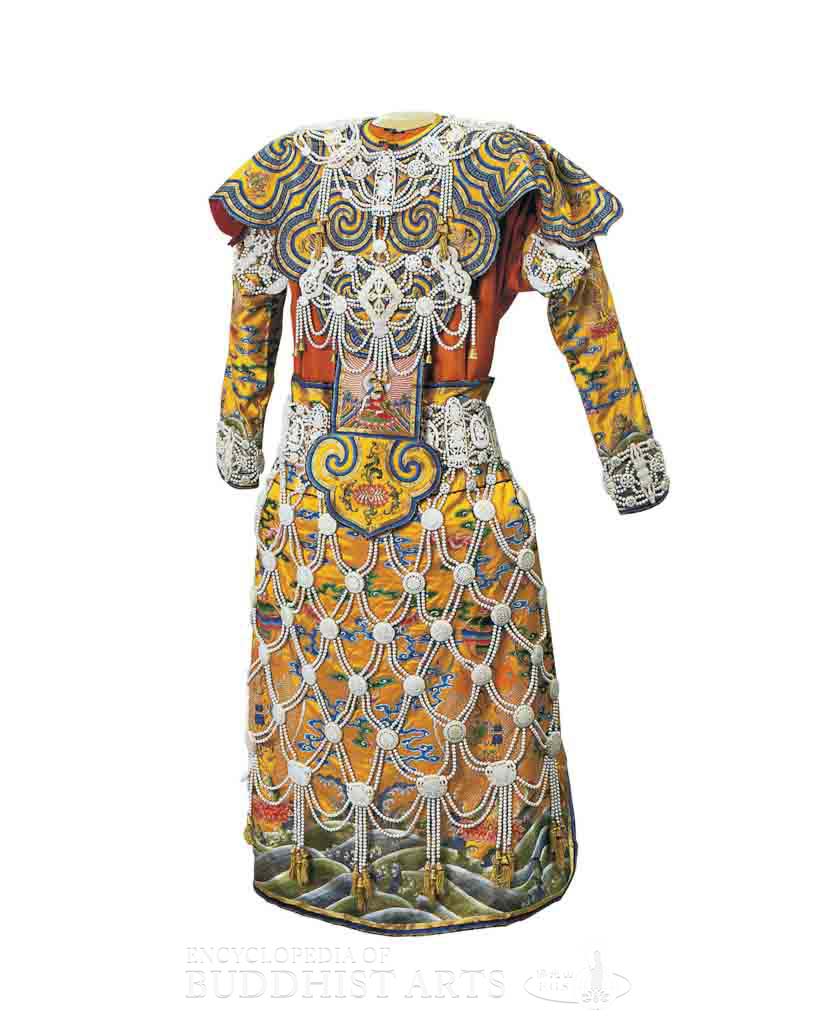
These five costumes were used in Tibetan Buddhist rituals during the Qing dynasty, and were worn by lamas during important Dharma services in the palace. They were fashioned during the rule of Emperor Qianlong (reigned 1736–1795) of the Qing dynasty.
Each costume has a foundation of white, blue, yellow, red, and green silk with embroidered patterns. They are each comprised of an ornate cape with large pendant, sleeves, and a skirt, all worn over an inner robe. The skirts are embroidered with various images including waves, twin fish, canopies, red bats, Dharma wheels, seahorses, ruyi, or coral, all with colorful silk threads. The bottom is embroidered with two golden dragons facing each other, and the surface is decorated with hanging bead ornaments, in between which there are round disks carved with lotuses and chrysanthemums. Fifteen carved disks hang from the waist and are carved with either Buddhas, Bodhisattvas, auspicious creatures, or other patterns.
The sleeves are narrow and embroidered using colorful silk threads to create designs of auspicious clouds, lotuses, red bats, twin fish, and the ocean at the foot of a cliff. The cuffs are decorated with golden embroidery with hems in mineral blue. Additionally, they are sewn with vajras, lotuses, and beads.
The capes have round collars and various forms of ornamentation, in between which there are 16 disks carved with Buddhas, Bodhisattvas, vajras, and lotuses. The part of the cape hanging on the chest has a Sakyamuni Buddha image followed by a cloud pattern.
For more details, go to the Encyclopedia of Buddhist Arts: Artifacts, page 283.
Cite this article:
author = Hsingyun and Youheng and Youji and Pokorski, Stefanie and Mankuang and Fan, Wen,
booktitle = {Encyclopedia of Buddhist Arts: Artifacts },
pages = 283,
title = {{Ritual Costumes}},
volume = 18,
year = {2016}}