
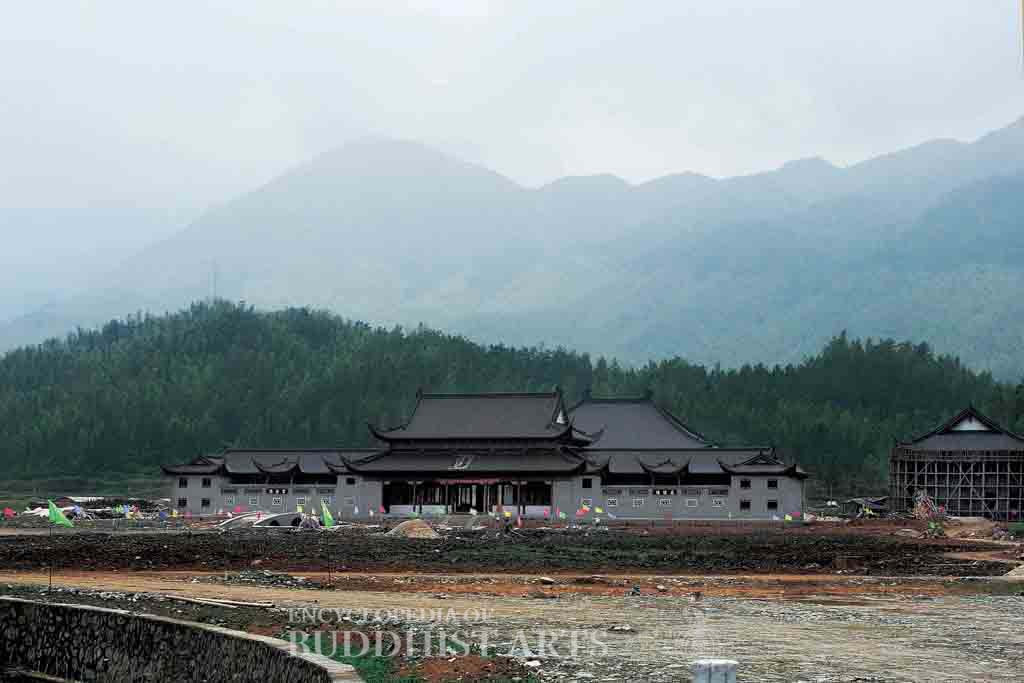
Baizhang Temple
Baizhang Temple
CHINA, Jiangxi, Yichun
The temple is located on Baizhangshan. It was built between 766 and 779 during the Tang dynasty. Chan Master Baizhang Huaihai was invited to become the abbot of this temple in 784 and strongly promoted Chan practice. He built additional Dharma halls and meditation halls, and compiled the famous Pure Regulations of Baizhang here. Emperor Xuanzong (reigned 846–859) lived a secluded life here before he was enthroned, and the temple was renovated after he became emperor. The temple flourished during the rule of Emperor Taizu (reigned 1368–1398) of the Ming dynasty, prompting other temples to be constructed nearby. Subsequently, the area became known for having Three Monasteries, Five Temples, and Forty-Eight Shrines. The temple eventually fell into disrepair and by 1949 only the Great Hero Hall and monastic quarters remained. The temple was reconstructed and expanded in 2004. It is listed as a Provincial Cultural Heritage Site.
The temple buildings include the Heavenly King Hall, Great Hero Hall, Jade Buddha Hall, Hall of the Three Sages, and the Patriarch Hall. At the back of the temple, there are two famous steles. The first is inscribed Pure Regulations of the World, and was carved by calligrapher Liu Gongquan during the Tang dynasty (618–907). The second is inscribed with Wild Fox Cliff, which refers to the Chan story of Master Baizhang Huaihai helping to liberate a Chan practitioner who had been reborn as a fox 500 times.
For more details, go to the Encyclopedia of Buddhist Arts: Architecture A-F, page 42.
Cite this article:
author = Hsingyun and Youheng and Johnson, Peter and Mankuang and Lancaster, Lewis,
booktitle = {Encyclopedia of Buddhist Arts: Architecture A-F},
pages = 42,
title = {{Baizhang Temple}},
volume = 1,
year = {2016}}