
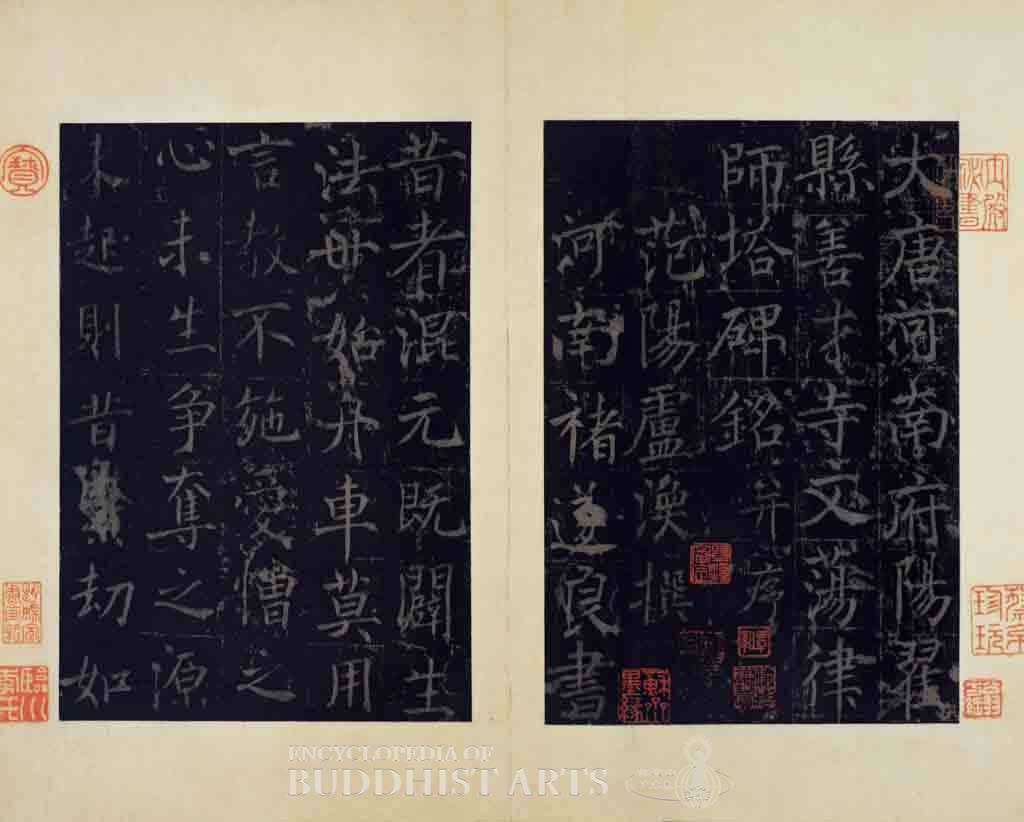
Stele of Master Wendang at Shancai Temple by Wei Qiwu (detail); Dated 725
Rubbing
Wei Qiwu
CHINA; Tang dynasty
Wei Qiwu was a calligrapher active during the rule of Emperor Xuanzong (reigned 712–756) of the Tang dynasty. Compared to the thin, firm strokes of regular scripts from the Early Tang period (618–712), Wei’s regular script calligraphy, penned in broader strokes, was unique in appearance and composition. Reminiscent of Chu Suiliang’s style, the bold, energetic strokes of his works were imbued with a hint of “relaxed playfulness.”
The full essence of Wei’s calligraphy style is displayed on the Stele of Master Wendang at Shancai Temple. Installed originally in Henan, the stele was once thought to be the work of Chu Suiliang. However, researchers Qing Wangshu and Weng Fanggang determined that the stele was carved by Wei in 725. The original stele no longer exist, but rubbings made during the Song dynasty (960–1279) are now in the collection of the Mitsui Memorial Museum in Tokyo, Japan. The rubbings were once in the possession of Li Zonghan, a Qing dynasty (1644–1911) collector from Linchuan.
For more details, go to the Encyclopedia of Buddhist Arts: People, page 289.
Cite this article:
author = Hsingyun and Youheng and Youlu and Pokorski, Stefanie and Yichao and Mankuang and Miaohsi,
booktitle = {Encyclopedia of Buddhist Arts: People },
pages = 289,
title = {{Wei Qiwu}},
volume = 19,
year = {2016}}