
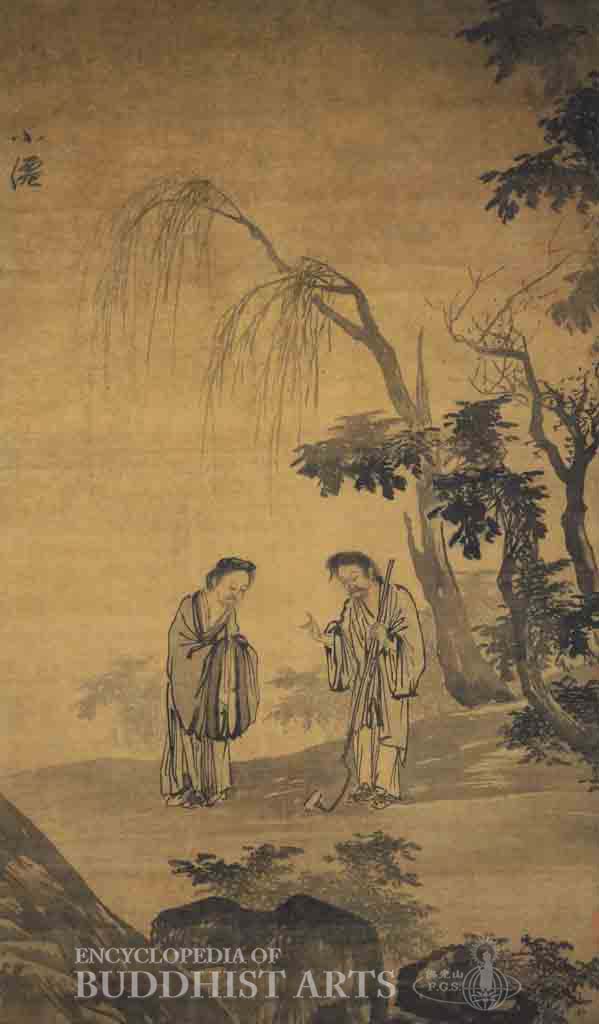
Requesting the Way by Wu Wei; Ming dynasty
Ink on silk
Wu Wei
CHINA, Hubei, Wuhan; Ming dynasty
Wu Wei was a landscape painter born in Jiangxia (present day Wuhan). Orphaned at a young age after the death of both of his parents, he was later adopted and lived in Nanjing. During the rule of Emperor Chenghua (reigned 1464–1487) of the Qing dynasty, Wu was appointed as a civil official, and later painter-in-attendance in the Imperial Painting Academy. He was known as one of the Three Masters of the Zhejiang school, together with Dai Jin and Lan Ying.
In his early years, he painted figures with meticulous, cautious lines. Later, following Dai Jin, Ma Yuan, and Xia Gui, he began to specialize in landscape painting. Influenced by the renowned Tang dynasty (618–907) painter, Wu Daozi, he started to use the unrestrained, vigorous style of Southern Song court painters. He also painted numerous images of Buddhas, Bodhisattvas, and Arhats. His masterpieces include Mountains Covered with Snow, kept at the National Palace Museum in Taipei, Taiwan; Iron Flute, kept at the Shanghai Museum; Ba Bridge in Wind and Snow, kept at the Palace Museum in Beijing; Requesting the Way, kept at the Mukden Palace in Liaoning, and Noble Man Under the Tree, kept at Museum of Fine Arts in Boston, USA.
For more details, go to the Encyclopedia of Buddhist Arts: People, page 298.
Cite this article:
author = Hsingyun and Youheng and Youlu and Pokorski, Stefanie and Yichao and Mankuang and Miaohsi,
booktitle = {Encyclopedia of Buddhist Arts: People },
pages = 298,
title = {{Wu Wei}},
volume = 19,
year = {2016}}