
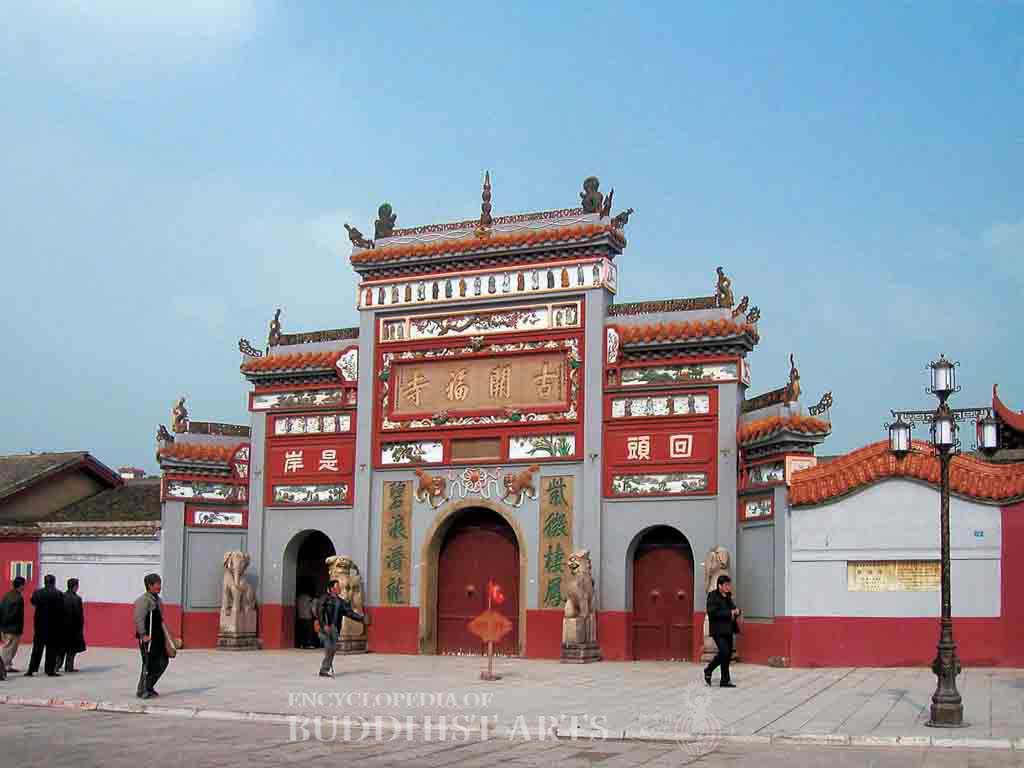
Kaifu Temple: Main Temple Gate
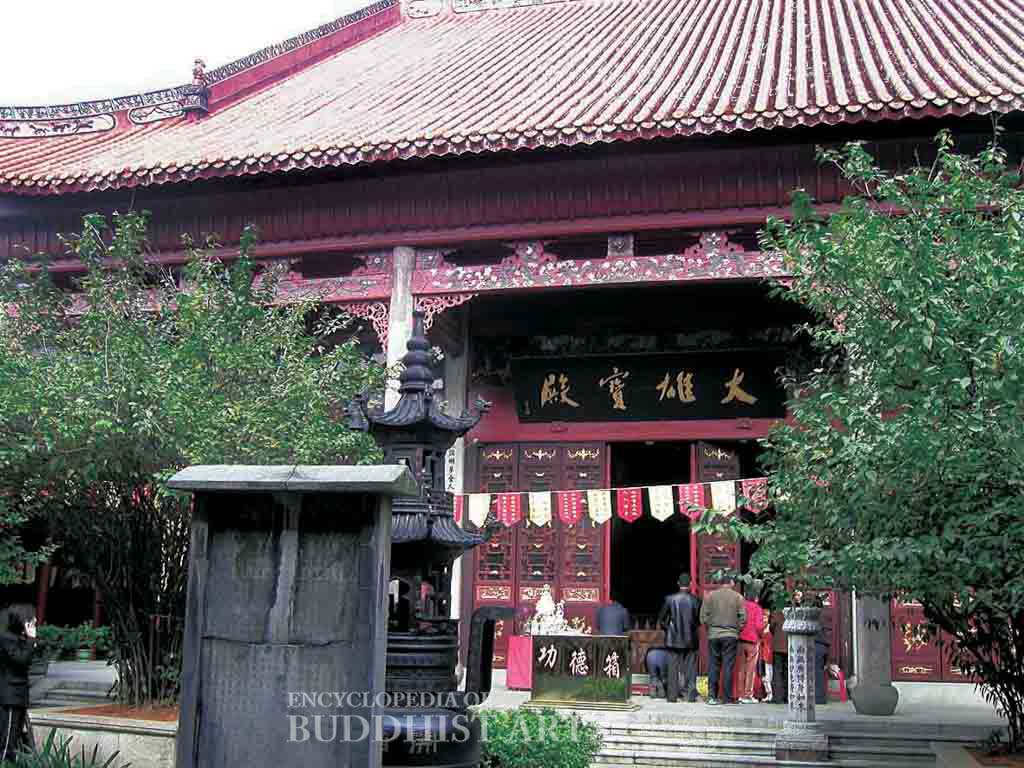
Kaifu Temple: Great Hero Hall
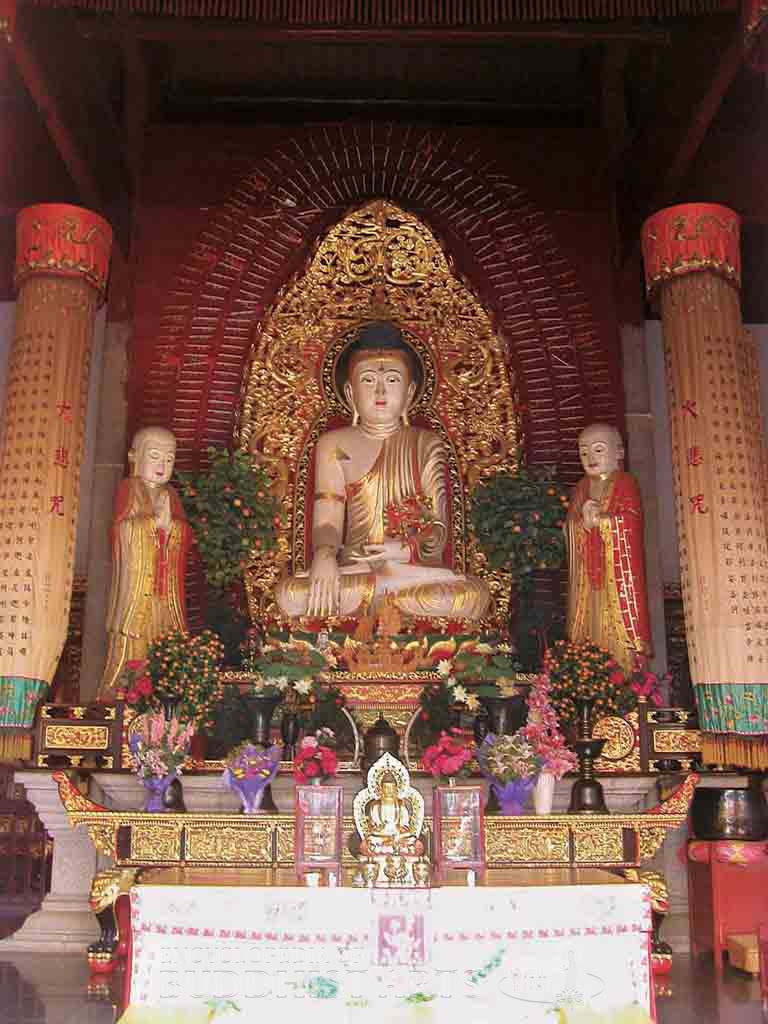
Kaifu Temple: Great Hero Hall (interior)
Kaifu Temple
CHINA, Hunan, Changsha
Kaifu means Initiate Good Fortune. It was built on the Xiang River in 927 during the late Tang dynasty. It is a famous temple of the Yangqi branch of the Linji school of Chinese Chan Buddhism. During the Northern Song dynasty (960–1127), it was developed into a temple garden with sixteen different features, such as the Delicate Purple Mountain and the Blue Wave Lake. Throughout its history, the temple has been repaired and restored a number of times. It was listed as a key Buddhist temple in the Han region of China in 1983.
The temple occupies 4.8 ha. The buildings along the central axis include the main temple gate, Maitreya Hall, Great Hero Hall, and Vairocana Hall. The buildings on the east side include the reception hall, dining hall, Mani Hall, and Ziwei Hall, while the buildings on the west side include the meditation hall, lecture hall, and chanting hall. The halls are separated by courtyards, where there are several stone steles from the Qing dynasty (1644–1911).
The granite main temple gate is 10 m high and has three doorways. It is covered with colorful reliefs of people and plants. There are stone lions and elephants sitting on either side of the gate. Just within the gate there is the Free Life Pond with an arched granite bridge. A white jade Avalokitesvara Bodhisattva statue is erected in front of the bridge. The Great Hero Hall has a single-eave hip-and-gable roof and is 20 m high. The hall houses Sakyamuni Buddha, flanked by Mahakasyapa and Ananda. Along the sides of the hall are the Sixteen Arhats. The Vairocana Hall contains Vairocana Buddha, as well as Five Hundred Arhats. The Arhats are all different in appearance and each is around 40 cm high.
For more details, go to the Encyclopedia of Buddhist Arts: Architecture G-L, page 569.
Cite this article:
author = Hsingyun and Youheng and Johnson, Peter and Mankuang and Lancaster, Lewis,
booktitle = {Encyclopedia of Buddhist Arts: Architecture G-L},
pages = 569,
title = {{Kaifu Temple}},
volume = 2,
year = {2016}}