

Nanputuo Temple

Nanputuo Temple (aerial view)
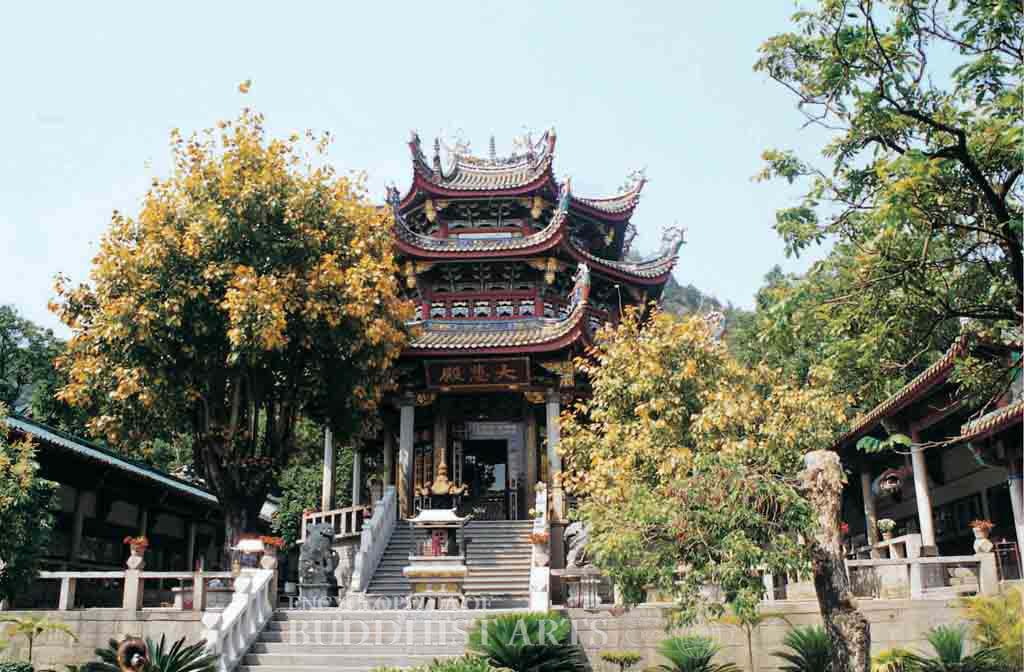
Nanputuo Temple: Great Compassion Hall
Nanputuo Temple
CHINA, Fujian, Xiamen
Nanputuo Temple is located beneath the Wulao Peaks and was built between the end of the Tang dynasty (618–907) and the Five Dynasties (907–960). The temple has undergone a number of repairs and expansions throughout its history. Eventually it developed enough facilities to be considered a large-scale Chan monastery, the largest and most famous in the province. It was listed as a key Buddhist temple in the Han region of China in 1983.
Along the central axis there are the Heavenly King Hall, Great Hero Hall, Great Compassion Hall, and the sutra repository. The meditation hall is located on the west side, while the Minnan Buddhist College is to the east. There are two ponds in front of the temple: the Free Life Pond and the Lotus Pond. Between the ponds and the temple buildings there are two 13-tier hexagonal pagodas with seven white marble stupas between them.
The nine-bay wide Great Hero Hall has a double-eave hip-and-gable roof. It houses the Three Buddhas, as well as the Amitabha Buddha Triad. The octagonal Great Compassion Hall has triple eaves and stands on a stone platform with multiple corners. The ceiling in the hall is made from numerous layers of bracket sets. The highest building of the temple is the seven-bay wide sutra repository, which has a double-eave hip-and-gable roof. The upper story houses the sutras, while the lower story functions as the Dharma Hall. The building has a veranda on three sides.
In 1924 it was converted to a temple whose abbotship is open to anyone. The Minnan Buddhist College was established the following year. Master Taixu presided over the temple as the abbot and it flourished.
For more details, go to the Encyclopedia of Buddhist Arts: Architecture M-S, page 782.
Cite this article:
author = Hsingyun and Youheng and Johnson, Peter and Mankuang and Lancaster, Lewis,
booktitle = {Encyclopedia of Buddhist Arts: Architecture M-S},
pages = 782,
title = {{Nanputuo Temple}},
volume = 3,
year = {2016}}