

Lingyan Temple Thousand Buddha Hall: Dharmakaya Buddha
Wood
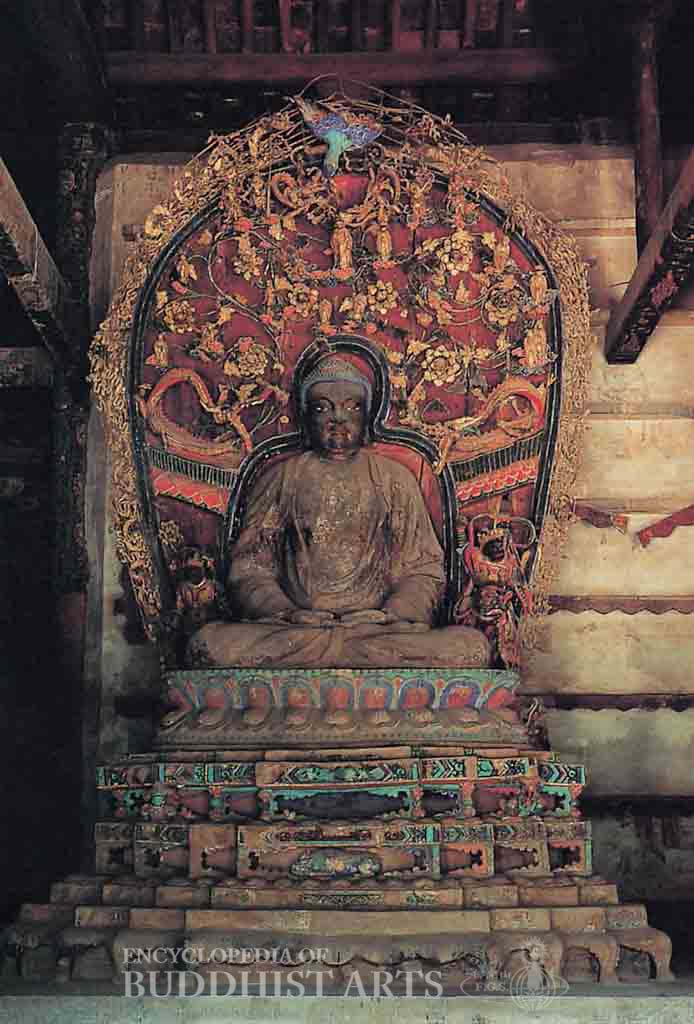
Lingyan Temple Thousand Buddha Hall: Nirmanakaya Buddha
Gilt bronze
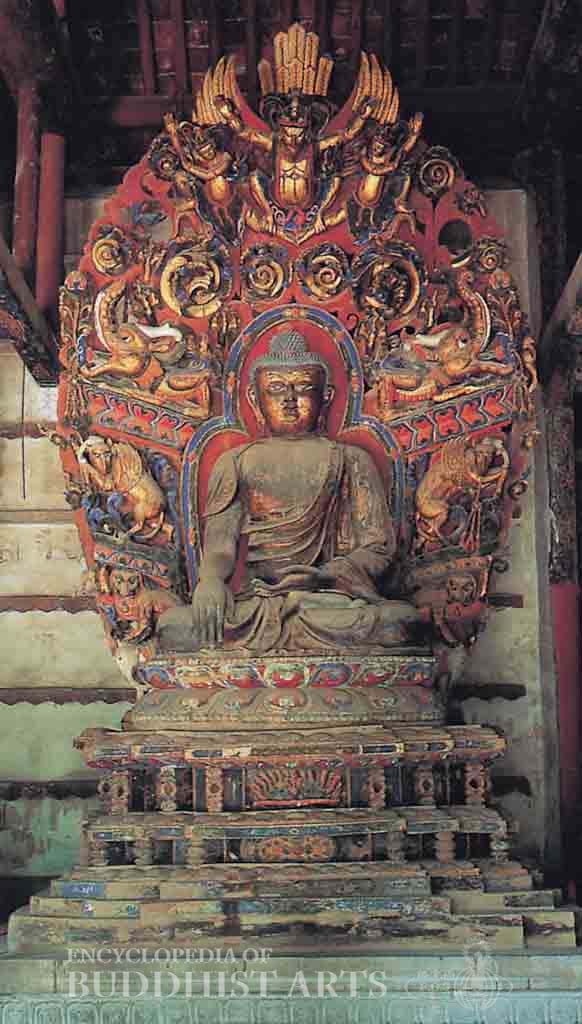
Lingyan Temple Thousand Buddha Hall: Sambhogakaya Buddha
Gilt bronze
Lingyan Temple Thousand Buddha Hall: Trikaya Buddhas
CHINA, Shandong, Jinan; Northern Song dynasty
The Trikaya (Three Bodies) Buddhas consist of the figures of Dharmakaya Buddha (Dharma body) in the middle, Sambhogakaya Buddha (reward body) on the right, and Nirmanakaya Buddha (manifestation body) on the left.
According to the temple records, Dharmakaya Buddha was shipped from Qiantang to this location in 1065. The statue sits high on a unique lotus throne with petals spreading out in all directions. The base on which the lotus throne balances is also rarely seen. The figure wears a jeweled crown and a monastic robe that covers both shoulders. The figure’s hands are bent outwards at the wrist and held at shoulder height. A large decorated mandorla with flaming edges rises from below to surround the composition.
The Nirmanakaya Buddha was created in 1543. The body is darker in color and garbed in a monastic robe that covers both shoulders but is opened at the front. The figure is seated in meditation posture on a double lotus throne supported on a stepped octagonal base. The mandorla behind is mounted with a foliated garden design.
The Sambhogakaya Buddha was made in 1477 and was cast from 2,500 kg of bronze. The figure is in full lotus position with one hand in bhumisparsa (earth-touching) mudra. The Buddha wears a monastic robe that leaves the right shoulder bare and is surrounded by an ornate floral-shaped mandorla mounted with the Six Dharma Symbolic Features: garuda, makara, naga, young boy, animal king, and elephant king.
For more details, go to the Encyclopedia of Buddhist Arts: Sculpture G-M, page 608.
Cite this article:
author = Hsingyun and Youheng and Lovelock, Yann and Chou, Yuan and Huntington, Susan and Edson, Gary and Neather, Robert,
booktitle = {Encyclopedia of Buddhist Arts: Sculpture G-M},
pages = 608,
title = {{Lingyan Temple Thousand Buddha Hall: Trikaya Buddhas}},
volume = 11,
year = {2016}}