
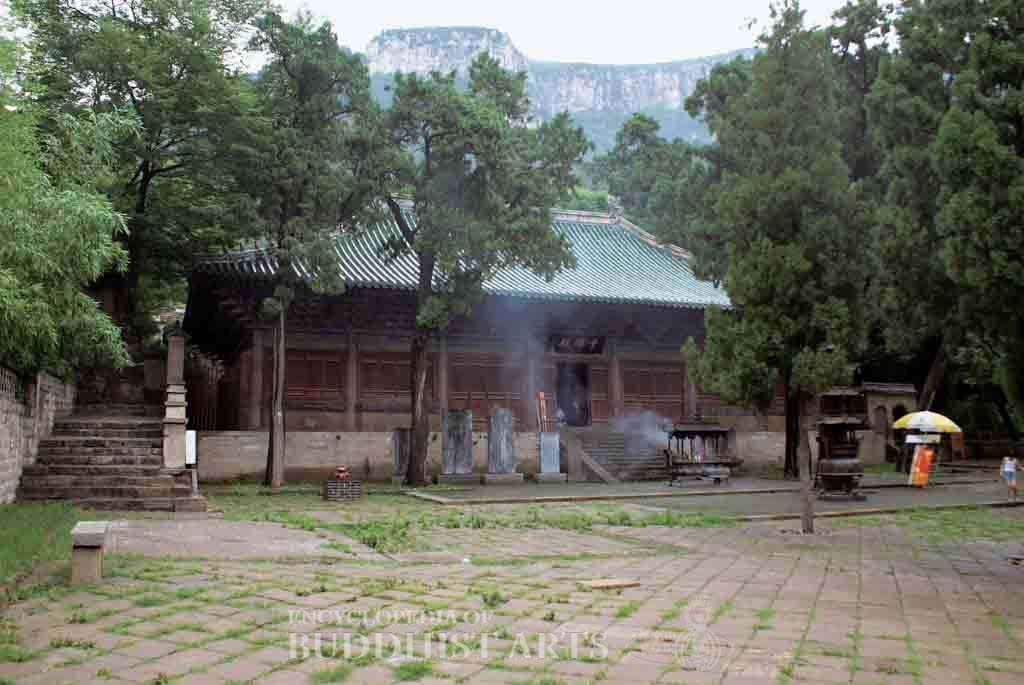
Lingyan Temple: Thousand Buddha Hall
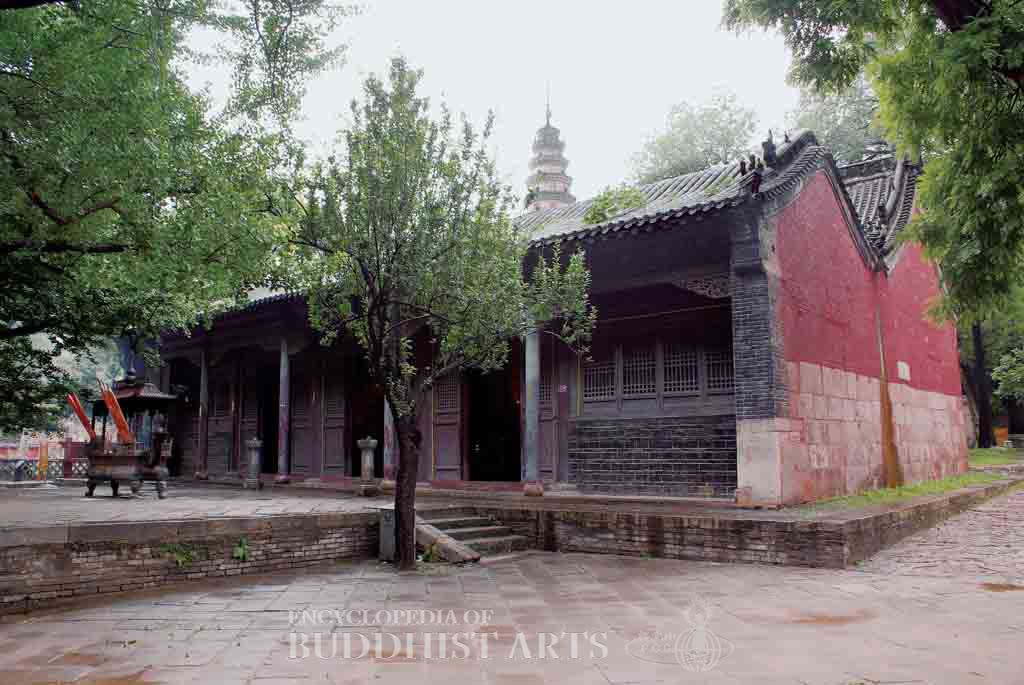
Lingyan Temple: Great Hero Hall
Lingyan Temple
CHINA, Shandong, Jinan
Lingyan Temple was founded by the monk Zhu Senglang in 357 during the Former Qin Kingdom, but it was destroyed less than a hundred years later. The monk Fading built Lingyan Temple on the south side of Lingyan Mountain towards the end of the Northern Wei dynasty (386–534). The temple was later relocated to its present site by the monk Huichong in the early years of the Tang dynasty (618–907). It was listed as a National Cultural Heritage Site in 1982.
Built to integrate with the landscape, most of the buildings lie along the south to north axis as follows: the main temple gate, Heavenly King Hall, Great Hero Hall, Five Flower Hall, Thousand Buddha Hall, and the imperial writing pavilion. To the west there are the Pratyekabuddha Pagoda and the forest of stupas.
The five-by-six bay Great Hero Hall has two parallel roofs. The roof at the front covers a veranda and is curved. Both of them are flush gable roofs. The seven-by-four bay Thousand Buddha Hall was repaired in 1587 during the Ming dynasty, but still retains structural features of the Song dynasty (960–1279). It has a single-eave hip roof covered in green glazed tiles. At the front there are eight stone columns supporting the densely packed bracket sets. The bases of the columns are decorated with carvings of lotus flowers, dragons, or phoenixes, all of which are remnants from the Tang and Song dynasties. The hall houses the Trikaya Buddhas, while along the walls there are rows of gilt wooden seated Buddhas. Lining the walls there are low platforms with 40 colorfully painted Arhats. Twenty-seven of the statues were created during the Song dynasty, while thirteen were restored during the Ming dynasty. The temple houses numerous stone steles.
For more details, go to the Encyclopedia of Buddhist Arts: Architecture G-L, page 671.
Cite this article:
author = Hsingyun and Youheng and Johnson, Peter and Mankuang and Lancaster, Lewis,
booktitle = {Encyclopedia of Buddhist Arts: Architecture G-L},
pages = 671,
title = {{Lingyan Temple}},
volume = 2,
year = {2016}}