
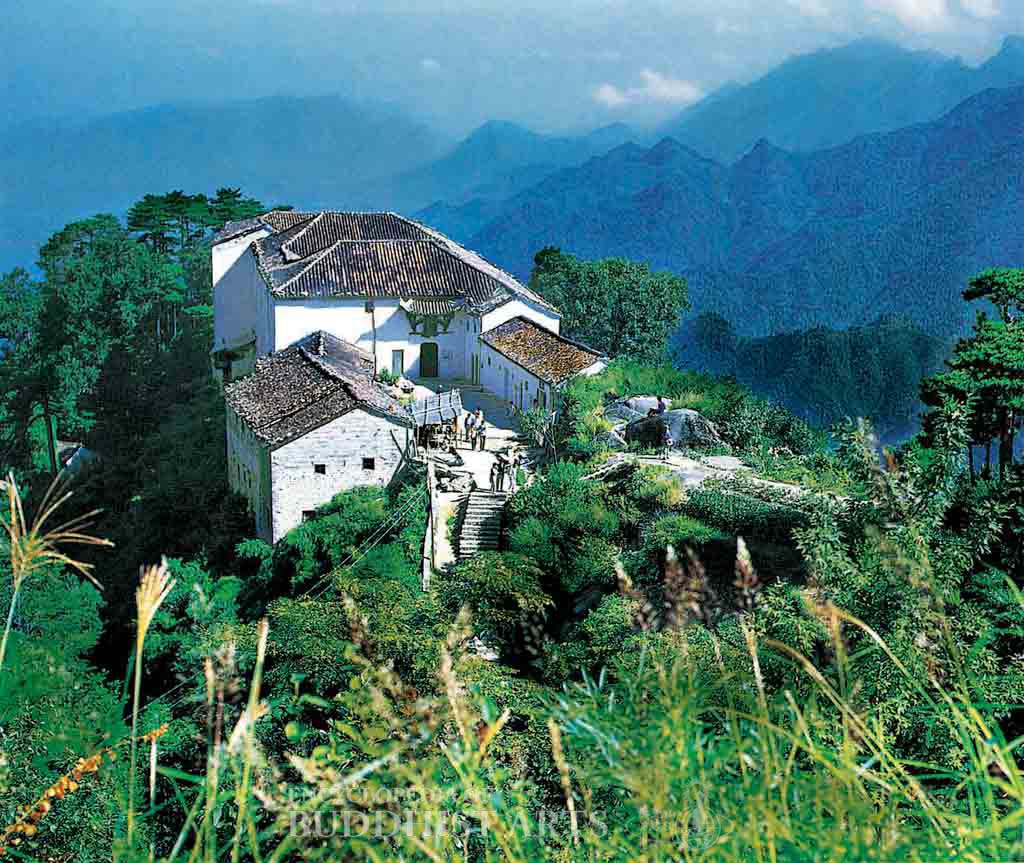
Jiuhuashan Baisuigong Temple (aerial view)
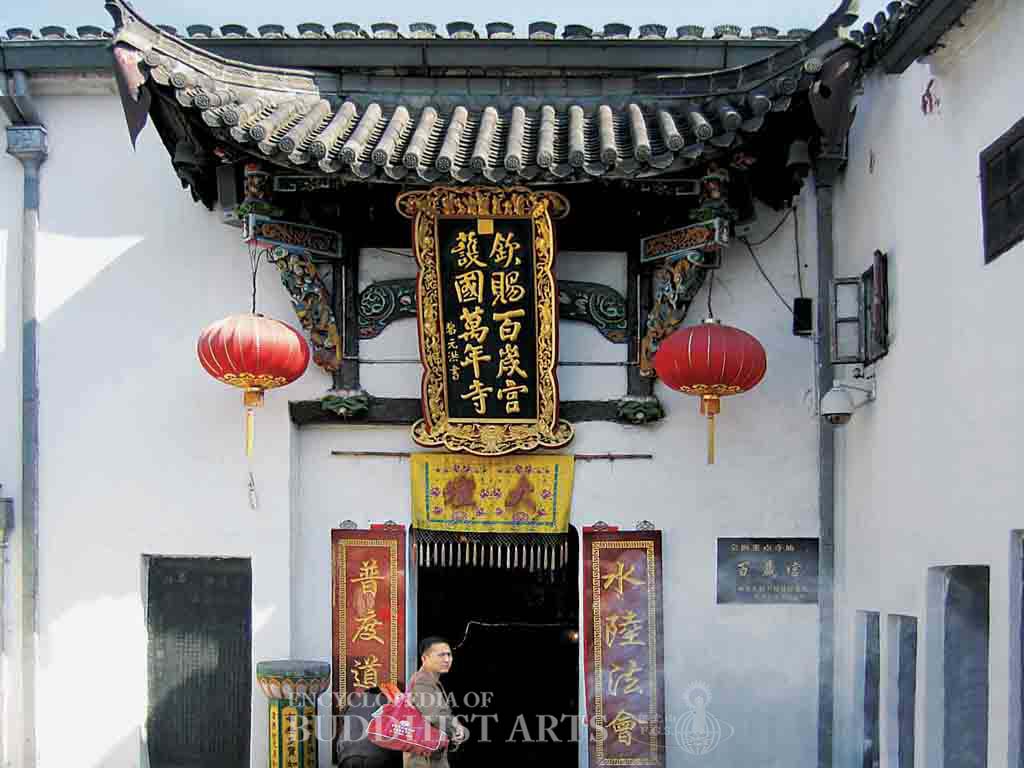
Jiuhuashan Baisuigong Temple: Great Hero Hall
Jiuhuashan Baisuigong Temple
CHINA, Anhui, Chizhou
The temple was originally a hermitage for Chan Master Wuxia, who lived for more than 100 years during the Ming dynasty (1368–1644). The local residents renamed the hermitage Baisuigong Temple, meaning Hundred Years Old Temple. In 1630 Master Wuxia was awarded the title of Manifested Bodhisattva by the imperial court. The temple was later expanded to enshrine the true body relic of Master Wuxia. The temple has been repaired and expanded a number of times. It was listed as a key Buddhist temple in the Han region of China in 1983.
The temple is located on the summit of Jiuhuashan. The buildings face north and the east wall is built along the cliff. The steep Jiuhua Gorge lies to its west. The foundation platform is more than 20 m wide and a little over 60 m long. Although it is narrow, it accommodates many buildings, including the Great Hero Hall, meditation hall, ordination hall, Dharma Hall, bell tower, monastic quarters, and a reception hall. Despite all these buildings compacted into such a tight space, there is still an open space in front of the Great Hero Hall, forming a courtyard with side buildings to the east and west. The east building is the bell tower, which houses a bronze bell for the underworld. The storage area and kitchen are in the west building.
The entrance to the Great Hero Hall is slightly skewed to the east. The hall is three bays wide and there are eaves above the doorway. Statues of Sakyamuni Buddha, Manjusri and Samantabhadra Bodhisattvas are enshrined in the center of the hall. The niche on one side of the hall houses an image of Bodhidharma, while the other contains Master Wuxia’s true body relic, which has been gilded. The doorway beneath the niche on the northeast side of the hall leads to the rear. The rooms at the rear are small and have been constructed around two tiny courtyards. The side rooms are built onto the cliff and are either three, four, or five stories high. Each room consists of an inner shrine.
The temple is unusual in that its component buildings were built to fit their restricted physical environment.
For more details, go to the Encyclopedia of Buddhist Arts: Architecture G-L, page 539.
Cite this article:
author = Hsingyun and Youheng and Johnson, Peter and Mankuang and Lancaster, Lewis,
booktitle = {Encyclopedia of Buddhist Arts: Architecture G-L},
pages = 539,
title = {{Jiuhuashan Baisuigong Temple}},
volume = 2,
year = {2016}}