
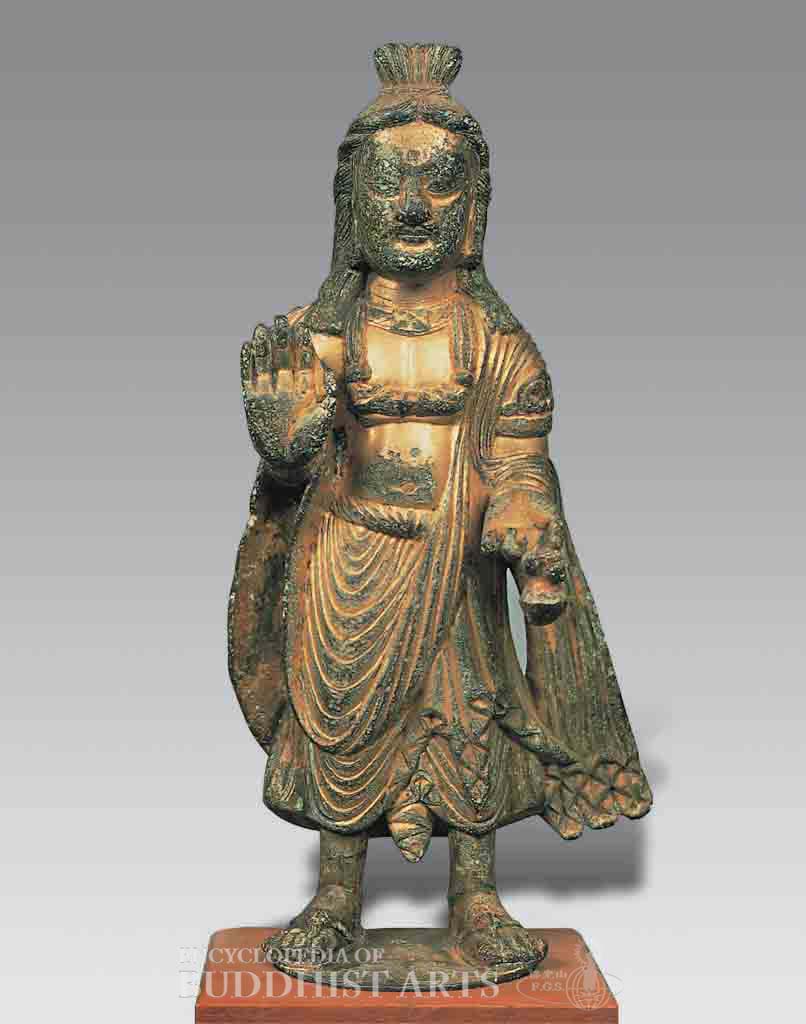
Standing Bodhisattva
Gilt bronze
Standing Bodhisattva
CHINA; Sixteen Kingdoms
The statue is believed to have been discovered in Xianyang, Shaanxi. The Gandharan influence suggests it was created near the start of the 4th century. This date would place it among the earliest Bodhisattva statues discovered in China.
The figure has long hair tied into a topknot and falling in braids to the shoulders. The disproportionately large right hand is raised in abhaya (fearlessness) mudra and webbing is apparent between the fingers. A vase is in the other hand, commonly the attribute of Maitreya in Gandharan statues of the period. The upper body is adorned with a few pieces of heavy jewelry as well as a stole that hangs from the left shoulder and falls over the forearm to descend in an intricate pattern of folds. A robe that leaves the chest bare is tucked at the waist and falls over the right arm. The raised folds of the robe and the skirt are treated in some detail. Further evidence of Gandharan influence is the Bodhisattva’s thong sandals.
For more details, go to the Encyclopedia of Buddhist Arts: Sculpture St-Z, page 1109.
Cite this article:
author = Hsingyun and Youheng and Lovelock, Yann and Chou, Yuan and Huntington, Susan and Edson, Gary and Neather, Robert,
booktitle = {Encyclopedia of Buddhist Arts: Sculpture St-Z},
pages = 1109,
title = {{Standing Bodhisattva}},
volume = 13,
year = {2016}}