
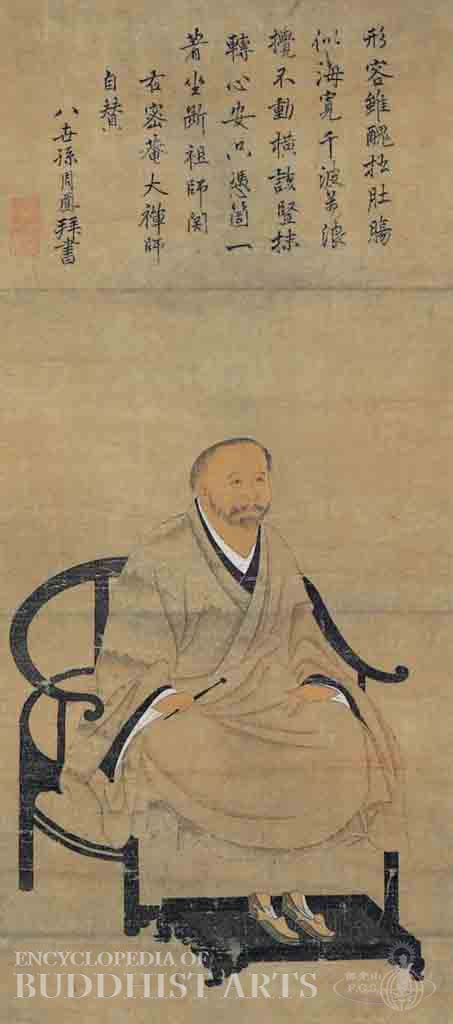
Mi’an Xianjie; Muromachi period
Ink and color on silk
Mi’an Xianjie
CHINA, Fujian, Fuzhou; Song dynasty
Also known as Mittan Kanketsu throughout Japan, Mi’an Xianjie was a Chan master of the Yangqi branch of the Linji school. Born in Fuqing, Fuzhou, he renounced at the age of 17 and traveled extensively to study under various masters, eventually receiving Dharma transmission from Chan Master Ying’an Tanhua. Master Mi’an propagated the teachings of the Linji school of Chan Buddhism while staying in temples such as Jiangshan Temple and Huazang Temple. Beginning in 1177, Emperor Xiaozong (reigned 1162–1189) of the Song dynasty requested him to be stationed at monasteries such as Jingshan Temple and Lingyin Temple, and eventually retired in Tiantong Temple before his passing at the age of 69. Master Mi’an had many disciples who went on to become eminent monks, including Po’an Zuxian, Songyuan Chongyue, and Caoyuan Daosheng.
Master Mi’an’s calligraphy reflects his virtues and reveals his noble spirit and integrity. A sense of tranquility is revealed in his brushstrokes, which also garner the spirit of Chan calligraphy. His only surviving work of calligraphy is Advice to Attendant Zhang, which is written in running script on silk in austere yet distinct characters. The content was written to provide guidance on the essentials of Chan practice. Listed as a National Treasure of Japan, it is kept at Ryokoin Temple in Kyoto. To exhibit the calligraphy, the temple opened the “Mittan Tea Room,” in which the viewing public can partake in the Japanese Tea Ceremony and appreciate the Chan nature of the piece.
For more details, go to the Encyclopedia of Buddhist Arts: People, page 192.
Cite this article:
author = Hsingyun and Youheng and Youlu and Pokorski, Stefanie and Yichao and Mankuang and Miaohsi,
booktitle = {Encyclopedia of Buddhist Arts: People },
pages = 192,
title = {{Mi’an Xianjie}},
volume = 19,
year = {2016}}