
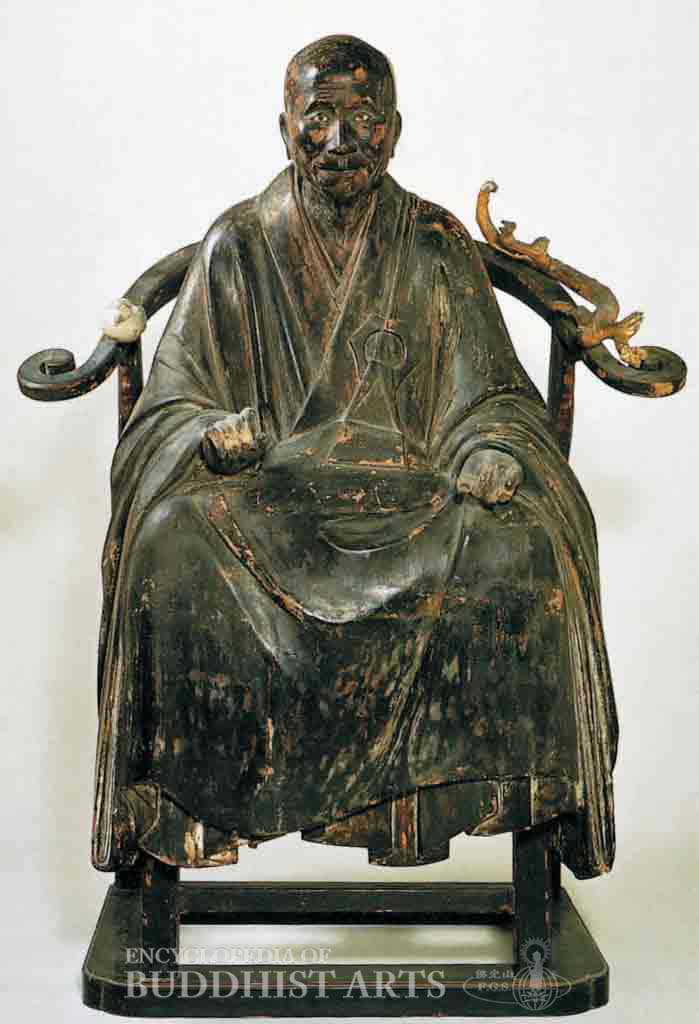
Master Wuxue Zuyuan; Kamakura period
Wood
Wuxue Zuyuan
CHINA, Zhejiang, Ningbo; Southern Song to Qing dynasty (1127–1911)
Wuxue Zuyuan, known also as Ziyuan and in Japan as Mugaku Sogen, was a master of the Linji school of Chan Buddhism from Qingyuanfu, Mingzhou (present day Ningbo, Zhejiang). He renounced under Beijian Jujian at Jingci Temple in Zhejiang at the age of 12. He later regarded Chan Master Wuzhun Shifan as his teacher, and succeeded his lineage. After Master Wuzhun’s passing, Wuxue sought other Chan masters such as Shiqi Xinyue, Xutang Zhiyu, Wuchu Daguan, and Huanxi Weiyi for teachings. He stayed at Zhenru Temple in Zhejiang in 1269, and later he went to Nengren Temple in Zhejiang to escape the invasion of Mongol troops of the Yuan dynasty.
In 1279, Master Wuxue was invited to Japan by Hojo Tokimune, the eighth regent of the Kamakura Shogunate. Once there, he became the abbot of Kenchoji Temple in Kamakura. In memory of the warriors killed by the Yuan army, Hojo Tokimune established Engakuji Temple in Kamakura in 1282 and subsequently invited Master Wuxue to serve as the first abbot.
He was bestowed the posthumous title of National Master Bukko (Buddha Radiance) after his passing in 1286 at the age of 61. Succeeding Chan Master Lanxi Daolong, known in Japan as Rankei Doryu, Master Wuxue propagated the Southern school of Chinese Chan Buddhism and laid a strong foundation for Japanese Zen practice. He was thus being regarded as the founding patriarch of the Bukko lineage of the Zen school. Among his many disciples, the most well-known were Mugai Nyodai, the first female Zen master, Koho Kennichi, and his Dharma descendant Muso Soseki. A wood statue of Master Wuxue was erected at Engakuji Temple in Kamakura and is listed as an Important Cultural Property of Japan. His used embroidered sitting mat and whisk are also kept at the temple.
Calligraphy by Master Wuxue is in the style of the Southern Song dynasty (1127–1279) and illuminates the spirit and discipline of Chan teachings. Buddhist Verses Presented to Ichio Ingo, a calligraphic piece given to the abbot of Chorakuji Temple, is now a National Treasure of Japan kept at Shokokuji Temple in Kyoto. One of his pieces which is listed as an Important Cultural Property of Japan is Dialog with Koho Kennichi, mounted on two pieces, one of each kept at Shokokuji Temple and Rokuonji Temple in Kyoto. Poem of the Double Ninth is at the Tokiwayama Bunko Foundation in Kamakura, Japan, and other works are kept at Engakuji Temple in Kamakura and the Gotoh Museum in Tokyo, Japan.
For more details, go to the Encyclopedia of Buddhist Arts: People, page 300.
Cite this article:
author = Hsingyun and Youheng and Youlu and Pokorski, Stefanie and Yichao and Mankuang and Miaohsi,
booktitle = {Encyclopedia of Buddhist Arts: People },
pages = 300,
title = {{Wuxue Zuyuan}},
volume = 19,
year = {2016}}