
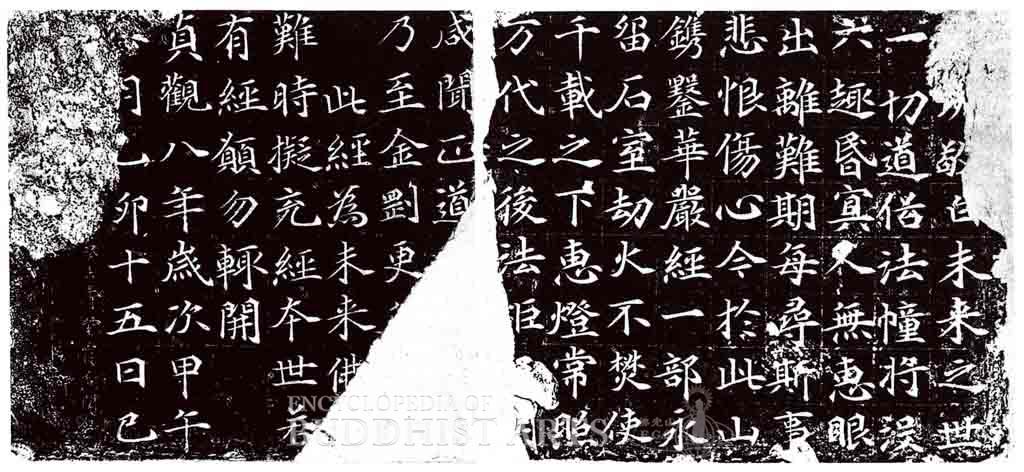
Stele on Preserving the Dharma by Jingwan; Tang dynasty, dated 634
Rubbing
Jingwan
CHINA; Sui to Tang dynasty
Jingwan, also known as Zhiyuan, was a monk and disciple of Master Nanyue Huisi, the second patriarch of the Tiantai school of Chinese Buddhism. He was known for his rock carvings of Buddhist sutras on Baidaishan in Beijing, as well as the construction of Yunju Temple in the same location.
As remarked in Mingbao Records, Jingwan made a vow to engrave Buddhist sutras onto stone so that in the event of a Buddhist persecution, they would be immortalized. Thus, the mountainous area surrounding Yunji Temple was excavated in order to create caves for the sutra engravings. After his passing in 639, Jingwan’s disciples carried forth his vow and continued inscribing stone sutras generation after generation. The location later became known as Fangshan Stone Cave. Yunju Temple and its stone sutras were listed as a National Cultural Heritage Site in 1961.
The stone sutras that are extant today include the Lotus Sutra, Mahaparinirvana Sutra, Vimalakirti Sutra, Avatamsaka Sutra, Diamond Sutra, Srimala Sutra, Sutra on the Buddha’s Bequeathed Teaching, Sutra of Innumerable Meanings, and Sutra on the Ascent of Maitreya. Particularly precious are Jingwan’s personal notations on the various stele inscriptions that remain; one such example is Stele on Preserving the Dharma. The characters of his notes are considered graceful in appearance and rigorous in form.
For more details, go to the Encyclopedia of Buddhist Arts: People, page 121.
Cite this article:
author = Hsingyun and Youheng and Youlu and Pokorski, Stefanie and Yichao and Mankuang and Miaohsi,
booktitle = {Encyclopedia of Buddhist Arts: People },
pages = 121,
title = {{Jingwan}},
volume = 19,
year = {2016}}