
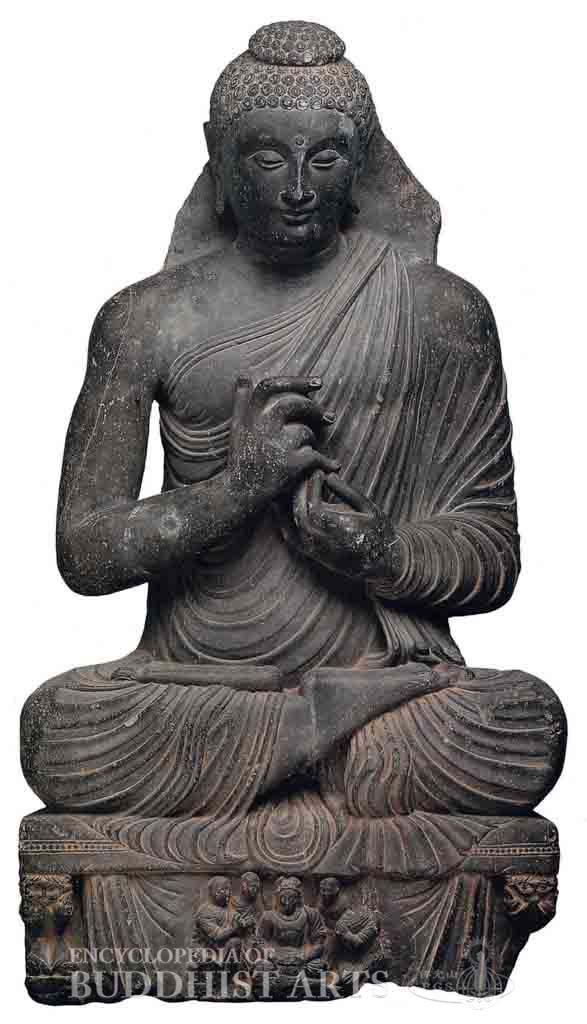
Buddha Teaching the Dharma
Gray schist
Buddha Teaching the Dharma
PAKISTAN
This statue was created in Gandhara during the 3rd century. The design of the hair and the folds in the clothing are similar to statues found in the ruins of Taxila and Sahri Bahlol.
The Buddha’s hair is tightly curled and the usnisa is flat. An inner and outer robe is worn, and the left shoulder is covered. The figure is seated in the full lotus position upon a retangular throne. The gesture that the Buddha forms has some similarities with the bodhyangi (wisdom fist) mudra. It differs from the Dharmacakra (Dharma wheel) mudra that is often seen in Gandharan statues created after the 4th century. The gesture despite the differences can still be regarded as a symbol of the Buddha teaching the Dharma. The panel below the throne has a carving of a meditating Bodhisattva surrounded by four bhiksus, who offer their respect with palms joined.
For more details, go to the Encyclopedia of Buddhist Arts: Sculpture A-F, page 206.
Cite this article:
author = Hsingyun and Youheng and Lovelock, Yann and Chou, Yuan and Huntington, Susan and Edson, Gary and Neather, Robert,
booktitle = {Encyclopedia of Buddhist Arts: Sculpture A-F},
pages = 206,
title = {{Buddha Teaching the Dharma}},
volume = 10,
year = {2016}}