
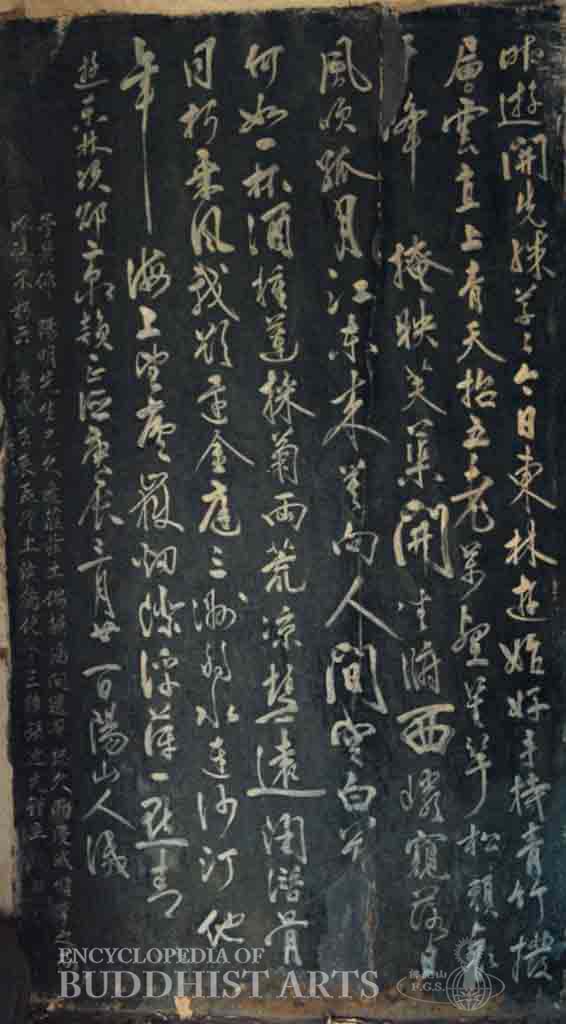
Stele of Travel Poetry by Wang Yangming; Ming dynasty
Stone
Wang Yangming
CHINA, Zhejiang, Ningbo; Ming dynasty
Wang Yangming had an original name of Wang Shouren and was also known as Bo An. He was a famous philosopher, humanities scholar, calligrapher, and military strategist during the Ming dynasty (1368–1644). Originally from Yuyao, Ningbo, in his later years he dwelled in a cave named Yangming at Kuaijishan. Aside from classical literature, Wang also studied military strategy. In 1481, he became an Imperial Scholar and worked in the border control section of the military department.
Despite his significant contributions as an official, he was demoted and sent to Longchang, Guizhou in 1506. Despondent but not defeated, he used this time for self-reflection. He explored and gained fresh insights into topics such as the relationship between mind and principle, and knowledge and its applications. His philosophical theories were recorded in three important books: Complete Book of Wang Yangming, Inquiry on the Great Learning, and Record of Practice. The three fascicles that comprise Record of Practice document his thoughts on self-cultivation and contain handwritten letters in running script. Wang’s works left a profound impression on Chinese academia and culture, as well as that of Japan, Korea and Southeast Asia. As a scholar in Confucian studies, Buddhism, and Daoism, he gave many lectures far and wide.
Wang’s mastery of calligraphy, particularly in running script, left a resounding influence in the field. His uninhibited and fluid scripts can be seen in Farewell Poems in Longchang, a collection of writings exchanged between himself and some friends when they bade him farewell at Longchang; this work is now kept at the Palace Museum in Beijing. Other works such as Stele of Travel Poetry, a series of poems chronicling his expeditions, is kept at Donglin Temple in Jiangxi; and a stele inscribed with “Caoxi Branch,” is at Jingju Temple in Jiangxi.
For more details, go to the Encyclopedia of Buddhist Arts: People, page 286.
Cite this article:
author = Hsingyun and Youheng and Youlu and Pokorski, Stefanie and Yichao and Mankuang and Miaohsi,
booktitle = {Encyclopedia of Buddhist Arts: People },
pages = 286,
title = {{Wang Yangming}},
volume = 19,
year = {2016}}