
Marici
Stone
Marici
INDIA
Artworks featuring Marici were common during the Pala period (circa 8th–12th century), when Vajrayana Buddhism flourished.
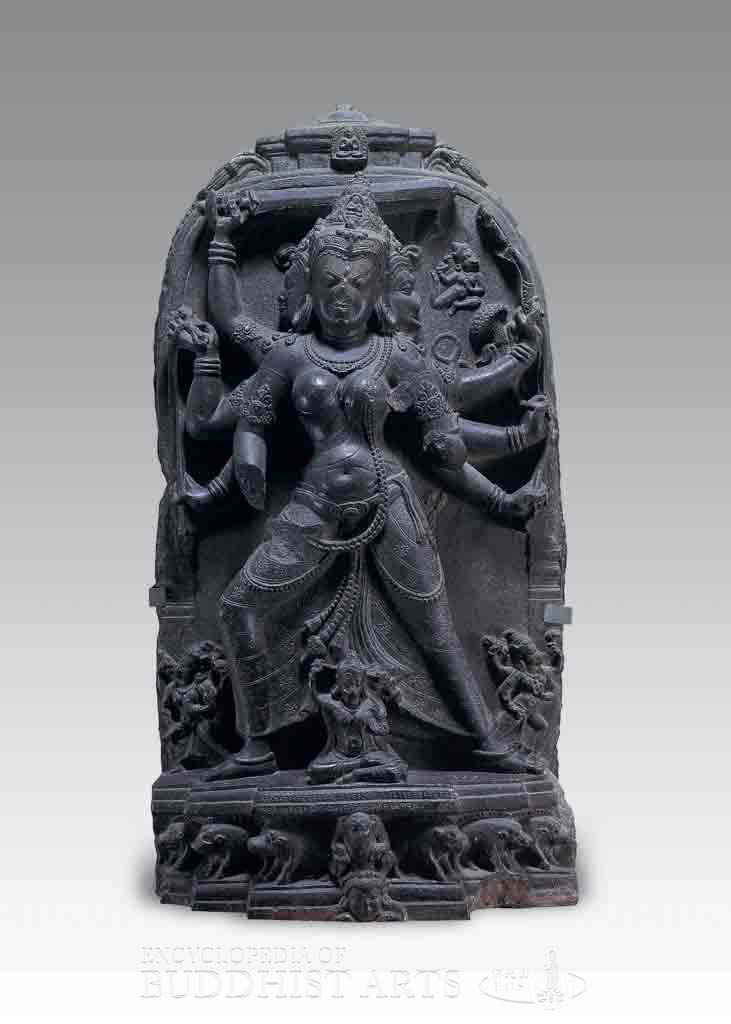
Marici is presented in this stele in a three-headed, eight-armed form. The head on the right is a sow’s while the other two are human. Above the central head is an elaborate crown fronted with the image of Vairocana, of whom the protector is a manifestation. A vertical third eye appears between the eyebrows. The figure wears a large assortment of jewelry and a beaded sacred thread. The belted skirt is decorated with floral designs and is gathered between the legs, allowing the folds to exhibit the curve of the thighs. The figure is in warrior stance with the left leg extended and the right leg bent. The front two arms are missing hands, while the rest hold, on the left, a sword, a vajra, and an arrow; on the right are a bow, an asoka flower, and a rope.
A monkey goddess sits between Marici’s legs, while two female figures with four arms stand on both ends of the pedestal. This is extended outward by increments and features seven pigs. Beneath the central pig, the head of another figure protrudes out at the bottom.
For more details, go to the Encyclopedia of Buddhist Arts: Sculpture G-M, page 689.
Cite this article:
author = Hsingyun and Youheng and Lovelock, Yann and Chou, Yuan and Huntington, Susan and Edson, Gary and Neather, Robert,
booktitle = {Encyclopedia of Buddhist Arts: Sculpture G-M},
pages = 689,
title = {{Marici}},
volume = 11,
year = {2016}}