
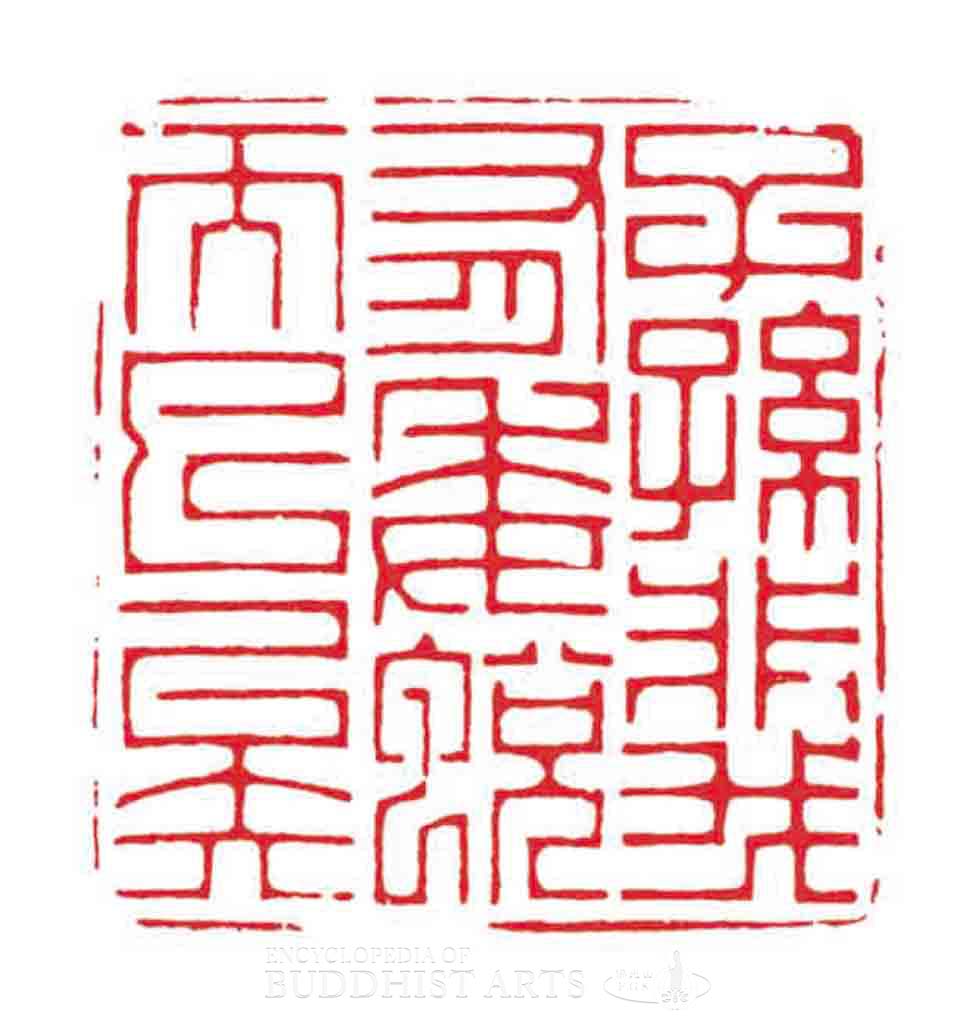
Seal by Wang Guan; Ming dynasty
Red-character square seal
Wang Guan
CHINA, Anhui, Huangshan; Ming dynasty
Originally named Dongyang, Wang Guan was inspired to change his name to reflect the two characters he saw on an ancient Han bronze seal he obtained in Suzhou. He was a seal engraver from Shexian county in Huangshan, Anhui, but later moved to Taichang, Jiangsu. Wang modeled his seals after those found in the Han (206 BCE–220 CE) dynasty, possessing both the form and the spirit of these pieces. He was adept in using solid and strong swift knife technique to create neat and orderly patterns. He was adept in running, regular, and clerical scripts and produced elegant and beautiful characters that appeared natural without being overly decorative. Alongside Lin Gao and Shen Shihe, Wang is reputed to be a part of the Loudong school. His seal style influenced other artists such as Lin Gao, Ba Weizhu, and Chen Julai. Two fascicles of Seal Styles of Baoyin Studio were compiled by him.
Three of Wang’s extant seals, including Virtuous Way and Zhang Bingfan, are currently kept at the Shanghai Museum. In addition, his works, Monk Yuanxin, a white-character square seal, and the red-character square seal Past Life as Maitreya, are extant today.
For more details, go to the Encyclopedia of Buddhist Arts: People, page 278.
Cite this article:
author = Hsingyun and Youheng and Youlu and Pokorski, Stefanie and Yichao and Mankuang and Miaohsi,
booktitle = {Encyclopedia of Buddhist Arts: People },
pages = 278,
title = {{Wang Guan}},
volume = 19,
year = {2016}}