
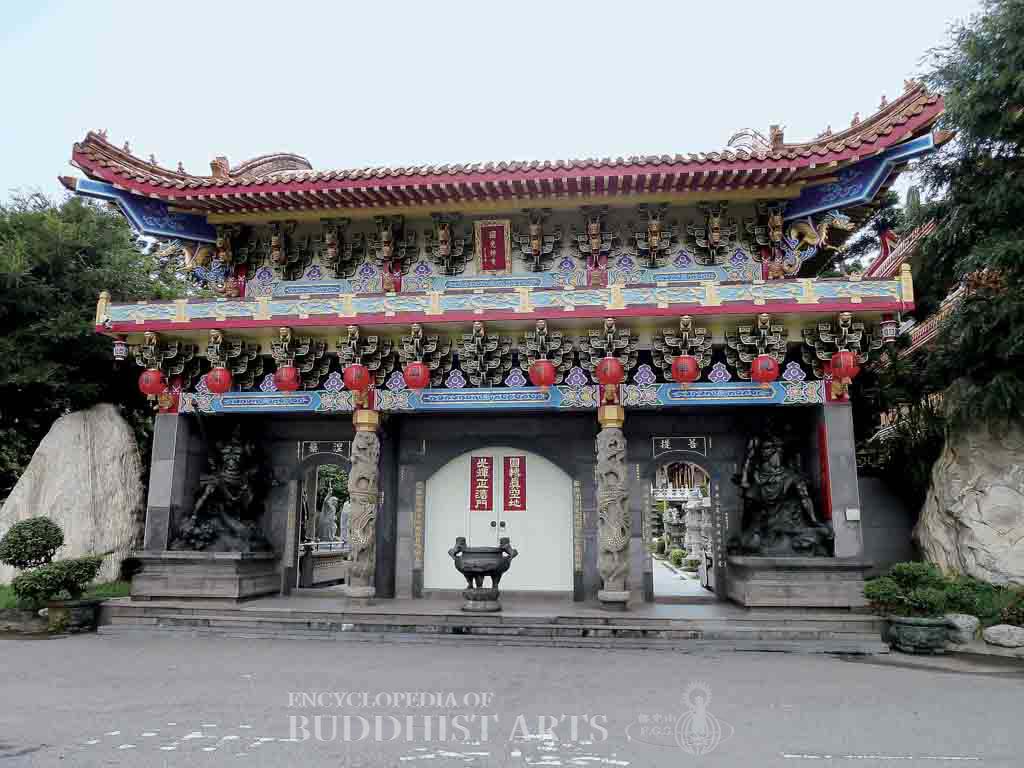
Yuan Kuang Chan Monastery: Main Temple Gate
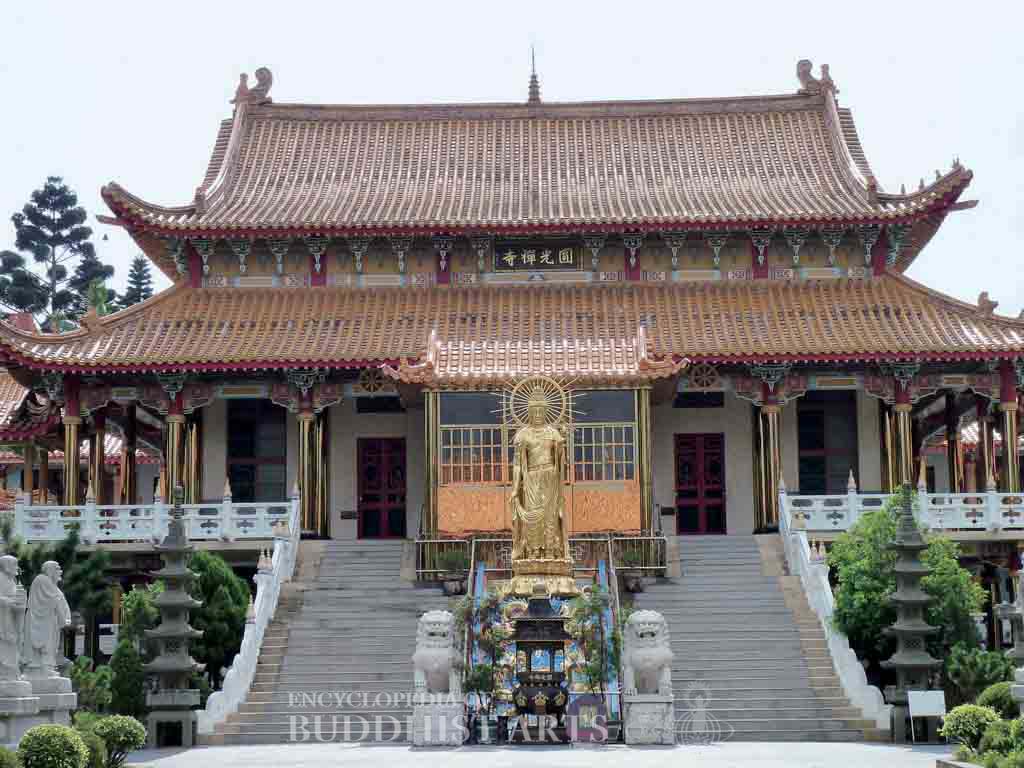
Yuan Kuang Chan Monastery: Great Hero Hall
Yuan Kuang Chan Monastery
TAIWAN, Taoyuan
This monastery was built by monk Miaoguo in 1917. In 1948 Miaoguo saw the importance of nurturing new monastics and established the Taiwan Buddhist College. However, the college lasted only six months as it was a time of instability and there was a shortage of funds. In 1975, after a long period of lack of maintenance, the monk Ruwu undertook the repair and expansion of the monastery, which spanned seven years. In 1981, classes resumed in the Taiwan Buddhist College and the school was subsequently renamed Yuan Kuang Buddhist College.
The present monastery consists of the main temple gate, Great Hero Hall, and memorial hall. The three-bay wide main temple gate has a roof whose eaves curve upwards at the corners. It has a portico with three arched doorways and a statue of Vajrapanibalin on each side. Behind the main door there is a statue of Maitreya Bodhisattva, while figures of the Four Heavenly Kings, Skanda and Sangharama Bodhisattvas are located at the sides. The Great Hero Hall has a double-eave hip-and-gable roof covered with yellow glazed tiles. It contains statues of Sakyamuni Buddha, Manjusri Bodhisattva, Samantabhadra Bodhisattva, Mahakasyapa, and Ananda. There is a mural of the Ten Ox Herding Pictures. In front of the Great Hero Hall, there is a statue of Avalokitesvara Bodhisattva standing on a lotus pedestal. Between the main temple gate and the Great Hero Hall there are sculptures of Arhats, stone lanterns, and pagodas. The Arhats appear in various poses and stand on Sumeru bases. They are portrayed with lifelike features holding staffs, miniature pagodas or ruyi (wish-fulfilling talisman).
For more details, go to the Encyclopedia of Buddhist Arts: Architecture T-Z, page 1367.
Cite this article:
author = Hsingyun and Youheng and Johnson, Peter and Mankuang and Lancaster, Lewis,
booktitle = {Encyclopedia of Buddhist Arts: Architecture T-Z},
pages = 1367,
title = {{Yuan Kuang Chan Monastery}},
volume = 4,
year = {2016}}