
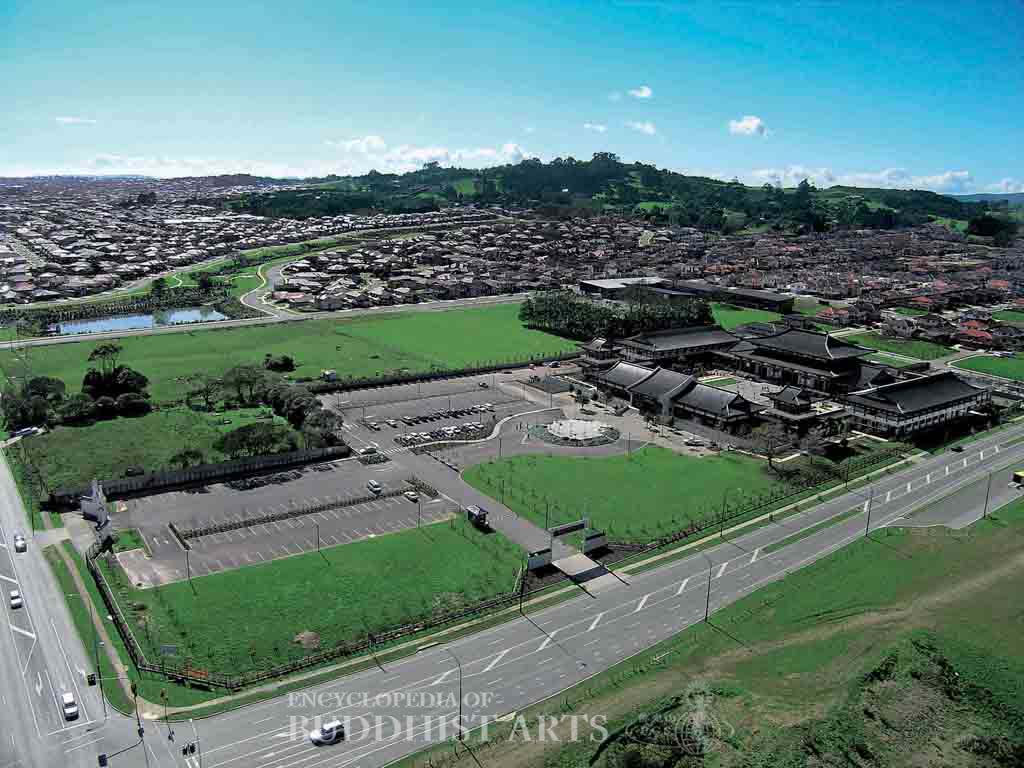
Fo Guang Shan North Island New Zealand (aerial view)
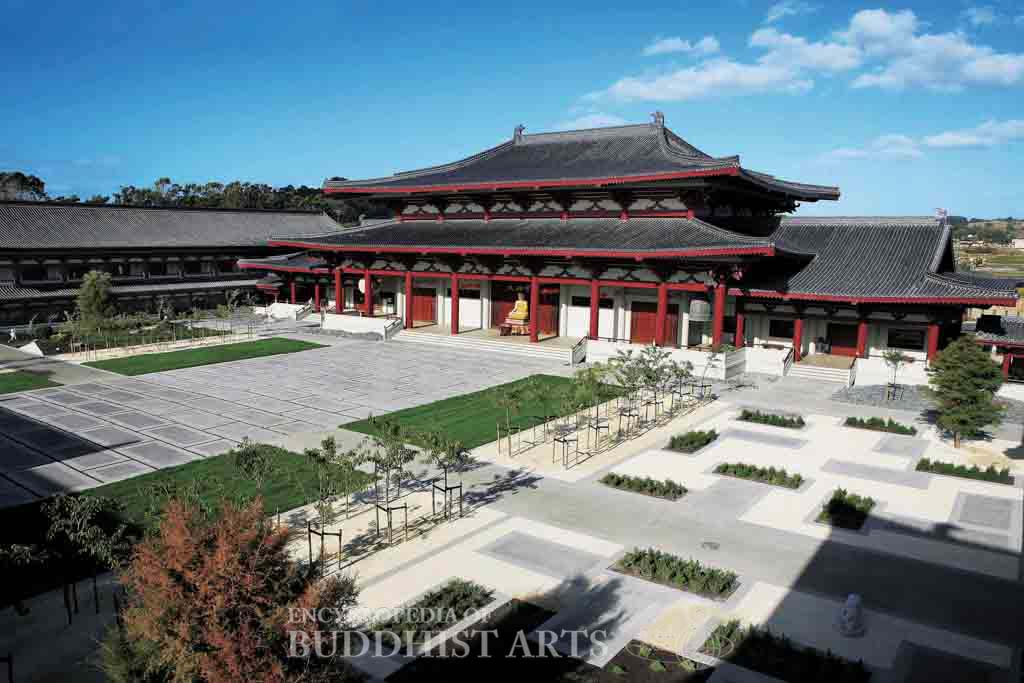
Fo Guang Shan North Island New Zealand: Great Hero Hall
Fo Guang Shan North Island New Zealand
NEW ZEALAND, North Island, Auckland
The temple is the largest Buddhist temple in New Zealand. Originally, 3,600 sq m of land was donated by Lai Yaosen to Fo Guang Shan as a base for the propagation of Buddhism. The first monastics from Fo Guang Shan arrived in 1991. With the increase in number of devotees and the start of a Chinese school, the premises became inadequate. Preparations for a new temple began in 1996. A site for the new temple was found and it was opened in 2007.
The temple occupies 3.6 ha and is built in Chinese Tang dynasty (618–907) style. It has Chinese architectural features such as grayish green glazed roof tiles and vermilion pillars. The complex consists of the main temple gate, Great Compassion Hall, Great Hero Hall, a pagoda, and the Fo Guang Yuan Art Gallery. The principal statue enshrined within the Great Compassion Hall is Avalokitesvara Bodhisattva, with Manjusri, Samantabhadra, and Ksitigarbha Bodhisattvas on the sides. The Great Hero Hall houses a Burmese jade Buddha statue, as well as a piece of pounamu (greenstone) donated by Maori elders. The greenstone is regarded as a treasured artifact by the Maoris.
As this is the first Chinese temple built in the Tang style in New Zealand, it has become a famous landmark in Auckland.
For more details, go to the Encyclopedia of Buddhist Arts: Architecture A-F, page 332.
Cite this article:
author = Hsingyun and Youheng and Johnson, Peter and Mankuang and Lancaster, Lewis,
booktitle = {Encyclopedia of Buddhist Arts: Architecture A-F},
pages = 332,
title = {{Fo Guang Shan North Island New Zealand}},
volume = 1,
year = {2016}}