
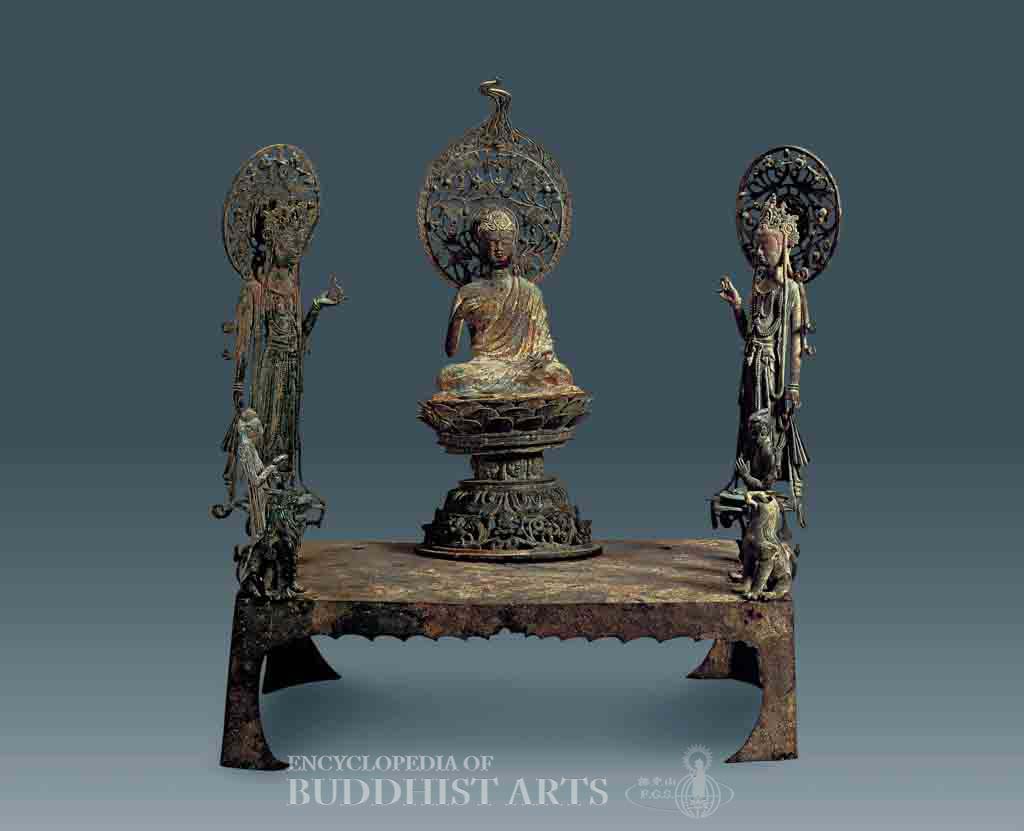
Amitabha Buddha Triad
Gilt bronze
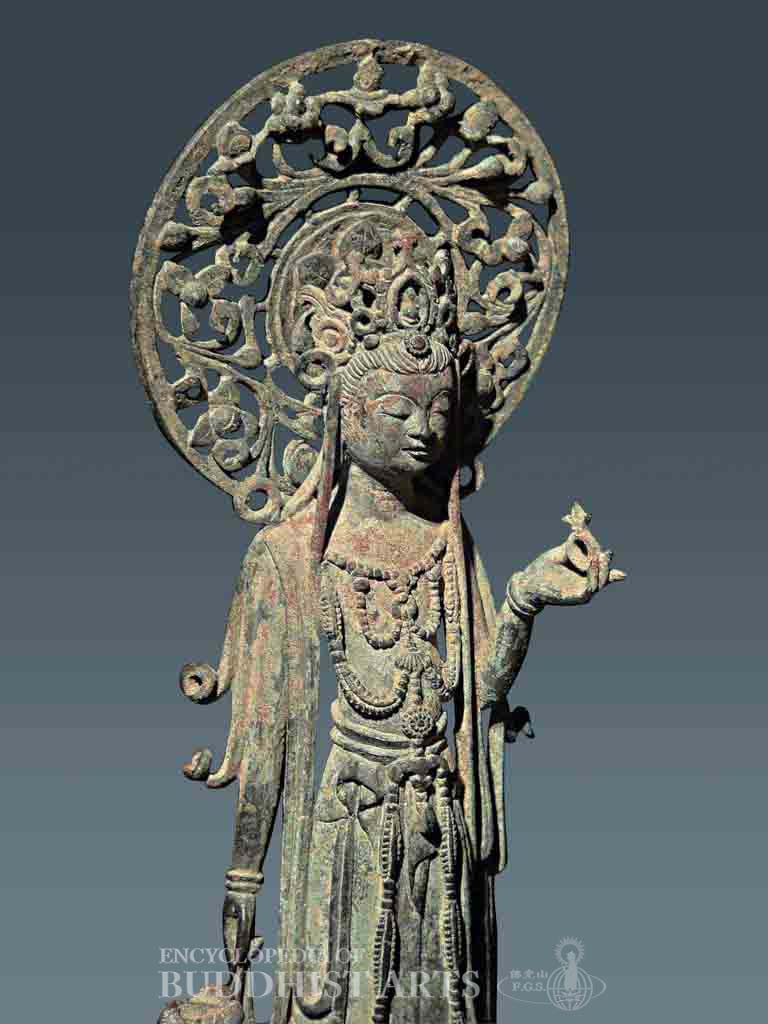
Amitabha Buddha Triad - Avalokitesvara Bodhisattva (detail)
Amitabha Buddha Triad
CHINA; Sui dynasty
The figures in this triad were cast using the lost-wax technique. They consist of a Buddha, two Bodhisattvas, two worshippers, and a pair of Dharma protecting lions, all placed on a four-legged stand. The composition centers on Amitabha, who wears a monastic robe, with right shoulder bare, that is very much in the style of the late Northern Dynasties (386–581). The top section of the Buddha’s lotus throne has numerous petals, human faces surround the middle section, and the bottom section is balanced on an openwork base. A ring of flames surrounds the openwork nimbus while seven Buddha images are within the foliated patterns of the inner section.
The two attendant Bodhisattvas face inwards. Avalokitesvara, the figure on the right, holds a jewel in the right hand and is identified by the presence of a Buddha on the headdress. The other figure is Mahasthamaprapta, who has a vase on the headdress and holds a flower in the left hand. Both Bodhisattvas are lavishly adorned with jewelry, ribbons, and stoles. They stand on lotus pedestals and have elaborate openwork nimbuses. A male and female worshipper accompanies the Bodhisattvas at a lower level. The worshippers have hands joined in reverence, and the female is holding an offering. Crouching lions close the semicircle. Judging from the mortise holes right next to the Buddha, there were initially two more figures. Experts believe they were disciples.
For more details, go to the Encyclopedia of Buddhist Arts: Sculpture A-F, page 36.
Cite this article:
author = Hsingyun and Youheng and Lovelock, Yann and Chou, Yuan and Huntington, Susan and Edson, Gary and Neather, Robert,
booktitle = {Encyclopedia of Buddhist Arts: Sculpture A-F},
pages = 36,
title = {{Amitabha Buddha Triad}},
volume = 10,
year = {2016}}