
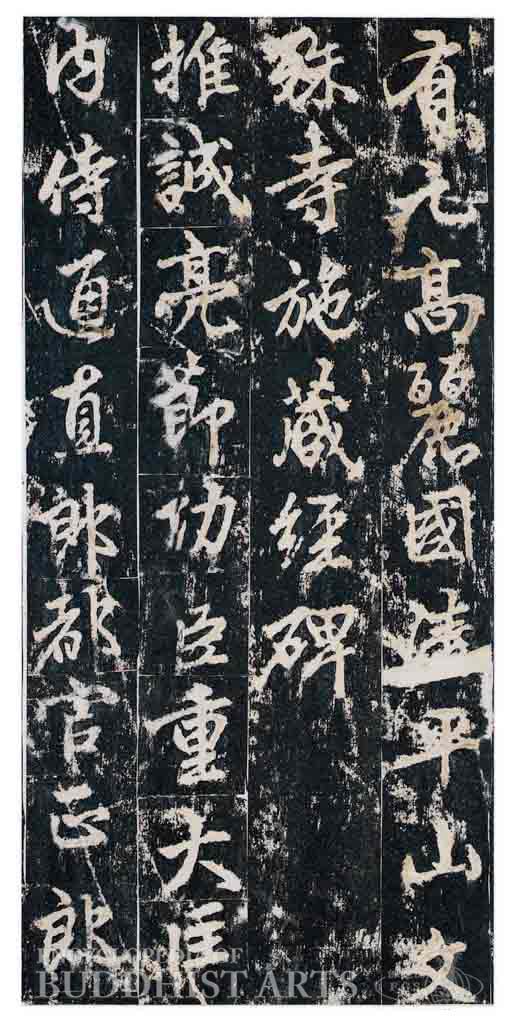
Stele of Buddhist Canon at Munsusa Temple by Lee Eon (detail); Goryeo dynasty, dated 1327
Rubbing
Lee Eon
SOUTH KOREA, South Gyeongsang, Goseong; Goryeo dynasty
Lee Eon, also known as Haengchon or Munjeong, was a politician and calligrapher from Goseong (present day South Gyeongsang Province). He was proficient in running and cursive scripts and was highly-regarded as the second Sage of Korean Calligraphy, after Kim Saeng.
Emperor Chungseon (reigned 1309–1313) of the Goryeo dynasty was renowned as an adept calligrapher who, after living for some time in Beijing, brought several Chinese paintings and calligraphic works back to Korea, including those by Zhao Mengfu. As a result, the influence of Zhao Mengfu could be seen in Korea until the Joseon dynasty (1392–1910). Many people copied his style, however, only Lee Eon was able to achieve Zhao’s quintessence.
Lee’s most well-known work is Stele of Buddhist Canon at Munsusa Temple, written in the distinctive Zhao Mengfu regular script style. Although the stele was lost, a rubbing of the original work still exists.
For more details, go to the Encyclopedia of Buddhist Arts: People, page 152.
Cite this article:
author = Hsingyun and Youheng and Youlu and Pokorski, Stefanie and Yichao and Mankuang and Miaohsi,
booktitle = {Encyclopedia of Buddhist Arts: People },
pages = 152,
title = {{Lee Eon}},
volume = 19,
year = {2016}}