
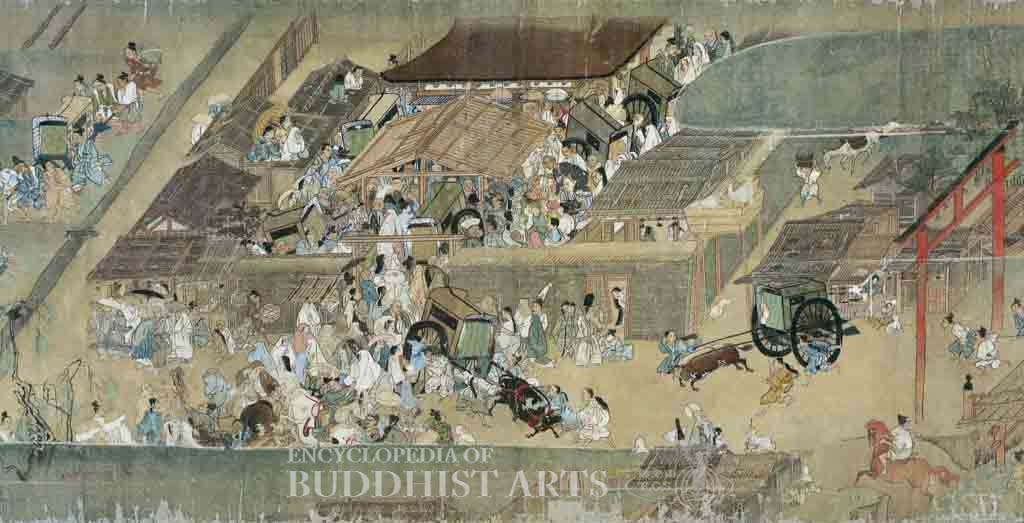
Biography of Master Ippen by En’i (detail); Kamakura period, dated 1299
Ink and color on paper
En’i
JAPAN; Kamakura period
En’i was a monk and painter who obtained the title Hogen (Dharma Eye), the second-highest rank awarded to Buddhist artist; thus he is often also known by the name, Hogen En’i. Proficient in the Japanese yamato style of painting, he was further influenced by the landscape paintings of the Chinese Song (960–1279) and Yuan (1271–1368) dynasties.
His only surviving work is Biography of Master Ippen, a National Treasure comprising 12 scrolls with 48 scenes in total. The majority of the Scroll 7 is now kept at the Tokyo National Museum, while the other scrolls were distributed between Kankikoji Temple in Kyoto and Shojokoji Temple in Kanagawa. The painting illustrates the life and major events of Master Ippen, the founding monk of the Jishu sect of the Pure Land school in Japan. To promote reciting Amitabha Buddha’s name as a path to enlightenment, Ippen traveled across Japan, advocating the simple act of generosity along the way. Depicted in the Scroll 7 of the Biography of Master Ippen is the historical account of Master Ippen’s journey from Omi (present day Shiga) to Rakusai (present day Kyoto). Utilizing the yamato style, En’i illustrated the temples and natural scenery of Japan in a delicate and lively manner.
For more details, go to the Encyclopedia of Buddhist Arts: People, page 62.
Cite this article:
author = Hsingyun and Youheng and Youlu and Pokorski, Stefanie and Yichao and Mankuang and Miaohsi,
booktitle = {Encyclopedia of Buddhist Arts: People },
pages = 62,
title = {{En’i}},
volume = 19,
year = {2016}}