
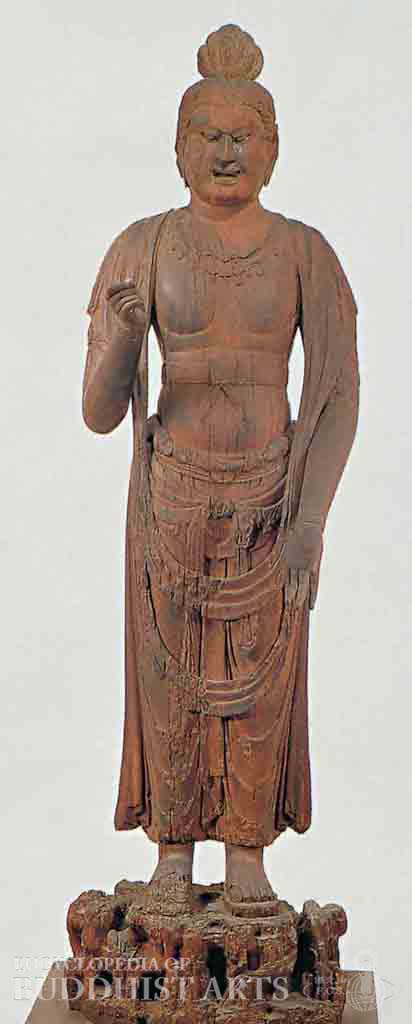
Daianji Temple: Avalokitesvara Holding a Willow Branch
Nutmeg wood
Daianji Temple: Avalokitesvara Holding a Willow Branch
JAPAN, Nara; Nara period
The sculpture was assembled from different pieces of wood, and dates from the end of the Nara period (710–794). The finer details were modeled in dry lacquer and painted. The sculpture was listed as an Important Cultural Property in 1902.
The Bodhisattva’s hair is arranged around an upright frame, adding intensity to the upward tilt of the eyes and mouth. The angry expression comes from Vajrayana Buddhism and is rarely seen in sculptures of Avalokitesvara. A stole that descends from the shoulders to loop twice across the skirt covers the figure’s broad torso. The Bodhisattva stands in wooden sandals on a rocky base. The left hand opens in varada (wish-granting) mudra and the right arm is raised as if holding something that is missing.
For more details, go to the Encyclopedia of Buddhist Arts: Sculpture A-F, page 276.
Cite this article:
author = Hsingyun and Youheng and Lovelock, Yann and Chou, Yuan and Huntington, Susan and Edson, Gary and Neather, Robert,
booktitle = {Encyclopedia of Buddhist Arts: Sculpture A-F},
pages = 276,
title = {{Daianji Temple: Avalokitesvara Holding a Willow Branch}},
volume = 10,
year = {2016}}