
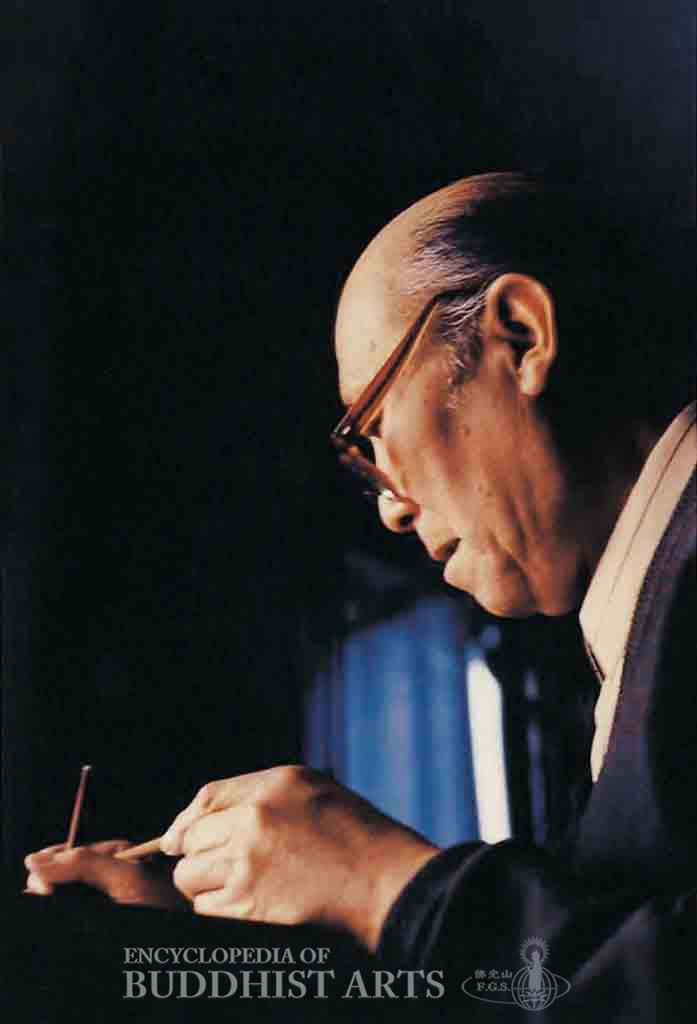
Wang Dingli
Wang Dingli
CHINA, Beijing
Wang Dingli began creating folk art paintings after learning from his father Wang Ziming at the age of 12. Later, he became a student of Xie Yongxi. He traveled frequently and extensively with his father to places such as Tibet and Qinghai, and engaged in the painting of murals at temples along the way.
In 1953, he became the chief artist of Yonghe Temple in Beijing and oversaw the painting on the wall of the Dharma Wheel Hall. The massive painting portrays as many as 34 Jataka tales, including the Buddha’s past lives as a king, a prince, a sage, a heavenly being, and more. Wang later participated in the reproduction of wall murals in Yongle Temple in Shanxi in 1957. At the invitation of the Xinjiang Autonomous Region Government in 1964, he assisted in the copying of mural paintings from the various well-known grottoes in the area.
As an associate professor at the China Central Academy of Fine Arts, Wang led many students on tours to conduct studies and copy wall murals all over China, such as the mural paintings in the Eastern Han’s Tomb in Henan and Beihuang Temple in Hebei. He also utilized his expertise in the chemistry of color pigmentation and established a color manufacturing facility division within the China Central Academy of Fine Arts. The realistic, lively, and three-dimensional aspects of his portraiture work are largely attributed to his strong foundation in the traditional gongbi style of figure painting, in addition to his keen observations of the lives of folk people.
Wang’s works include Emperor Tang’s Visit to Yong’s Mansion and Bodhidharma’s Journey to China. Furthermore, he adapted the well-known classic, Dream of the Red Chamber, into numerous pieces. In 1993, he completed a collection of 56 paintings detailing the Biography of Master Xuanzang. Wang also wrote several books on art and painting, such as Application and Creation of Traditional Chinese Paint Pigments, and A Selection of Mural Paintings from the Han and Tang Dynasties.
For more details, go to the Encyclopedia of Buddhist Arts: People, page 276.
Cite this article:
author = Hsingyun and Youheng and Youlu and Pokorski, Stefanie and Yichao and Mankuang and Miaohsi,
booktitle = {Encyclopedia of Buddhist Arts: People },
pages = 276,
title = {{Wang Dingli}},
volume = 19,
year = {2016}}