
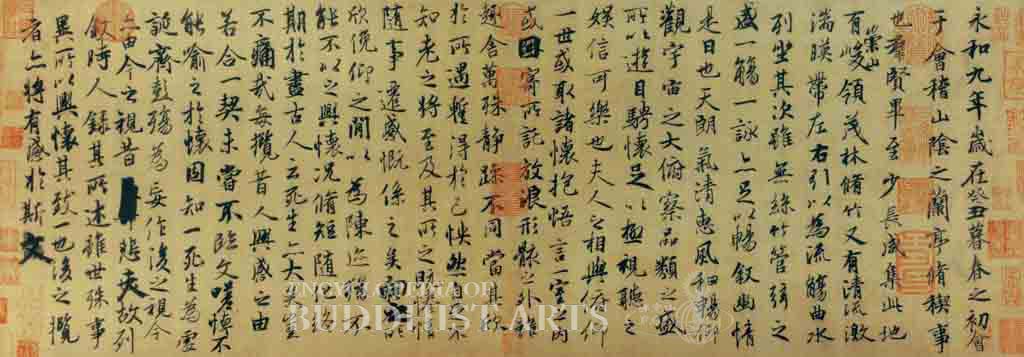
Copy of Wang Xizhi’s Preface to the Poems Composed at the Orchid Pavilion by Feng Chengsu; Tang dynasty
Ink on paper

Copy of Wang Xizhi’s Preface to the Poems Composed at the Orchid Pavilion by Feng Chengsu (detail); Tang dynasty
Ink on paper
Wang Xizhi
CHINA, Shandong, Linyi; Eastern Jin dynasty
Renowned as the Sage of Calligraphy, Wang Xizhi, also known as Yishao or Danzhai, was a famous calligrapher and painter who was originally from Langya (present day Linyi, Shandong), and later resided in Kuaijishan (present day Shaoxing, Zhejiang). He worked as a military general and imperial official in Kuiji, and was hence also known as General Wang or Wang Kuaiji.
Early in his career, Wang learned the art of calligraphy from Lady Wei Shuo. Later, after seeing the works of artists before his time, he combined the strengths of various calligraphic styles to create his own. His cursive script followed that of Zhang Zhi, while his regular script is reminiscent of Zhong Xi’s works. Wang also studied the styles of Cai Yong, Liang Hao, Zhang Xu, and others. His calligraphy combines the essence of various scripts that range from clerical, seal, and running scripts to cursive, flying, and white scripts. Alongside Zhong Xi, the two were known as the Zhong-Wang, and together with his son, Wang Xianzhi, who was also a distinguished calligrapher, Wang Xizhi is one of the famous Two Wangs.
Wang’s most famous work, Preface to the Poems Composed at the Orchid Pavilion, is known to be a foremost masterpiece of calligraphy. The original work no longer exists, but it has been preserved in a number of finely traced copies and rubbings. Another well-known masterpiece, Clear Day After Brief Snow, is now kept at the National Palace Museum in Taipei, Taiwan. A Tang dynasty (618–907) copy of three of his pieces, Note of Chaos, Double Note of Gratitude, and Note of Acknowledgement, all strung together in a single scroll, is kept at the Museum of the Imperial Collections in Tokyo, Japan.
Emperor Taizong (reigned 626–649) of the Tang dynasty composed the appraisal note, Preface to Sagely Teachings, for which he also ordered monk Huairen to compile the calligraphic writings by Wang Xizhi into two steles named Preface to Sagely Teachings in Wang Xizhi’s Calligraphy. In 721, monk Daya collected rubbings of these steles with Wang’s calligraphy and compiled the text for the Stele of Xingfu Temple in Shaanxi. In addition, the Diamond Sutra in Wang Xizhi’s Calligraphy was compiled and later inscribed into a stele.
Also known for his painting skills, Wang painted various animals, self-portraits, and figures on hand-held fans. He was noted in Famous Paintings in History as having produced paintings of remarkable quality.
For more details, go to the Encyclopedia of Buddhist Arts: People, page 285.
Cite this article:
author = Hsingyun and Youheng and Youlu and Pokorski, Stefanie and Yichao and Mankuang and Miaohsi,
booktitle = {Encyclopedia of Buddhist Arts: People },
pages = 285,
title = {{Wang Xizhi}},
volume = 19,
year = {2016}}