
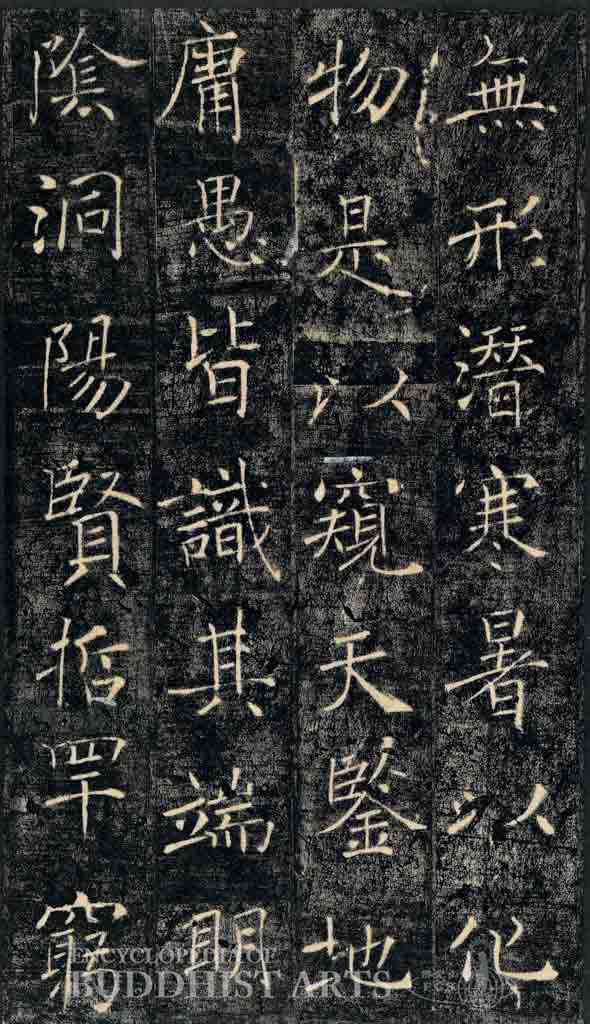
Daci’en Temple Pagoda (detail): Preface to Sagely Teachings
Rubbing
Daci’en Temple Pagoda: Preface to Sagely Teachings
CHINA, Shaanxi, Xi’an; Tang dynasty
This 191 cm high by 106 cm wide stele is inscribed with text composed by Emperor Taizong (reigned 626–649) of the Tang dynasty. It was scripted in the calligraphy of Chu Suiliang and engraved by Wan Wenshao. The stele is kept under the Daci’en Temple Pagoda, and a rubbing of the stele is currently kept at the Tokyo National Museum of Japan. The text commends the great feat of Master Xuanzang, a monk who spent 17 years in India seeking teachings and obtaining Buddhist scriptures to bring back to China. When Xuanzang returned to Xi’an, he started translating the Buddhist sutras into Chinese. Both the stele and its inscription are well-preserved. A total of 21 lines, each with 42 characters, make up the entire text.
The strong and elegant strokes are fluidly executed in both their rounded and rectilinear aspects. The blend of clerical and regular scripts results in a refined, antiquated style. Lines are thin yet vigorous, and curves and returns are expressively articulated, while the character form is structured within a secure composition. This late work of Chu Suiliang is regarded as one of the most well-known pieces of regular script stele inscription calligraphy from the Tang dynasty (618–907).
Chu Suiliang, also known as Dengshan, was one of the Four Great Calligraphers of the Early Tang period (618–712). He distinguished himself with a style built upon the qualities of Yu Shinan, Ouyang Xun, Wang Xizhi, and several other famous calligraphers. His contributions carried a profound influence on later generations.
For more details, go to the Encyclopedia of Buddhist Arts: Calligraphy, page 37.
Cite this article:
author = Hsingyun and Youheng and Youlu and Pokorski, Stefanie and Mankuang and Edson, Gary,
booktitle = {Encyclopedia of Buddhist Arts: Calligraphy },
pages = 37,
title = {{Daci’en Temple Pagoda: Preface to Sagely Teachings}},
volume = 17,
year = {2016}}