
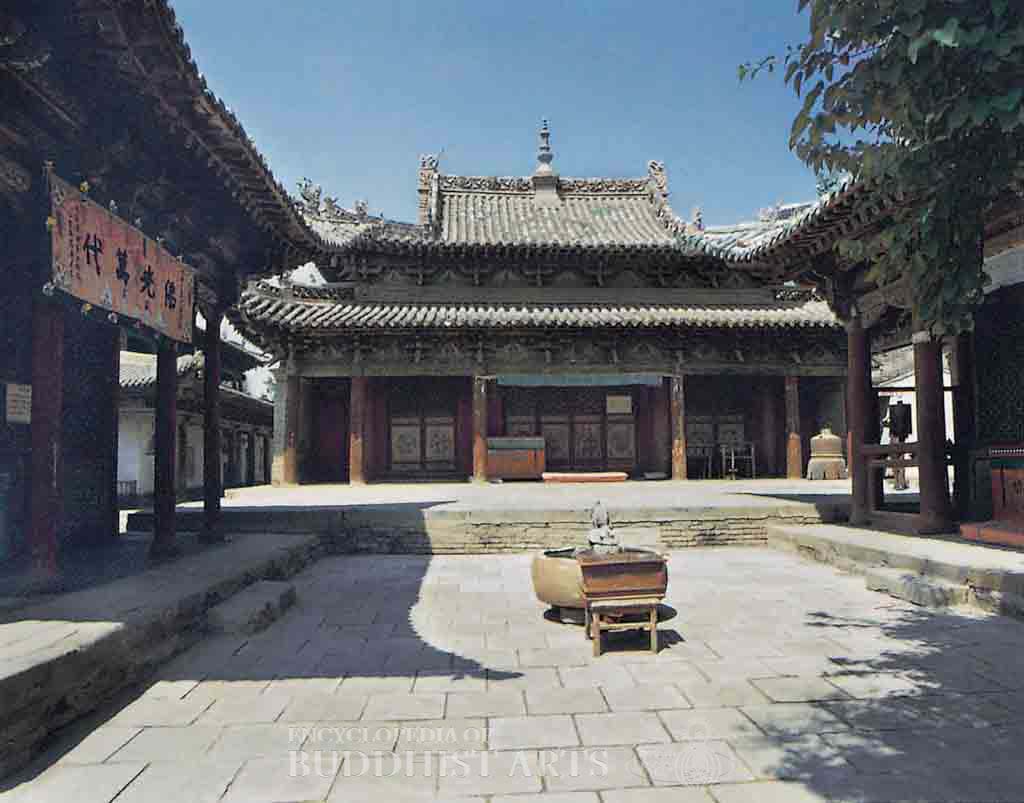
Miaoyin Temple: Hall of Ten Thousand Years

Miaoyin Temple: De’er Assembly Hall - Relief
Miaoyin Temple
CHINA, Gansu, Lanzhou
Miaoyin means Wondrous Cause. The temple lies 50 km west of Yongdeng and stands to the west of the old Lu Chieftain’s Yamen (administrative office and residence) in Liancheng. It served as a private temple of the Lu Chieftain and was affiliated to Qutan Temple in Qinghai. The temple was built in the early years of the rule of Emperor Xuande (reigned 1426–1435) during the Ming dynasty. During the rule of Emperor Xianfeng (reigned 1851–1861) of the Qing dynasty, the 17th Lu Chieftain rebuilt and expanded the temple, which gave rise to its present layout. As part of the Lu Tusi Yamen, the temple was listed as a National Cultural Heritage Site in 1996.
The temple is extensive and along the central axis are the main temple gate, Eagle King Hall, Heavenly King Hall, Hall of Ten Thousand Years, and De’er Assembly Hall. There is also the central hall, Kumbum Hall, Chan Monastic Hall, and several stupas. The five-by-five bay Hall of Ten Thousand Years was built in 1427. It has a double-eave hip-and-gable roof and is surrounded by galleries. The walls of the galleries are painted with murals depicting the Life of the Buddha. The figures in the murals are realistic and provide a clear and well-preserved glimpse of life in the early Ming dynasty.
The three-by-three bay De’er Assembly Hall has a hip-and-gable roof covered with green glazed tiles. The hall houses statues of the Three Buddhas, the Eight Great Bodhisattvas, and two Dharma protectors. The side walls are filled with suspended sculptures of 36 Dharma protectors. The seven-by-six bay central hall is the largest building in the temple. It has a double-eave hip-and-gable roof covered with green glazed tiles. There are verandas on all four sides and a large interior space with 30 columns. The ceiling is painted with mandalas in bright colors, with the main color being mineral green. The hall contains many statues and murals.
For more details, go to the Encyclopedia of Buddhist Arts: Architecture M-S, page 733.
Cite this article:
author = Hsingyun and Youheng and Johnson, Peter and Mankuang and Lancaster, Lewis,
booktitle = {Encyclopedia of Buddhist Arts: Architecture M-S},
pages = 733,
title = {{Miaoyin Temple}},
volume = 3,
year = {2016}}