

Chaofeng Temple
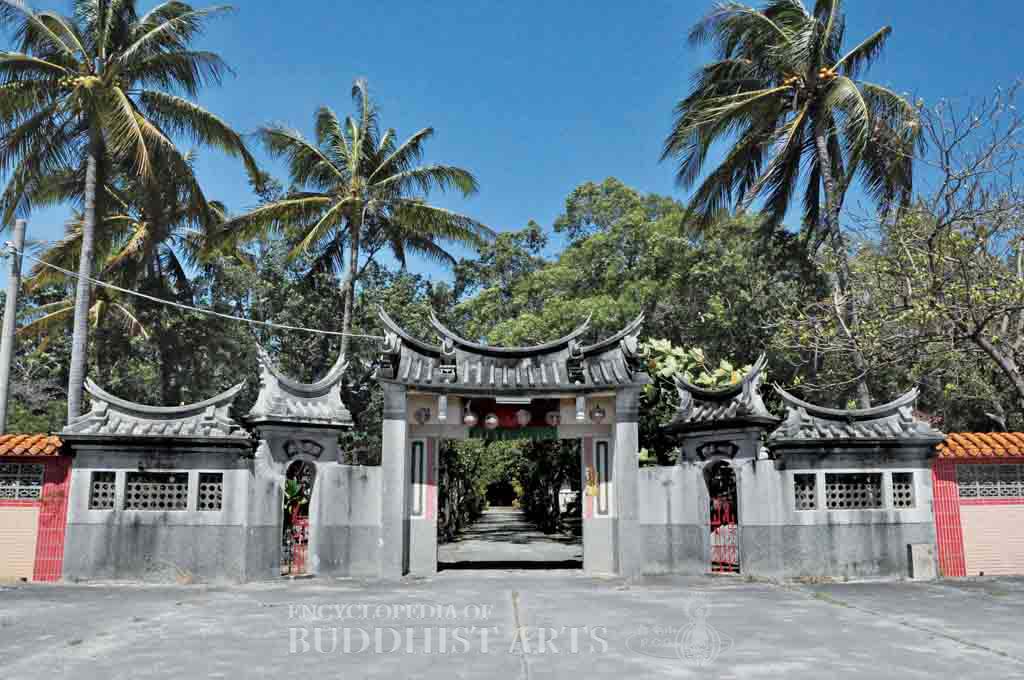
New Chaofeng Temple: Main Temple Gate
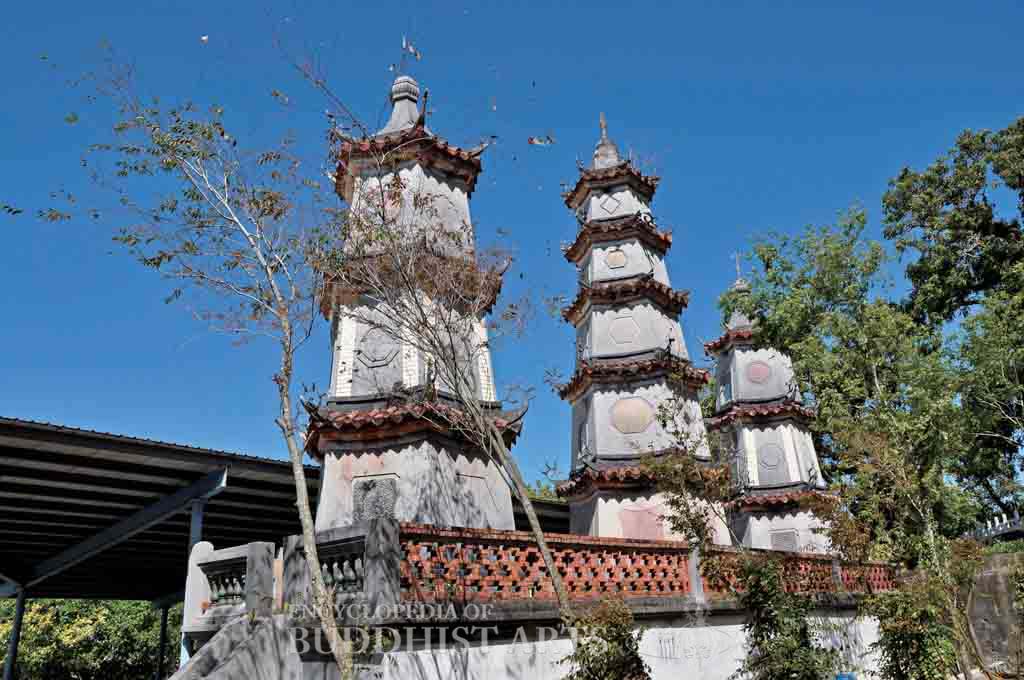
Chaofeng Temple: Three Pagodas
Chaofeng Temple
TAIWAN, Kaohsiung
The temple is situated on Dagangshan (Great Mound Mountain) in Kaohsiung. It is said that in 1731, monk Shaoguang built a hermitage on Dagangshan. In 1763, magistrate Jiang Yunxun built an Avalokitesvara Hall housing a statue of Avalokitesvara of the South Sea. It slowly gained popularity and became a well-known temple. In 1942 the Japanese army considered that it was too prominent and was susceptible to aerial attack. The temple was relocated to the foothills and named New Chaofeng Temple. Monk Kaizhao led a team of monastics to rebuild the original temple in 1948 and since then there have been two Chaofeng Temples.
Chaofeng Temple was built according to the mountainous terrain. It consists of the main temple gate, Avalokitesvara Hall, Amitabha Buddha Triad Hall, and three pagodas. The roof of the Avalokitesvara Hall has upward-curving eaves with colorful decorations on the ridge, including the four Heavenly Kings, monks, dragons, and phoenixes. The hall houses a statue of Avalokitesvara Bodhisattva flanked by Sudhana and Nagakanya.
The Amitabha Buddha Triad Hall was built in 1977 and has a double-eave hip-and-gable roof. Its wooden doors and windows are finely carved. The hall contains Amitabha Buddha, together with Avalokitesvara and Mahasthamaprapta Bodhisattvas. The walls are adorned with reliefs of the Life of the Buddha and other scenes. The three elaborately decorated, hexagonal pagodas were built in 1924 and consist of the Bao’en Pagoda, the Putong Pagoda, and the Lotus Pagoda, which stand on a common base. Two of the pagodas are three stories high, while the Putong Pagoda is five stories high. The pagodas are the earliest remaining structures of Chaofeng Temple.
The New Chaofeng Temple consists of the main temple gate, the front hall, and the rear hall. The three-bay wide main temple gate has a rectangular doorway in the central bay, flanked by two arched doorways. There are square open-work windows on the compound walls extending from the arched doorways. The gate has a three-section roof with a bow-shaped main ridge and uplifted swallowtail ends. There are imitation wood pendills below the eaves.
For more details, go to the Encyclopedia of Buddhist Arts: Architecture A-F, page 124.
Cite this article:
author = Hsingyun and Youheng and Johnson, Peter and Mankuang and Lancaster, Lewis,
booktitle = {Encyclopedia of Buddhist Arts: Architecture A-F},
pages = 124,
title = {{Chaofeng Temple}},
volume = 1,
year = {2016}}