
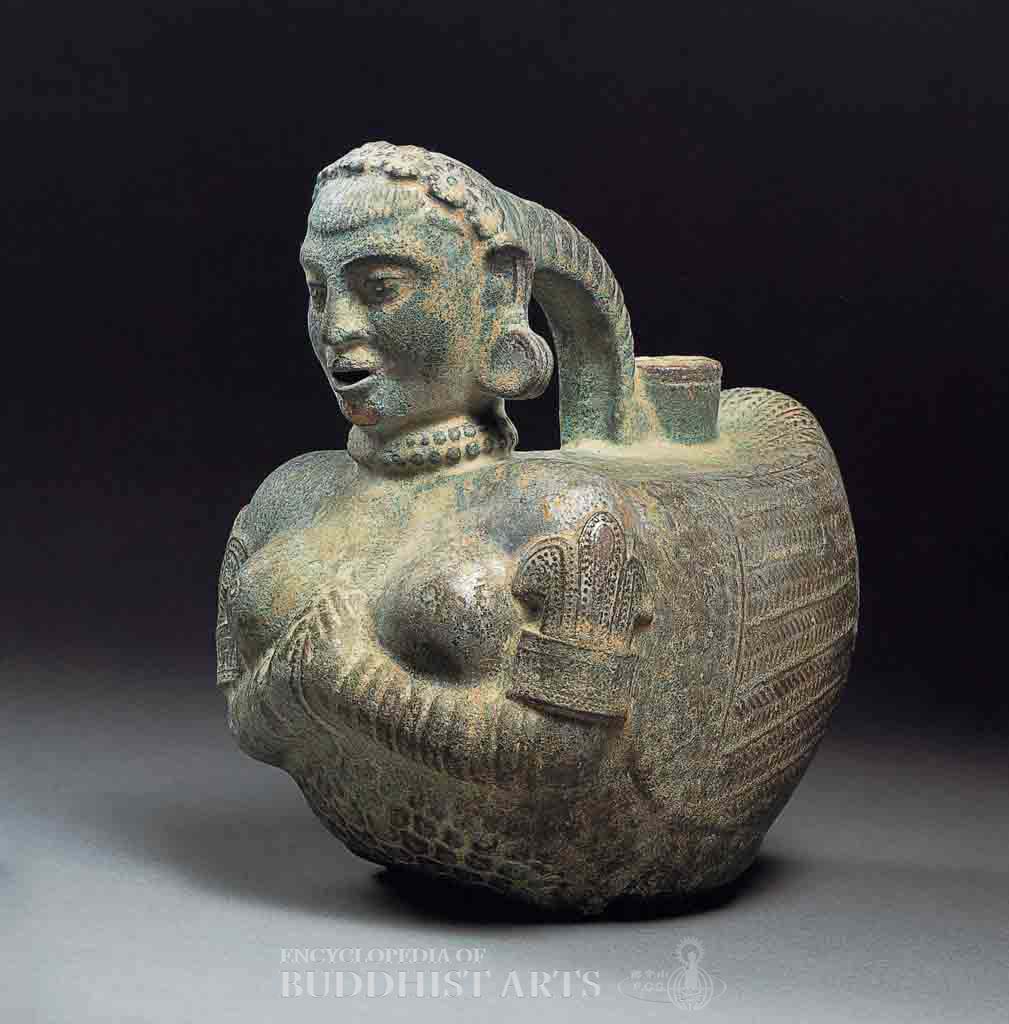
Begram Room 13: Vessel in the Shape of a Kinnari
Ceramic
Begram Room 13: Vessel in the Shape of a Kinnari
AFGHANISTAN, Parwan, Begram
It is thought that this ceramic vessel was made in India and exported to Begram in Afghanistan during the 1st century. It was discovered during the excavation of the archaeological site at Begram, 80 km north of Kabul.
The vessel has a blue-green coloring and is in the shape of a kinnari, with a woman’s face and a bird’s body. The face has large eyes, a high nose, and a mouth that serves as the spout of the vessel. It has large earrings and a necklace consisting of two rows of beads. A flowery band covers the head, and the hair is tied back into a ponytail that functions as a handle. The vessel is filled using the opening behind the handle. The kinnari’s hands are held in anjali (reverence) mudra, and the body is covered in feathers and at the sides there are representations of wings.
For more details, go to the Encyclopedia of Buddhist Arts: Artifacts, page 9.
Cite this article:
author = Hsingyun and Youheng and Youji and Pokorski, Stefanie and Mankuang and Fan, Wen,
booktitle = {Encyclopedia of Buddhist Arts: Artifacts },
pages = 9,
title = {{Begram Room 13: Vessel in the Shape of a Kinnari}},
volume = 18,
year = {2016}}